Valencia Flag: Crowned Senyera, Blue Stripe & Meaning
Why does Valencia’s flag have four red stripes, a blue band and a golden crown? Compare the official Reial Senyera with Catalonia’s Senyera and learn its legal history.
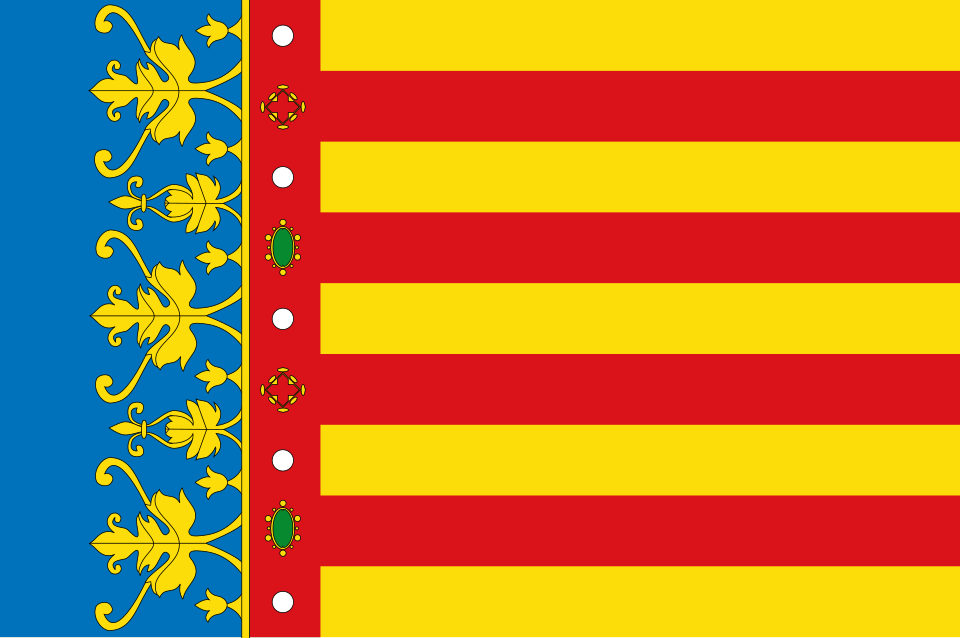
Valencia’s regional flag stands out because it combines the familiar red-and-yellow bars of historic Aragonese heraldry with an ornate blue band bearing a golden crown. It is frequently confused with the four-striped Catalan Senyera, particularly in small photographs that crop away the part nearest the flagpole.
The Valencian symbols law explicitly defines the traditional Senyera as four red bars on yellow crowned on a blue stripe next to the hoist. This official description matters when distinguishing the Valencian flag from neighboring regional flags with related heraldic roots.
The flag represents the Valencian Community, an autonomous community within Spain including the provinces of Castellón, Valencia and Alicante. It is separate from Spain’s national flag and from the flags of individual cities.
Reial Senyera: what the flag looks like
The Valencian banner has four horizontal red bars on a yellow field, with a royal crown motif decorating the blue vertical section next to the pole. The crown, blue stripe and red/yellow body together form the familiar regional flag.
| Flag feature | Description |
|---|---|
| Community | Valencian Community (Comunitat Valenciana), Spain |
| Common name | Reial Senyera / Senyera coronada |
| Main field | Four horizontal red bars on yellow |
| Hoist band | Blue vertical stripe with gold crown |
| Official law | Valencian Law 8/1984, December 4 |
| Historic connection | Royal heraldry of Valencia and Crown of Aragon |
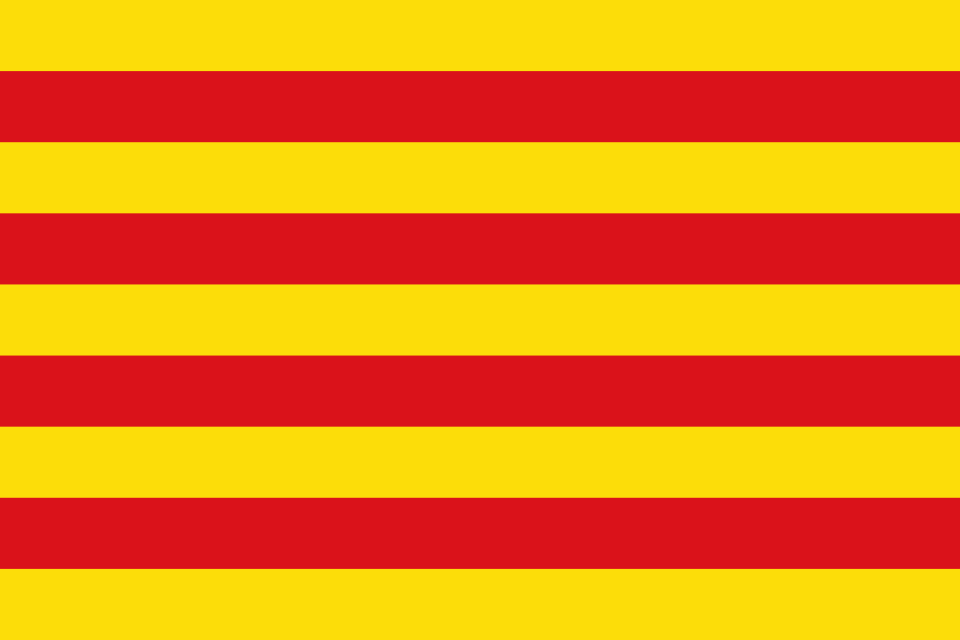
| Common confusion | Catalan Senyera without the blue crown band |
Why does Valencia’s flag have a blue stripe?
Next to the pole is a vertical blue section, a defining element of the crowned Valencian Senyera. The gold crown motif over this section refers to the historic royal privileges and symbols associated with Valencia under the Crown of Aragon.
The blue stripe is not an extra national flag, nor a marker of a separate blue province. It is part of one distinctive heraldic composition that differentiates Valencia’s regional flag from other red-and-yellow banners in eastern Spain.
In small photos the blue band may be hidden by the way the cloth wraps around the pole. A visible crown at the upper hoist is therefore an especially useful identification clue, while a red-and-yellow-only flag may instead be Catalonia’s Senyera or another related regional design.
What does the golden crown mean?
The crown is a historical royal emblem. Valencia’s flag tradition is closely linked with the royal city and kingdom of Valencia, which had its own institutions within the territories of the Crown of Aragon. The decorative crown helps express that inherited identity.
Modern official imagery can render the golden crown in fine detail that is difficult to reproduce at small sizes. In a classroom worksheet it is more useful to explain why a crowned blue band appears than to insist that a child must accurately draw every tiny heraldic ornament.
The existence of a crown should not be taken to mean that the modern Valencian Community is currently an independent kingdom. Its regional flag belongs to Spain’s contemporary autonomous system and has a legally defined design.
Is the crown optional?
Not when reproducing the officially prescribed Reial Senyera: the crowned blue band is part of the defined Valencian flag. Variants with red and yellow bars alone may have other historic or regional uses, but are not automatically the legally specified flag of the Valencian Community.
Why are there four red bars on yellow?
Four red bars on yellow are a well-known heraldic pattern linked to medieval rulers of the Crown of Aragon. Similar bands appear in the flags and arms of several places once connected to that political system, including Catalonia, the Balearic Islands and Aragon itself.
That shared heraldic origin does not make the modern regional flags identical. Valencia’s crowned blue section adds a defining distinctive mark. The Catalan Senyera uses the four red bars without the crowned blue hoist. The Balearic Islands flag adds a purple canton with a white castle.
The red bars should not be explained as four modern Valencian provinces. The autonomous community has three current provinces; the heraldic number four comes from an older visual tradition, not from a present-day map of provincial boundaries.
How old is the Valencian Senyera?
The flag’s symbolic roots reach back to medieval Valencia and the Crown of Aragon. Histories of the royal banner refer to the city’s heraldic privileges and the addition of a crowned section. These traditions evolved before the modern Autonomous Community existed.
Centuries later, public and political movements interpreted the Senyera as part of Valencian identity. After Spain’s democratic transition, the autonomous community formalized its current symbols through its Statute of Autonomy and the dedicated 1984 symbols law.
The modern law is an exact reference for the official design. It does not claim that a perfectly uniform modern printed flag has flown unchanged since the thirteenth century. Historic banners can differ in materials, proportions and artistic detail, so a museum photograph requires its own contextual caption.
What does the 1984 symbols law say?
Valencian Law 8/1984 of December 4 regulates the flag and other regional symbols. It describes the traditional Senyera with four red bars over a yellow background, crowned on a blue stripe by the pole. It also addresses the emblem and standards used by the Generalitat Valenciana.
These details are important because some historical or political flag variations use the same red and yellow colors without the official crowned blue section. The official law helps a publisher distinguish those variants from the autonomous community’s legal symbol.
Regional and national flags may be displayed together under applicable protocol. A Valencian flag at a school or government office does not replace the national Spanish flag; the two have different legal functions and designs.
Valencia vs Catalonia vs Balearic Islands flags
All three regional flags use red and yellow bars because their heraldic roots include the Crown of Aragon. But the modern designs are distinct: Valencia has a crowned blue band, Catalonia has only the red/yellow striped field, and the Balearic Islands have a purple upper-hoist canton displaying a white castle.
The distinction can be taught with an image exercise. Crop each picture to show the full flagpole side: Valencia’s crown and blue band become unmistakable, Catalonia remains plain, and the Balearic castle appears in its separate purple corner.
Be careful with political meanings. A Catalan Estelada bearing a star and triangle is a separate independence-associated design, not a variety of Valencia’s crowned Senyera. Refer to the Catalonia guide for that comparison.
How to draw the Valencian flag correctly
Begin with a horizontal yellow rectangle and add four red horizontal bars across the main body. Reserve space next to the hoist for a vertical blue band. Add the characteristic golden royal crown decoration along the blue section.
The red bars are horizontal, not vertical, and the blue band should remain next to the pole rather than centered over the flag. A simplified educational drawing can preserve those defining features even if the decorative crown is reduced to a recognizable outline.
For exact official artwork, use the Valencian legal annex or government symbol assets. Avoid copying an illustration of the Catalan Senyera and claiming that the missing blue band is a harmless simplification of the Valencian regional flag.
Frequently asked questions
What is the Valencian flag called?
The Reial Senyera or crowned Senyera of the Valencian Community.
Why does it have a blue stripe?
The blue hoist section belongs to the royal heraldic form of the Valencian Senyera.
What does the crown symbolize?
It reflects Valencia’s historic royal heritage within the Crown of Aragon.
How many red stripes are on Valencia’s flag?
Four horizontal red bars on yellow.
Is Valencia’s flag the same as Catalonia’s?
No. Valencia adds the crowned blue hoist band; Catalonia’s official Senyera consists of the red/yellow bars alone.
Is Valencia a country?
It is an autonomous community of Spain, comprising Valencia, Alicante and Castellón provinces.
When was the current flag specified by law?
Valencian Law 8/1984 of December 4 regulates the community’s symbols.
Why does the Balearic flag look similar?
The two share historic Crown of Aragon red-and-gold bars, but Balearic Islands use a purple canton with a castle.
Does the flag have a white star?
No. The official crowned Senyera does not include a white star.
Official sources and image credits
Spanish Official Gazette — Valencian symbols Law 8/1984
Corts Valencianes — political laws and symbol description
Wikimedia Commons — official Valencian flag
Wikimedia Commons — Catalonia Senyera
Crowned Senyera vector by Mutxamel/Commons contributors at Wikimedia Commons, converted from SVG to PNG. Catalan Senyera comparison from Commons. Follow file-page reuse conditions.
Illustrations were imported into the FlagExplorers media library as PNG renditions of Wikimedia Commons source files. Graphic reproduction should observe any separate institutional use of protected official emblems. Sources checked November 2026.