Galicia Flag: Blue Diagonal Stripe & Coat of Arms Explained
Why does Galicia’s flag have one blue diagonal line on white, and when does it include the chalice coat of arms? Compare civil and official variants using Galicia’s 1984 symbols law.
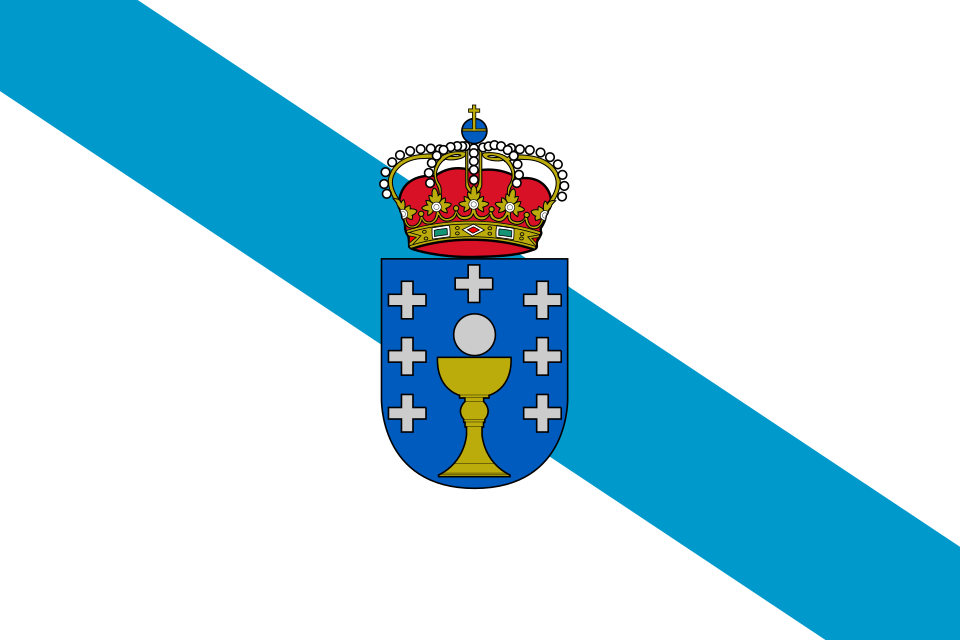
Galicia is an autonomous community in northwestern Spain, known for its Atlantic coastline, Galician language and long maritime history. Its flag is a simple composition of white and light blue, made more elaborate when used by regional institutions with an official coat of arms.
The difference between the plain civil flag and the shield-bearing institutional version is a frequent source of confusion. Some illustrations present the coat of arms as though it were compulsory on every private flag; others omit it when describing government display. Galicia’s 1984 symbols law explains when the emblem is required.
The Galician law and the Galician encyclopedia maintained by Xunta describe the legal pattern. This article distinguishes them from nearby regional flags, such as the red-green-white Basque Ikurriña and Canary Islands three-color flag.
Galicia flag: civil and institutional versions
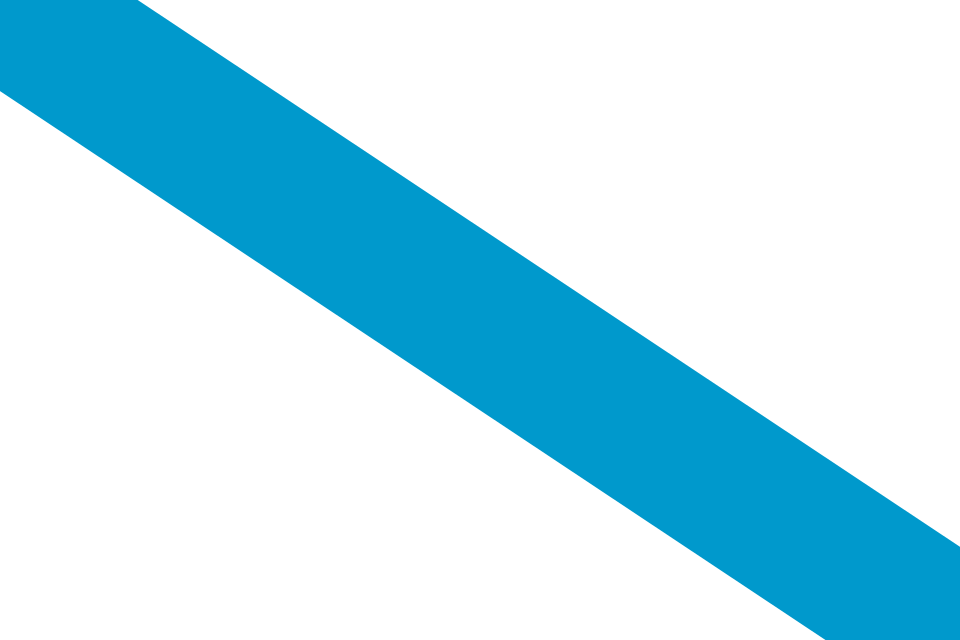
Both versions use a white field crossed by one blue diagonal stripe descending from upper-left hoist to lower-right fly. The institutional version adds Galicia’s heraldic shield at the centre; the civil version leaves that space clear. The diagonal does not reverse direction depending on whether an illustration has the coat of arms.
| Feature | Details |
|---|---|
| Autonomous community | Galicia (Galiza), northwestern Spain |
| Core design | White field with blue diagonal stripe |
| Direction | Upper hoist to lower fly |
| Civil flag | Plain blue diagonal on white |
| Institutional form | Coat of arms centered over diagonal |
| Statutory reference | 1981 Statute of Autonomy, Article 6 |
| Specific symbol law | Law 5/1984 of May 29 |
| Heraldic elements | Chalice, host, seven small crosses and crown |
Why does the Galician flag have a blue diagonal stripe?
The diagonal blue stripe is connected to Galicia’s late-nineteenth-century maritime and cultural flag traditions. A commonly documented origin is the naval registration flag used at the port of A Coruña, a white-and-blue saltire that was simplified into a single blue diagonal for a new Galician emblem.
Galician cultural movements increasingly used the white flag with a blue band by the late nineteenth century, and the design became a familiar expression of regional identity. Historic discussions trace usage at least to the 1890s. It is worth distinguishing the origin story of a maritime signal from the later adoption of the regional flag under law.
The blue band runs from the upper-left corner next to the pole to the lower-right corner. It is not a central horizontal stripe, nor is it a full X-shaped saltire. These details let readers tell Galicia apart from Scotland, which uses a white diagonal X on blue, and the Basque Country, which has both a green saltire and white upright cross on red.
Is the blue stripe supposed to represent a river?
Popular explanations connect blue with Galicia’s Atlantic maritime setting, coastline or rivers. Those are reasonable cultural associations, but the legal definition identifies the flag’s appearance without assigning one named river to the diagonal. It is safer to cite the maritime flag tradition than to state that the stripe officially represents the Miño or another particular river.
Why does the official flag have a chalice and seven crosses?
Galicia’s coat of arms typically shows a golden chalice with a silver host above it, surrounded by seven small crosses on a blue shield, beneath a royal crown. Its heraldic symbolism has deep roots in the region’s religious and political history, especially the chalice associated with the Kingdom of Galicia.
The coat of arms is a distinct legal regional symbol. On an institutional flag it sits centered across the blue diagonal, making the design more complex than a plain civil flag. The Xunta’s maintained historical entries explain that an early twentieth-century definition of the coat of arms influenced the modern regional form.
The seven small crosses should not be casually identified as today’s seven largest cities, provinces or dioceses without a source. Galicia currently has four provinces, so a simple claim that each cross represents one province would be wrong. The heraldic elements belong to a much older symbolic history.
In a small online image, the chalice may look like a golden cup with a white oval above it. For clear illustration, use a larger version or accompany it with a descriptive caption rather than relying on tiny details.
What does Galicia’s 1984 flag law require?
Article 6 of Galicia’s 1981 Statute of Autonomy describes the flag as white with a diagonal blue band running from the upper-left to lower-right corner. Law 5/1984 of May 29 further regulates regional symbols and specifies their use.
The 1984 law requires Galicia’s official coat of arms to be present at the center when the flag is flown on public buildings or at official events of the autonomous community. The law gives the coat of arms a height equal to half the width of the flag, rather than allowing arbitrary oversized placement.
This distinction is why official regional premises may display a flag with the shield while supporters at events or private homes use the simpler band-only design. Both are identifiable as Galician flag variants, but a legal-use graphic should follow the correct official requirements.
The law also addresses the region’s coat of arms and anthem, establishing the three as symbols of Galicia’s historic-national identity within the Spanish autonomous framework. It is not a rule creating a separate sovereign state.
History of the Galician flag from the 1800s to autonomy
Galicia has a long history of maritime trade and cultural movements. In the nineteenth century, the design associated with A Coruña’s maritime registration flag influenced a simplified white-and-blue diagonal banner. Cultural and political organisations seeking a recognizable Galician symbol helped spread the pattern.
After the Spanish Civil War and the Franco dictatorship, Galicia’s modern autonomy arrangements took form during Spain’s democratic transition. The Statute of Autonomy was approved in 1981, and the symbols law followed in 1984.
Neither legal date means that the basic diagonal blue flag first appeared then. The visual design is older, while its legal status was clarified in those modern acts. Historical photos and printed banners can therefore show the regional flag even before the constitutional framework defining its present institutional use.
The central coat of arms also has its own chronology, developing from the emblem of the Kingdom of Galicia rather than being invented for the 1984 law.
Galicia flag with shield vs. without shield: which is correct?
A flag with only a blue diagonal stripe on white is the familiar civil form. A version with the regional coat of arms centered on that diagonal is used by regional institutions and at official occasions. Both versions retain the same background and blue band orientation.
The appropriate choice depends on context. For a general geography quiz, the plain civil version may be easier for younger learners to identify. For an article about official flag display at Xunta buildings or the Parliament of Galicia, the coat-of-arms version is particularly important.
Do not describe a civil flag as “wrong” just because it does not include the shield. Conversely, when reproducing the government flag, do not remove its coat of arms without checking the official-use context. A caption should state clearly which version is pictured.
The two included images make this comparison straightforward: the institutional image adds the chalice shield, while the plain flag shows the diagonal as the sole emblem.
How does Galicia’s flag differ from other Spanish regional flags?
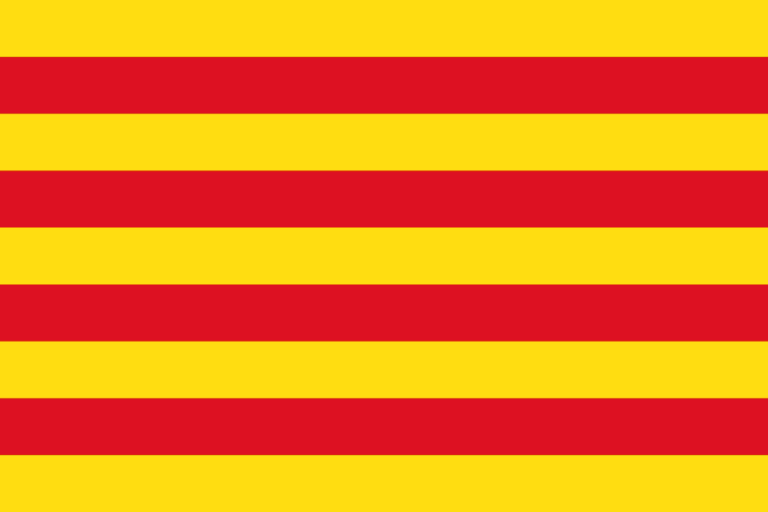
The Basque Ikurriña uses a green diagonal X and a white upright cross on red, whereas Galicia has one blue diagonal on white. The Catalan Senyera has four red horizontal bands on yellow. The Canary Islands flag uses three vertical bands in white, blue and yellow.
These differences make a useful image-identification exercise. Show all four flags side by side and ask students to identify whether the main device is a single diagonal, two crosses, multiple horizontal bars or a vertical tricolour.
All four are regional symbols in Spain, but their legal bases and visual histories are separate. You should not assume that sharing the status of an autonomous community means the flags have the same adoption year or color interpretation.
How to draw and identify the Galicia flag
Draw a white rectangular field. Add one medium-width light-blue diagonal from the upper-left corner by the flagpole to the lower-right corner. For the simplest civil version, stop there: no extra stars, letters or crosses are needed.
For the institutional version, place Galicia’s coat of arms in the center. It should include the golden chalice, white host, seven small crosses, and crown. Consult the regional symbols law and government artwork for the exact heraldic composition rather than improvising a decorative shield.
For a quiz, ask what happens when the emblem is removed. The answer is that the plain civil version is still Galician. The distinction is about public display and symbolic context, not a new national flag or a reversal of the blue stripe.
Frequently asked questions
What does the Galicia flag look like?
A white field with one light-blue diagonal stripe, from upper hoist to lower fly.
Why is the stripe blue?
It is traditionally linked with Galicia’s maritime flag history and A Coruña, rather than a legally assigned single river.
What is on the official Galician coat of arms?
A chalice and host with seven small crosses on a shield beneath a crown.
Do all Galicia flags have a coat of arms?
No. The civil flag can be plain, while institutional use on public buildings and at official regional events requires the coat of arms.
When was the flag legally recognized?
The design appears in Galicia’s 1981 Statute of Autonomy and is regulated by Law 5/1984.
Which way does the diagonal run?
From the upper corner nearest the pole to the lower corner on the fly side.
Is Galicia a country?
Galicia is an autonomous community of Spain, with its own language and regional flag.
Is the Galicia flag the same as Scotland’s?
No. Galicia has one blue diagonal on white, while Scotland has a white diagonal saltire on blue.
Why are there seven crosses on its shield?
They are part of historical Galician heraldry; it is inaccurate to claim they denote today’s four provinces.
Historical sources and artwork credits
Xunta de Galicia — Symbols Law 5/1984
Xunta de Galicia — Galicia flag historical encyclopedia
Galician Statute of Autonomy, Article 6
Xunta de Galicia — Galicia coat of arms
Wikimedia Commons — Galicia flag
Wikimedia Commons — Galicia civil flag
Institutional flag image from Flag of Galicia.svg by Pedro A. Gracia Fajardo (Commons public-domain notice). Civil comparison PNG rasterized from Bandera civil de Galicia.svg, with licensing on that file page.
The image files are PNG renderings of the linked Wikimedia Commons vectors and are used for identification. Follow credited source-file licenses when reusing the images. Regional symbolism and legal status checked November 2026.