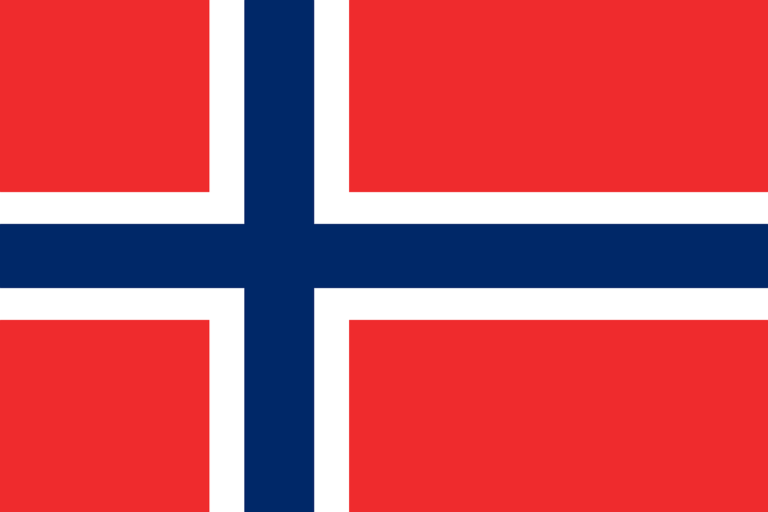
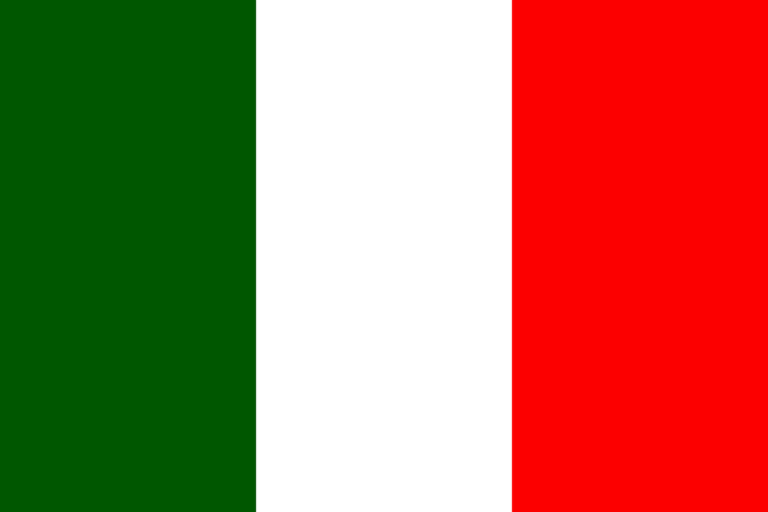
Corsica Flag: Moor’s Head, White Band & History Explained
Why does Corsica’s flag feature one black head on a white field? Explore the headband, Pasquale Paoli’s eighteenth-century history, and the difference from Sardinia’s Four Moors.
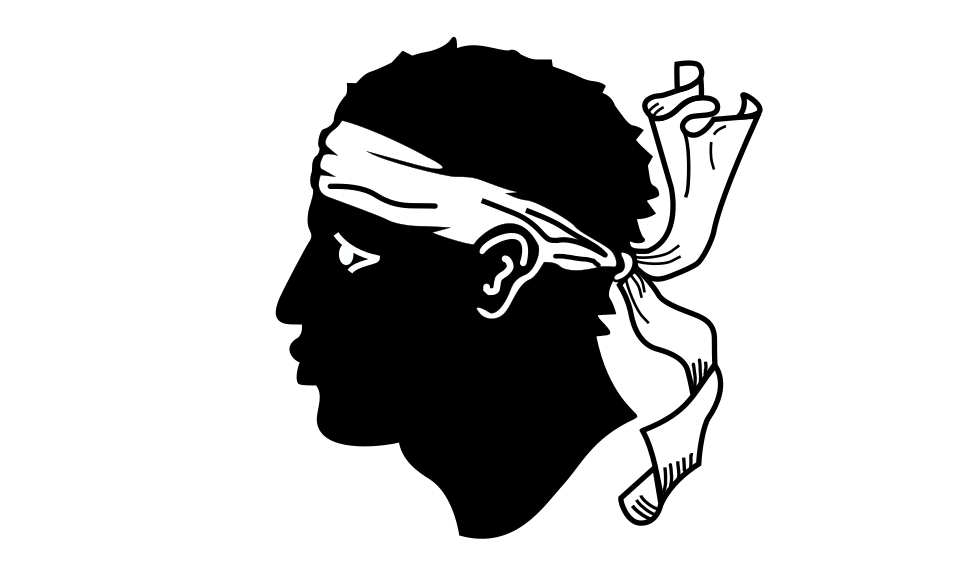
Corsica is a French Mediterranean island with its own language, historical traditions and recognizable regional symbol. Its flag is almost monochrome: white cloth and a single dark human profile. Because the face is prominent and the colors are simple, it is easy to identify even when a flag is small or flying at a ferry port.
The image is called the Testa Mora in Corsican or tête de Maure in French. The term is historical heraldic vocabulary. Modern people may interpret it in different ways, and its exact earliest origin should not be collapsed into one unverified legend.
The most useful comparison is with the Sardinia Four Moors flag. Both have historic Moor’s Head symbolism, but Sardinia has four profiles and a red cross, whereas Corsica has one large black profile on white. This article explains the historical link without pretending the two flags are identical.
Corsica flag design: how to recognize it
The whole field is white. The central black profile is normally shown with a white headband tied behind the head, with the band lying on the forehead. Some graphic versions alter the facial features and knot, but the one-head design and forehead band are the quickest recognition clues.
| Feature | Details |
|---|---|
| Place | Corsica (Corse), territorial collectivity of France |
| Regional symbol | Testa Mora — the Moor’s Head |
| Background | Plain white |
| Main emblem | Single dark head in profile with white forehead band |
| Important historic period | Paoli’s Corsican Republic, 1755–1769 |
| Compare with | Sardinia: four dark heads and a red cross |
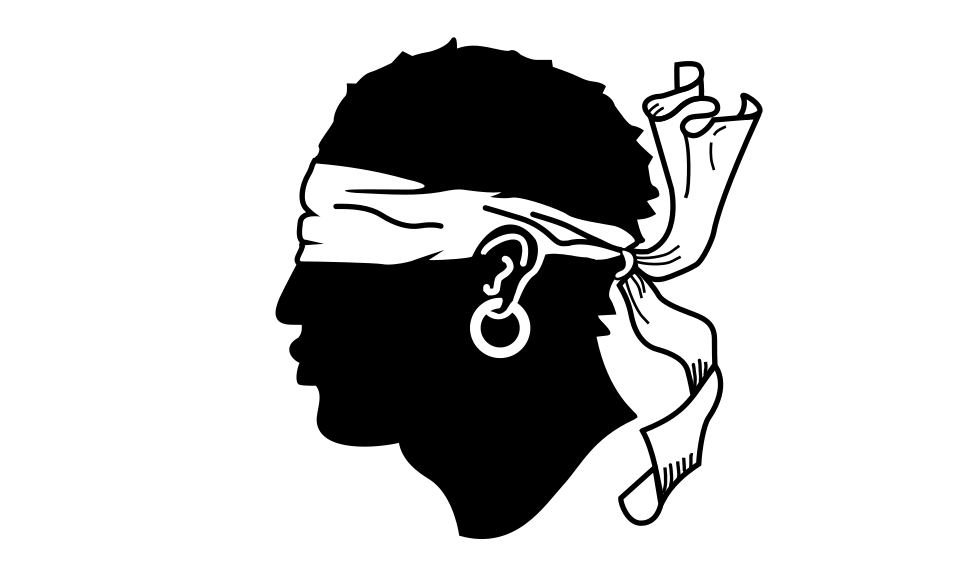
| Earlier depictions | Some versions showed a band crossing the eyes |
Why is there a Moor’s Head on the Corsica flag?
The Corsican emblem belongs to a broader Mediterranean history of heraldic Moor’s Heads. Comparable designs appeared on coins and arms around the medieval and early modern western Mediterranean, including heraldry linked to Aragon and Sardinia. That broader history does not conclusively explain when one particular Corsican designer selected this exact face.
Historical accounts connect the image to rulers and symbols adopted on the island well before the nineteenth century. Corsica’s cultural heritage institutions have preserved flags and representations with the head motif from the eighteenth century, giving the island a material record beyond today’s printed souvenirs.
One common explanation connects the symbol to a defeated Moorish adversary. There are multiple stories about an unnamed captive, king, saint or corsair. Corsica’s heritage authorities themselves have publicized historical research asking which, if any, of those stories is supported. It is better to treat a specific legendary character as uncertain than to invent a definitive historical identity for the figure.
The symbol is now a regional identifier used by people with differing political opinions. It does not automatically mean that its holder endorses any one interpretation of Corsican history or contemporary autonomy.
Why is the headband on the forehead instead of over the eyes?
For many readers the headband is the most meaningful detail. Some older depictions placed a cloth strip across the Moor’s eyes, resembling a blindfold. In the best-known Corsican design the band has been lifted to the forehead and the eyes are uncovered.
The change is associated with Pasquale Paoli, the eighteenth-century leader of the independent Corsican Republic. A widely accepted interpretation connects lifting the blindfold to liberation and an open-eyed people. Corsican regional cultural sources and heritage researchers describe that shift as a key part of the modern emblem’s story.
The precise moment and person responsible for every surviving variant are not universally settled. Older images may differ in profile direction, earrings, headband shape or the face itself. The main historical point is the contrast between the blindfolded type and the emblem with the visible eyes, not a rule that every nineteenth-century artist drew the same face.
For an educational worksheet, draw the current headband across the forehead. A headband obscuring the eyes should be labeled as a historical depiction or alternate reconstruction rather than quietly substituted for the contemporary emblem.
How Pasquale Paoli shaped the Corsican flag
In 1755, Pasquale Paoli was elected general of the Corsican nation and became the central political figure of the Corsican Republic. His government sought institutions, laws and symbols to express a self-governing island after long struggles involving Genoa and other European powers.
The Moor’s Head was among the emblems associated with that movement. Historical research links Paoli to the visible-eyed interpretation. The Museum of Bastia has documented an eighteenth-century Moor’s Head textile traditionally associated with an official in Paoli’s administration. Its provenance is not a license to claim that every current digital illustration is a precise copy of that one flag.
Paoli’s Corsican Republic endured until the French conquest in 1769. The historical emblem survived shifts in government and continued as a familiar sign of the island. Today, the black profile on white serves a broader cultural identity than the literal administrative boundaries of the short-lived eighteenth-century state.
When presenting a timeline, distinguish these events: the emblem’s earlier medieval or early modern development, its role in Paoli’s eighteenth-century state, and its contemporary cultural and regional use within France.
What do the black and white colors mean?
The contrast is deliberately simple: a black head on a white field, with the white cloth band visible against the profile. The design can be recognized without complicated multicolor heraldry and remains legible at sea, on clothing or in a parade.
Popular descriptions sometimes assign a fixed symbolism to every element of the face, including earrings or hair, but no single official historical text establishes all those readings as a mandatory code. The most clearly documented contemporary interpretation concerns the lifted headband and the image’s association with Corsican freedom and identity.
The white background is not a separate horizontal stripe, and the flag has no central red cross. These simple details distinguish it from Sardinia’s Four Moors and from France’s blue-white-red tricolour. In photographs of an island festival, the Corsican flag may be flown alongside the French national flag without becoming a second sovereign national banner.
Corsica vs. Sardinia: why do the flags look related?
Corsica and Sardinia are neighboring Mediterranean islands, and both display versions of Moor’s Head imagery. That visual relationship reflects centuries of movement, dynastic links and heraldic traditions around the western Mediterranean.
The distinction is immediate when the flags are placed together: Corsica has one large head on white; Sardinia has four heads separated by a red upright cross. Modern Sardinian flags also place forehead bands on the four heads, a feature that makes the similarity stronger than in some older blindfolded depictions.
Sardinia is an autonomous region of Italy, while Corsica forms part of France with a different territorial status. Sharing a symbol does not make the islands one administrative unit, nor does it prove every detail of the two emblems had a single common designer.
Our Four Moors guide compares the 1950–1999 Sardinian artwork with the design established in 1999. It is a different historical issue from the headband tradition connected to Paoli.
What historians know—and do not know—about its origin
Heraldic and regional history supports the use of a Moor’s Head symbol in Corsica well before modern tourism. The Museum of Bastia has displayed an eighteenth-century flag related to the Paoli period, and Corsica’s public cultural bodies have organized research discussions devoted to the emblem.
That evidence is stronger than a single sensational explanation naming a specific enemy whose severed head supposedly became the flag. Such stories belong to folklore and must be labeled as traditions unless a dated document establishes the connection. The scholarly question includes how representations traveled between Mediterranean rulers and why particular headband forms emerged.
Historical photographs and replicas may also be reversed, cropped or stylized. A picture of a head facing the opposite direction from the one on a standard flag does not necessarily identify a wholly different regional flag. Inspect the source, the headband position and the period before asserting an origin.
The safest teaching description is simple: one Moor’s Head, on white, with a raised band, associated especially with Corsica’s eighteenth-century independence tradition and modern regional identity.
How to identify Corsica’s flag in a picture or quiz
Look for one dark head in profile, placed prominently in the middle of an entirely white rectangle. The eyes should be visible and the headband should cross the forehead. There should be no other major symbols and no multicolored stripes.
For an identification quiz, pair it with the Sardinian Four Moors flag and ask students to count the heads. Then show the national French tricolour and ask which banner represents the modern state. This creates a meaningful difference between a regional emblem and a sovereign national flag.
Finally, ask students why the headband placement matters. A strong answer explains the association of the open eyes with liberation, while acknowledging that the earliest precise origins of the emblem are debated. This is more historically useful than merely memorizing a face silhouette.
Frequently asked questions
What is the Corsican flag called?
A Bandera Corsa or the Corsican Moor’s Head flag; the emblem is known as Testa Mora.
Why does it have a black head?
The motif comes from historic Mediterranean heraldry and is associated with Corsican identity; its precise earliest legend remains disputed.
Why does the flag have a white headband?
The band sits on the forehead in the modern design, often interpreted as a symbol of liberated, uncovered eyes.
Did Pasquale Paoli design the flag?
He strongly shaped the eighteenth-century use and raised-headband symbolism, but Moor’s Head imagery existed earlier and the original inventor of every element is not conclusively known.
Is Corsica’s flag the same as Sardinia’s?
No. Corsica has one Moor’s Head on white; Sardinia has four heads separated by a red cross.
Is Corsica an independent country?
Corsica is part of France and has its own regional symbols and political institutions.
Was the Corsican head originally blindfolded?
Some earlier representations show a band across the eyes; the modern familiar form moves it up to the forehead.
What color is the background?
White, behind a large black profile and white headband.
Does the Corsica flag have a red cross?
No. A red cross with four heads belongs to Sardinia’s Four Moors flag.
Historical sources and artwork credits
Collectivité de Corse — research event on origin of Moor’s Head
Musée de Bastia — Flag exhibition
Collectivité de Corse — restoration of historic Bandera
Western Corsica tourism office — Corsican flag symbolism
Wikimedia Commons — Corsica flag
Wikimedia Commons — older Corsican flag
Modern flag image sourced from Flag of Corsica.svg; earlier reconstruction from Flag of Corsica (before 1755).svg, both via Wikimedia Commons. PNG renderings preserve the source drawings; consult file histories for attribution/licensing.
The image files are PNG renderings of the linked Wikimedia Commons vectors and are used for identification. Follow the credited file-page licenses when reusing artwork. The historical designs, regional symbolism, and competing interpretations were checked November 2026.