Tennessee State Flag: Three Stars, Meaning & 1905 History
Discover what the current flag depicts, why its symbols matter, how the design developed and how to identify it accurately.
Flag at a glance
| Feature | Details |
|---|---|
| Designer | LeRoy Reeves |
| Adopted | April 17, 1905 |
| Stars | Three, for East, Middle and West Tennessee |
| Fly edge | Blue vertical bar separated by white |
What does the Tennessee state flag look like?
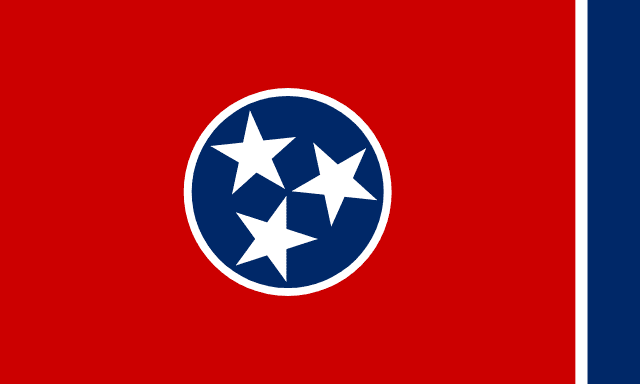
The field is predominantly red. A blue circular emblem edged with white appears toward the hoist, containing three equally important white five-pointed stars. A narrow white stripe separates the red field from a blue vertical bar at the fly end, the edge opposite the pole.
The stars are placed in a triangular pattern rather than in a vertical line, and their orientation is deliberate. The highest star sits toward the upper hoist side. The circle and border should remain clearly visible when a flag is flying or hanging in still air.
What do Tennessee’s three stars represent?
One star stands for East Tennessee, one for Middle Tennessee and one for West Tennessee: the state’s three Grand Divisions. This is the official documented meaning, confirmed by Tennessee’s government and State Museum. The stars do not represent the first three presidents, three branches of national government or three countries.
These regions differ in geography and history. The eastern region includes much of the Appalachian terrain; the middle region includes the Nashville area; and the west includes Memphis and Mississippi River communities. The blue circle binds the stars together as one state despite those differences.
What does the blue circle mean?
The designer’s explanation describes the three stars as an “indissoluble trinity” united by the surrounding circle. The stars do not crowd each other or sit in an artificial line suggesting that one region dominates the others. The white border around the blue circle separates it from the crimson background.
The larger red field is a bold design choice. The blue fly bar and thin white divider were included partly because a flag hanging limp would otherwise display too much uniform red. That practical design consideration is documented by the designer rather than being an invented symbolic story.
Who was LeRoy Reeves?
Captain Lee Roy (LeRoy) Reeves of Johnson City designed the flag in 1905. He served in the Tennessee National Guard and submitted the design that the legislature adopted on April 17 that year. The Tennessee Historical Society preserves the original Reeves flag and recounts his explanation of the colors and star arrangement.
Different sources style his name as Lee Roy or LeRoy; these forms refer to the same designer. State publications and the National Park Service provide consistent accounts of the official 1905 adoption and the meaning of the three Grand Divisions.
How to draw Tennessee’s stars correctly
Start with a red rectangular field. Add the blue circle edged white near the hoist and place three white stars so each is angled around the center. Put a thin white vertical separator near the fly, followed by the blue fly bar. Check the final image against the official Tennessee flag rather than letting graphic software automatically rotate the stars upright.
The flag’s legal specification controls the relative size and orientation of the stars. A flag with three stars arranged evenly in a straight row might convey a similar idea but would not be the approved design. Likewise, the far-right blue bar is part of the flag, not a decorative border you may omit.
What makes Tennessee’s state flag distinctive?
Tennessee’s three-star circle differs from Texas’s single Lone Star and Alaska’s eight-star Big Dipper. It also differs from Arkansas’s star-filled diamond. Comparing them illustrates how star counts can refer to administrative regions, admission order or geographic symbols rather than always counting U.S. states.
The All 50 U.S. State Flags directory allows readers to compare these forms side by side. A meaningful school comparison explains the reason for the number and arrangement rather than only memorizing which flag has a blue circle.
Frequently asked questions
What are the three stars for?
East, Middle and West Tennessee.
When was Tennessee’s flag adopted?
April 17, 1905.
Who designed it?
LeRoy Reeves.
Why is there a blue bar on the far right?
It provides color contrast when the flag hangs limp and is part of the official design.
Tennessee government — state symbols
Tennessee State Museum — three stars meaning
Tennessee Historical Society — Reeves flag
Flagpedia/FlagCDN state flag illustration, hosted in the FlagExplorers media library; verified against government or archival sources where available. Reviewed November 2026.