New South Wales Flag: Lion, Four Stars & Union Jack Meaning
Why does the NSW state flag have a gold lion, four eight-pointed stars and the Union Jack? Learn the official 1876 design and how it differs from Australia’s national flag.
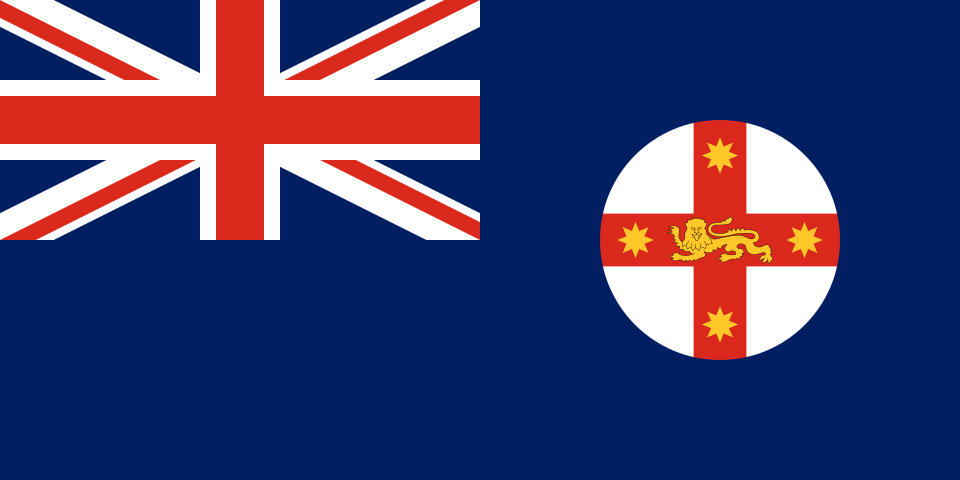
New South Wales (NSW) is Australia’s most populous state and includes Sydney. Its blue state flag is often mistaken for Australia’s national flag because the two both contain a Union Jack in the upper corner. The distinguishing feature is the circular badge at the fly side, which shows a lion and four gold stars instead of the national constellation and Commonwealth Star.
The NSW Government’s official flag guide specifies the design and explains the meaning of each part. This makes it possible to identify the state banner without relying on approximate clip-art or confusing it with the more detailed New South Wales coat of arms adopted in 1906.
Our guide covers the legal badge, its heraldic imagery, why 1876 matters, and the practical differences from the flags of Victoria and Queensland.
NSW flag at a glance: blue field and a distinctive white badge
The New South Wales flag keeps the Union Jack in the upper-left canton and has the familiar dark blue background of a British Blue Ensign. Its state badge sits on the right and comprises a red cross on white, the walking English lion at the middle, and a four-star representation of the Southern Cross.
| Feature | Explanation |
|---|---|
| Australian state | New South Wales (capital: Sydney) |
| Type | Blue Ensign with state badge |
| Upper hoist | Union Jack |
| State badge | White roundel with red St George cross |
| Central symbol | Gold lion passant guardant |
| Stars | Four gold eight-pointed stars |
| Badge proclaimed | 15 February 1876 |
| Different from | NSW full state coat of arms, granted in 1906 |
What is the emblem on New South Wales’ flag?
The state badge occupies a white circular area on the half of the blue flag farthest from the pole. Inside that disc is a red upright cross on white. A gold lion appears in the centre, and each of the four cross arms has one gold eight-pointed star. Unlike a typical printed coat of arms, there is no decorative shield border around the roundel.
The NSW Government gives the heraldic description as a silver field with a red cross, a gold lion walking forward and looking toward the viewer, and four gold stars of eight points. These details matter because a flag with five plain white stars on the blue field would be Victoria or Australia, not the correct NSW badge.
The badge is a precise device adopted for the state’s maritime ensign. It is related to but different from the NSW state coat of arms, which features a shield, golden fleece, wheat sheaves, rising sun, lion and kangaroo. It is common for a state to have separate official symbols with shared heraldic elements.
Why are there four gold stars with eight points?
The four stars on the red cross stand for the Southern Cross, a prominent constellation seen from the Southern Hemisphere and an important feature of Australian flag imagery. The NSW Government explicitly identifies them with the constellation and describes it as a traditional guide for mariners.
They differ from the five stars of the Southern Cross used on Australia’s national flag. The NSW badge has four gold stars and each has eight points, as prescribed in 1876. Counting the stars and their points is therefore useful when comparing heraldic designs, even though the actual star patterns of the sky do not correspond to a simple four-point rectangle.
The four gold stars should not be labeled as New South Wales’ four largest cities or four modern geographical regions. The official historical explanation links them to the Southern Cross, not to municipalities.
Why are the stars gold rather than white?
The gold color is part of the heraldic specification. Heraldry uses or for gold, which is traditionally shown as yellow or metallic gold on flags. Other Australian ensigns use white stars, but the NSW badge’s own coloring is legally distinctive.
What does the lion on the NSW flag represent?
The central gold lion is an English lion drawn from British heraldic tradition. The NSW Government describes it as a walking lion looking toward the viewer, a pose known as passant guardant. It recalls the colony’s British origins and earlier imperial links.
The lion is not the same as the kangaroo that supports the separate state coat of arms. Nor is it a lion found living wild in Australia. Its symbolism comes from historical English heraldry rather than Australian wildlife.
In the badge, the lion appears directly on the red St George cross, again referring to English heraldry. The combination of a British cross, lion and Southern Cross stars expresses nineteenth-century colonial identity in a style recognizable on other British-derived flags.
When was the New South Wales state flag adopted?
The present NSW badge was proclaimed on 15 February 1876. The government gazette defined its heraldic elements and authorized its use on the Blue Ensign employed by the colonial government. The state flag developed from maritime conventions in which British colonies added distinctive badges to British flags.
NSW had other early colonial flag and emblem experiments before that proclamation. The 1876 badge provided a recognizable official arrangement that continued into the period after Australian Federation in 1901. The NSW flag is therefore older than the current national design approved in the early twentieth century.
It is important to distinguish the 1876 state flag from the coat of arms granted in 1906. A web article describing the coat of arms’ golden fleece, wheat and supporters as though they were all present on the actual flag would be inaccurate.
Why is the Union Jack on an Australian state flag?
New South Wales was a British colony before it became an Australian state. The Blue Ensign structure reflects British maritime flag traditions, in which a Union Jack canton accompanied a colony-specific badge on a blue field.
Today, NSW is part of Australia and the state flag does not imply it is governed directly from London. The British symbol remains in the banner as a historic design element. Australia’s national flag also includes a Union Jack, but carries different Southern Cross and Commonwealth Star imagery.
Several Australian state flags have Blue Ensign layouts. This is why the roundel rather than the Union Jack alone is the reliable identification clue for NSW. To distinguish state and national symbolism, always look at the flag’s right-hand half.
NSW vs. Victoria vs. Queensland flags
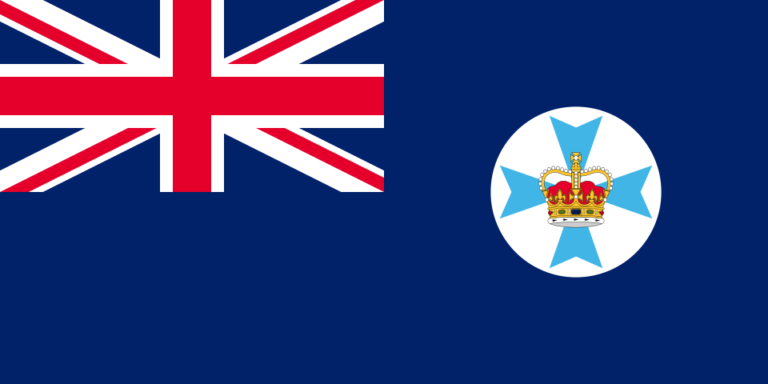
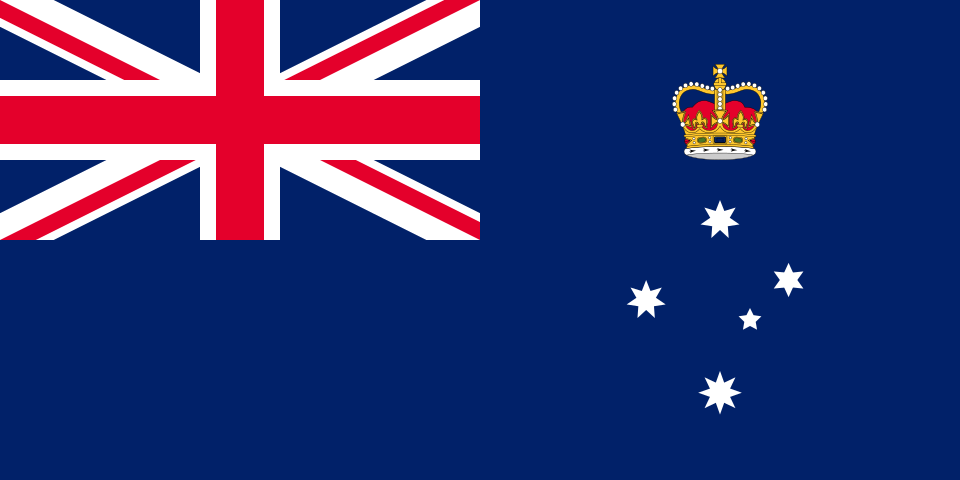
All three state flags have a dark blue background and a Union Jack canton, but their badges differ. NSW displays a white disc with a red cross, a lion and four gold stars. Victoria places five white Southern Cross stars and a royal crown on the blue field. Queensland uses a white disc with a light-blue Maltese cross and crown.
NSW can be identified by its red cross in a white circle, which the other two do not display. Victoria’s stars appear directly on the blue rather than inside a central disc. Queensland’s distinctive cross has eight points and a crown but no gold walking lion.
In a classroom exercise, show these three flags together and ask which contains the lion, which displays the stars without a disc, and which contains the blue Maltese cross. See our Victoria flag guide and Queensland flag guide for the separate histories of their badges.
How to draw and identify the NSW flag correctly
Start with a dark blue rectangle approximately twice as long as it is tall. Place a Union Jack at the upper-left corner. In the right half, draw a white circle; then draw a red upright St George cross inside the circle.
Put a small gold lion at the centre where the red arms meet. Add four gold stars, one on each cross arm, with eight points per star. This is a simplified educational construction: an exact reproduction requires accurate heraldic artwork rather than an arbitrary lion silhouette.
For a rapid identification test, check three things: a Union Jack canton, a white state disc and a red cross with a lion. If the state disc is missing and instead there are five large white stars and a crown, the flag is Victoria’s.
Frequently asked questions
What is on the flag of New South Wales?
A Union Jack in the upper hoist and a white roundel containing a red St George’s cross, gold lion and four gold eight-pointed stars.
What do the four stars represent?
The Southern Cross constellation, according to the NSW Government’s official symbolism.
Why is there a lion?
It is a historic English heraldic symbol, representing the state’s British colonial heritage.
What do the red and white cross colors mean?
The red St George’s cross on white is an English heraldic symbol used in the state badge.
When was the NSW flag introduced?
The present badge was proclaimed on 15 February 1876.
Are the stars eight-pointed?
Yes. The official 1876 badge specifies four gold stars of eight points each.
Is the NSW flag the same as the Australian national flag?
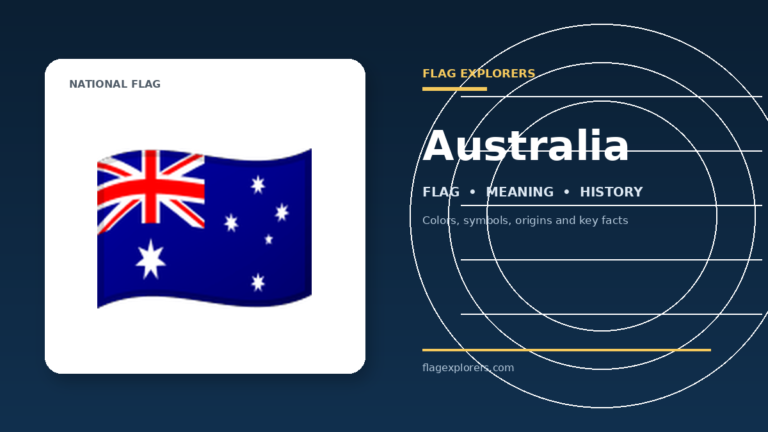
No. Both have a Union Jack and blue field, but the national flag has a Commonwealth Star and five white Southern Cross stars instead of the NSW badge.
What is the difference between the NSW flag and its coat of arms?
The flag carries the 1876 round state badge. The full 1906 state coat of arms includes different additional heraldic elements and supporters.
Does the NSW flag have a kangaroo?
No. A kangaroo appears in the full state coat of arms, not the NSW flag’s circular badge.
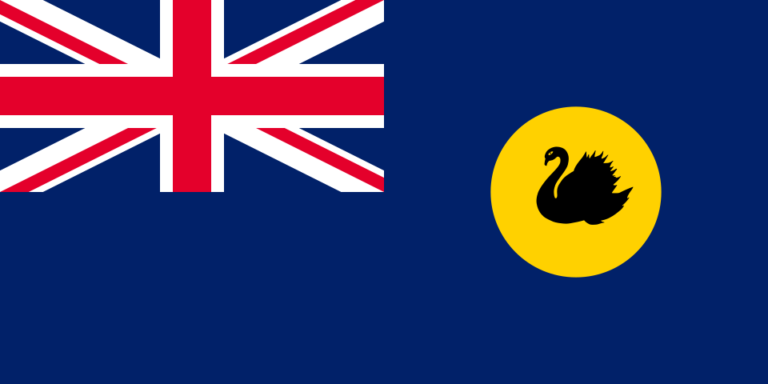
More Australian Blue Ensign badge comparisons: the Western Australia flag has a black swan, South Australia displays a piping shrike, and Tasmania has a red lion. NSW is distinct with its red cross, gold lion and four stars.
Official sources and illustration credits
NSW Government — Official state flag, history and badge
NSW Government — Flag and emblems of New South Wales booklet
NSW Government — State Arms (different from flag badge)
NSW Parliament Education — NSW coat of arms
Wikimedia Commons — New South Wales flag
Main flag image from Wikimedia Commons; the Victoria comparison is from Commons. Both are PNG renderings of public-domain flag artwork, with the NSW emblem details checked against the official NSW Government flag page.
Flag illustrations are PNG renderings of credited Wikimedia Commons images stored in the FlagExplorers media library, not photographs of one particular physical historical flag. Institutional emblem use may have separate requirements. Details reviewed November 2026.