British Columbia Flag: Sun, Waves, Crown & Union Jack
What do the sun, blue-white waves, crown and Union Jack on B.C.’s flag symbolize? Learn why the design was adopted in 1960 and how it differs from Ontario’s flag.
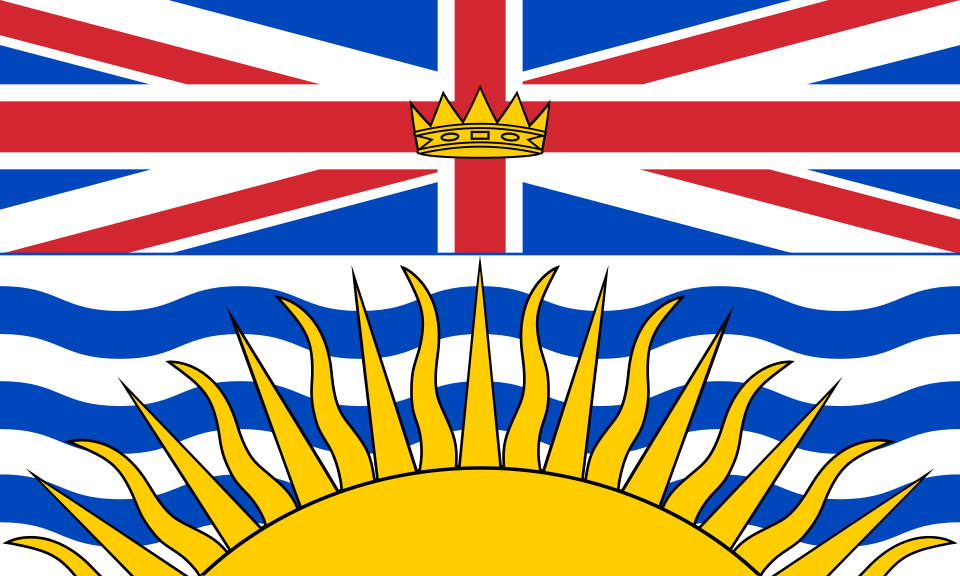
The British Columbia flag is one of Canada’s most visually intricate provincial banners. At first glance it resembles a Union Jack flying over a bright sun and moving blue waves. Each part has a historical and geographical explanation, and the overall pattern is derived from the province’s heraldic shield.
The Legislative Assembly of British Columbia explains the 1960 adoption and the meaning of its upper and lower parts. The Governor General’s heraldic register provides an exact description of the sun, the wavy bars and the crown.
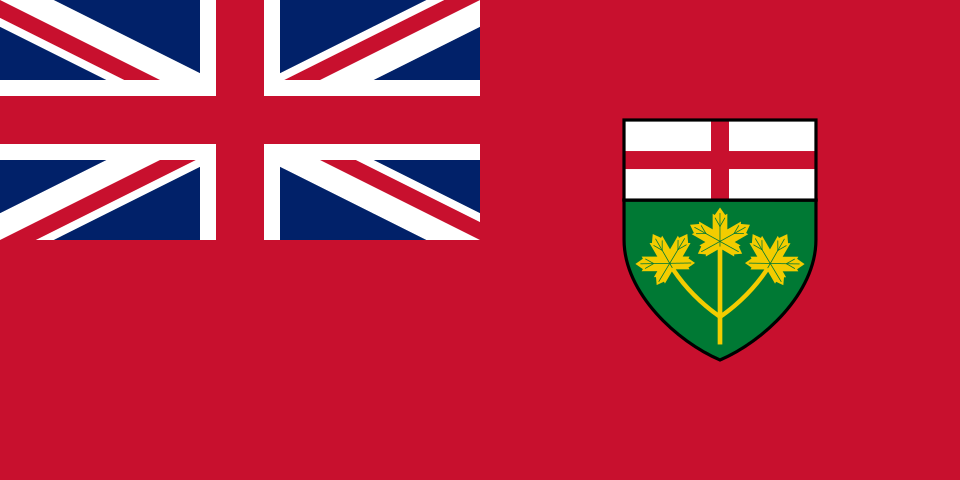
B.C.’s flag is different from Canada’s national red maple leaf and from Ontario’s Red Ensign, even though both B.C. and Ontario retain the British Union Jack as part of their provincial flags.
British Columbia’s flag at a glance
The banner was officially adopted in 1960. Its upper area is based on the Royal Union Flag with a golden antique crown at the center; the lower area has wavy blue and white horizontal lines and a rising or setting yellow sun motif at the bottom, symbolizing the Pacific coast and B.C.’s western position.
| Flag feature | Description |
|---|---|
| Province | British Columbia, Canada |
| Adoption | 1960 |
| Upper emblem | Royal Union Flag with golden antique crown |
| Lower design | White-and-blue wavy horizontal stripes |
| Sun | Large gold sun at base of design |
| Meaning of waves | Pacific Ocean |
| Meaning of sun | B.C.’s position at Canada’s western edge |
| Source | Shield of the provincial coat of arms |
Why is there a yellow sun on the British Columbia flag?
The large golden sun sits near the bottom of the flag, partly obscured by the lower border. It signifies British Columbia’s position on Canada’s western edge, where the Pacific coastline meets the horizon. Official descriptions refer to a sun in splendour and describe its western geographical meaning.
Depending on the official explanation, the sun is sometimes called rising or setting. The B.C. Legislature describes a rising sun symbolizing the province’s western position, while coat-of-arms descriptions also call it a setting sun. The stable visual and geographic fact is the bright golden sun at the base of the banner, with its rays rising into the wavy field.
The rays are not intended to mark a legally fixed number of mountain peaks or provincial districts. Their purpose is to show the dramatic solar emblem from the historic shield.
Does the sun mean the province is closest to Japan?
No such claim is part of the official flag definition. B.C.’s identity on the Pacific coast and western side of Canada is the documented geographic association. The sun is a symbolic way to communicate that location, not a literal diagram of international distances.
What do the white and blue wavy stripes represent?
The alternating white and blue wavy lines signify the Pacific Ocean, an essential element of British Columbia’s geography and history. They occupy the lower area of the flag, below the Union Jack and gold crown.
These lines are shaped like waves rather than straight horizontal stripes. That distinction makes B.C. different from many other blue-and-white regional flags. When drawing the flag, keep the lines undulating instead of replacing them with five rigid bars.
The blue color recalls water, but the white portions are part of the same oceanic heraldic design. They are not separately assigned to particular rivers, islands or municipalities. The heraldic register specifies three blue wavy bars on a white field, while the printed flag adapts that shield motif into a wider rectangular layout.
Why does British Columbia’s flag have a Union Jack?
The upper portion contains the Royal Union Flag, also known as the Union Jack. It represents the province’s development through British colonial institutions before and after its entry into Canadian Confederation.
The gold antique crown at the centre of the Union Jack is a royal heraldic symbol. It distinguishes the B.C. provincial banner from a plain British flag and shows that the upper design is derived from British Columbia’s coat of arms.
British Columbia is now a Canadian province, not a British overseas territory. The Union Jack is retained as a piece of historical symbolism, just as the Ontario provincial flag includes a Union Jack canton within its Red Ensign.
In B.C., the Royal Union design spreads across the entire upper section. In Ontario, it occupies only the upper corner next to the pole. This layout difference is one of the simplest ways to distinguish the two.
What does the golden crown mean?
The crown in the center of the upper Union Jack reflects the royal authority and British heraldic tradition associated with the province’s historic institutions. Its golden color contrasts with the red, white and blue Union design.
The crown is antique in heraldic terminology, referring to the stylized form used in the provincial arms, not to a current photograph of a particular monarch’s coronation crown. Different reproductions may simplify its details while retaining the overall antique-crown shape.
It is the crown, together with the sun and waves, that makes the B.C. flag recognizable. A regular Union Jack without the crown and oceanic elements would depict the British national flag, not the official British Columbia provincial banner.
When was the British Columbia flag adopted?
The B.C. provincial flag was officially adopted in 1960. Its design was based on the existing provincial shield of arms, which combined the Royal Union Flag and crown with a sun and blue wavy bars.
Heraldic developments preceded the flag’s creation. B.C.’s shield of arms was established under royal authority in the early twentieth century, and it later became part of the full provincial coat of arms. The 1960 flag transformed the shield’s symbols into a rectangular banner suitable for flying on buildings and at public events.
Historical accounts sometimes describe the British Union element as representing past colonial governance while the lower portion depicts the landscape and Pacific location. That two-part arrangement remains the flag’s central logic.
Canada’s current national maple leaf flag did not become official until 1965, five years after B.C. adopted its provincial flag. This makes B.C.’s design a useful contrast to Ontario’s, which was itself adopted in 1965.
B.C. vs Ontario vs Canada: how to tell the flags apart
The Ontario flag is a red ensign with a Union Jack only in the upper-left quarter and a provincial shield containing three gold maple leaves. B.C. instead has the Union Jack across its entire upper section, a centered crown and a dramatic sun over ocean waves below.
Canada’s national flag has a red eleven-pointed maple leaf centered on a white panel between red vertical side bars. It contains no Union Jack, crown, waves or sun. Both the Ontario and B.C. provincial flags coexist with that national design.
Quebec’s Fleurdelisé is almost entirely blue and white with a large white cross and four lilies, reflecting a different historical heritage. Learning all three provincial flags alongside Canada’s national maple leaf helps show the country’s diversity of official symbols.
How to draw the British Columbia flag accurately
Divide a horizontal rectangle into two major design areas. Draw the Union Jack across the top and place a gold antique crown at its centre. In the lower portion add several blue and white waves, then a large bright yellow sun emerging from the bottom edge with rays extending upward.
The lower stripes should be clearly wavy, not straight. Keep the sun yellow and place it beneath the Union Jack rather than in the middle of the British cross. The resulting arrangement should visually resemble the province’s historic shield of arms.
For a student quiz, include Ontario beside B.C. and ask two questions: where is the Union Jack, and what is beneath it? Ontario has the small Union canton and a leafy shield on red; B.C. has the large crowned Union design and oceanic sun.
Frequently asked questions
What is on the British Columbia flag?
A large Union Jack and gold crown in the upper portion, with blue and white wavy bands and a yellow sun below.
What does the sun symbolize?
British Columbia’s position at Canada’s western Pacific edge.
What do the blue and white waves mean?
The Pacific Ocean along British Columbia’s coast.
Why does B.C.’s flag have the Union Jack?
It reflects British Columbia’s British colonial and heraldic history.
What is the crown on the flag?
An antique golden crown, a royal heraldic symbol incorporated into the provincial shield.
When was the British Columbia flag adopted?
In 1960.
Does B.C.’s flag mean it belongs to Britain?
No. B.C. is a Canadian province. The Union Jack is a historic symbol in its provincial flag.
Is B.C.’s flag the same as Ontario’s?
No. Ontario uses a red ensign with a small Union Jack canton and Ontario shield; B.C. has a crown, large Union design, sun and ocean waves.
Is the sun rising or setting?
Different official explanations use both terms. Its stable heraldic meaning is the sun associated with B.C.’s western position.
What is the difference between the B.C. and Canadian flag?
The Canadian national flag displays a single red maple leaf, while B.C.’s provincial flag includes Union heritage and Pacific symbols.
For the neighbouring prairie province’s distinct landscape emblem, compare our Alberta flag guide with British Columbia’s sun and Pacific waves. Alberta uses mountains and wheat on a blue field without a Union Jack.
Official sources and image credits
Legislative Assembly of B.C. — B.C.’s Flag
Legislative Assembly of B.C. — Coat of Arms
Governor General — B.C. heraldic description
Canadian Heritage — British Columbia provincial symbols
B.C. Government — Flag protocol
Wikimedia Commons — B.C. flag
B.C. flag vector from Wikimedia Commons, rasterized to PNG, with the provincial heraldic description referenced to the Canadian Heraldic Authority. Ontario comparison graphic from Commons. Check both original file pages for reuse notices.
Flag graphics are PNG versions of the linked Wikimedia Commons images, imported into the FlagExplorers media library. Official flags are civic symbols and their use can be subject to protocol or emblem restrictions independently of image copyright. Checked November 2026.