How to Fold the Ohio State Flag: The Official 17-Fold Procedure
The statutory sequence, practical handling and a classroom demonstration.
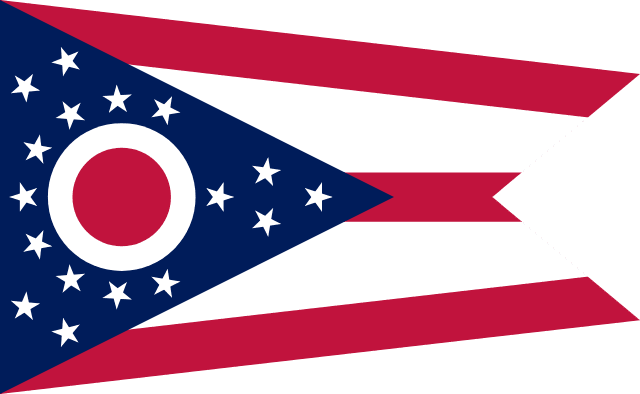
Ohio’s recommended flag-folding procedure uses two people and seventeen counted folds: two lengthwise folds, one fold to turn the pointed end into a rectangle, and fourteen alternating fan folds. The remaining cloth wraps around the fan-folded bundle. Ohio Revised Code §5.014 establishes this method, including a two-inch fold width for a flag with a three-foot hoist and five-foot fly. This guide explains the procedure, preparation, common mistakes and how to teach it using a practice model.
Folding procedure at a glance
| People | Two |
|---|---|
| Preparatory folds | Three |
| Alternating fan folds | Fourteen |
| Total counted folds | Seventeen |
| Reference width | Two inches for a 3 × 5 ft flag |
| Final shape | Compact rectangle |
| Legal basis | Ohio Revised Code §5.014 |
Prepare the flag and the two folding positions
Unlike a standard rectangular flag, the Ohio burgee ends in two points separated by an inward notch. That outline matters when the cloth is folded. Before starting, identify the hoist, which is the straight edge attached to the staff, and the fly, which is the pointed end away from it.
Choose two people who can hold the fabric at a comfortable working height. Have one stand at the hoist end and the other at the fly end. A three-by-five-foot flag is a convenient size for the recommended procedure, but participants may need to stand closer together when handling a smaller version.
Remove the flag from its staff or halyard using the facility’s normal lowering procedure. Do not leave metal clips attached where they could become trapped in the folded cloth. If the flag has sewn-in grommets, identify their position so the final bundle can be formed without forcing them through a crease.
Check whether the textile is dry, reasonably clean and suitable for folding. A flag that has just been lowered in rain should not be packed tightly into storage while wet. Follow the material care instructions and allow it to dry in an appropriate place first. This is a practical care recommendation, not a separate step in the statutory fold count.
Keep the flag above the ground throughout the activity. If the participants are learning the sequence, use a clean practice surface or a paper model to rehearse the folds before handling a ceremonial textile. Working with a practice flag makes it easier to restart without rushing.
Agree in advance who will lead the count. One person can call each completed fold while both check the alignment. The counter should not count the act of repositioning a hand, straightening a crease or passing a folded portion to the other person.
The code establishes a recommended method rather than requiring that every person who stores a state flag use the same ceremony. The object of this exercise is to demonstrate that method accurately and respectfully.
Folds 1 and 2: reduce the flag to a long strip
Start with the flag extended lengthwise between the two participants. For the first fold, bring the long edges together so that the two points at the fly are aligned. The important direction is parallel to the long axis of the flag. Do not begin by bringing the fly to the hoist.
Each person should guide the portion nearest them while checking that the fabric is not twisted. The person holding the fly can compare the two pointed tips. The person at the hoist checks that its upper and lower corners meet.
With a three-foot hoist, the original height is thirty-six inches. A clean lengthwise half-fold reduces the nominal strip height to eighteen inches. This measurement is useful for a paper model, although actual fabric thickness and seams can make the edges slightly less exact.
Count one only when the first lengthwise fold is complete. Then fold the strip lengthwise in half again. This produces a nominal nine-inch-high strip from the original thirty-six-inch height. The red disc of the flag must face downward at this stage, as the statutory instructions specify.
If the disc is facing upward after the second fold, stop and check the arrangement against the official illustrated guide. Do not make an additional fold simply to hide the disc. Correct the handling of the existing strip before moving to the next stage.
Keep the strip stretched gently, without pulling so hard that the fabric changes shape or seams are stressed. The two fly tips should still be aligned. Smooth wrinkles with the free hand rather than repeatedly folding and unfolding the entire textile.
The first two folds reduce the height of the burgee but leave its length largely intact. This prepares the cloth for the next step, which removes the irregular pointed outline from the working end. At the end of this stage the running total is two, not four, even if both participants have made corresponding hand movements.
Fold 3: turn the pointed end into a rectangular working edge
The Ohio flag’s fly is not a single straight vertical edge. Once its two points have been aligned by the lengthwise folding, the long strip retains a pointed portion at the far end. The third fold deals with that shape.
Bring the pointed portion back over the strip so that the working shape becomes rectangular. Use the Ohio Secretary of State’s illustrated folding reference to identify the direction and position of the crease. The statute describes the result rather than giving a separate inch measurement for this third fold.
This is not the first of the fourteen narrow fan folds. It is the final preparatory fold. Count it as number three only after the pointed end has been turned back and the remaining strip presents a straight working edge.
For a paper demonstration, hold the folded strip flat and compare its outline before and after this step. A paper burgee makes the geometric purpose of the third fold particularly visible: it converts a shape with a projecting tip into a strip that can be folded evenly.
If a pointed flap still projects from the end, inspect the alignment established by the first two folds. An uneven first fold can leave one point longer than the other, making it difficult to create a neat rectangular edge in the third step.
Avoid creating several small corrective folds at the tip. Those additional folds would complicate the seventeen-fold count. Instead, unfold to the appropriate preparatory stage, realign the fabric and repeat the intended single fold.
After the third fold, there should be a clear end from which to start the fan-fold sequence. That end is the former pointed fly, now folded back onto itself. The hoist end remains available for the final wrapping stage.
At this checkpoint, call out the running count of three. Participants can then concentrate on a new sequence of fourteen repeated movements without having to remember which preparatory actions are still outstanding.
Folds 4–17: make fourteen alternating fan folds
Start at the straight working edge created by fold three. For the standard three-by-five-foot flag named in the statute, measure approximately two inches along the strip and turn that section back over the fabric.
The next fold goes in the opposite direction, creating an accordion or fan pattern. Continue alternating the direction of the folds rather than rolling the fabric continuously in one direction.
Keep the fold widths consistent. The first person can manage the growing stack while the other supports the unfurled strip. This avoids allowing the full weight of the textile to hang from the last crease.
Count the fourteen fan folds separately if that is easier: fan fold one corresponds to overall fold four; fan fold two corresponds to overall fold five. At fan fold fourteen, the running total is seventeen.
A helpful training device is a small paper checklist with fourteen numbered boxes. The observer marks each box only after an alternating fold has been completed. The checklist is not part of the flag and should be kept clear of the fabric during the ceremony.
The alternating direction is what differentiates a fan-folded stack from a simple roll. If all the movements follow the same direction, stop and correct the method. A compact-looking bundle is not enough to demonstrate the recommended sequence if its internal structure is wrong.
For a flag of another size, the statute expressly allows an appropriate alternative fold width. Do not assume that two inches is required for a miniature or a very large flag. The aim is to make fourteen usable folds while preserving enough cloth for the wrapping stage.
The two-inch figure is a width measured along the long strip, not a reduction of the strip’s nine-inch nominal height. Mixing these axes can lead to a sequence that folds across the wrong direction.
Before starting the final wrap, verify that all fourteen fan folds have been counted. If a participant has lost count, a practice session should restart from the last reliable checkpoint. Avoid guessing whether the final stack contains thirteen or fourteen narrow folds simply because the bundle looks nearly complete.
Finish the bundle without adding another symbolic fold
After seventeen counted folds, some flag fabric remains beyond the accordion stack. The statutory procedure instructs the participants to wrap that remaining cloth around the fan-folded portion to create a compact rectangular bundle.
Support the stack while the remaining strip is brought around it. The wrap should keep the alternating layers together without requiring adhesive tape, a rubber band or an improvised fastener that could mark the cloth.
Keep the bundle snug rather than excessively tight. Thick seams, reinforced hoist material and metal grommets may make one side of the packet thicker. Guide the remaining fabric around those features without forcing sharp creases into the hardware.
The final wrap is described separately from the seventeen folds. The number remains three preparatory folds plus fourteen fan folds; do not announce the wrapping stage as fold eighteen.
The finished packet is rectangular. This is different from the familiar triangular packet associated with folding the United States flag. A triangular Ohio bundle is not the result specified by this particular state procedure.
Inspect the bundle for projecting corners or a loose section of cloth. A protruding point can indicate that the third fold was incomplete. A loose accordion section may indicate that the final wrap was not formed securely.
If the flag is to be stored for a long period, select storage suitable for its fabric and condition. A historic artifact or delicate silk flag may require specialist conservation advice instead of ordinary ceremonial handling. Do not repeatedly crease a valuable historical object merely to demonstrate the modern folding practice.
Label any storage container rather than writing directly on the flag. A removable label can identify the flag type, size and condition for the next use. When unfolding, support the bundle and reverse the sequence gently instead of pulling the free end abruptly.
Adjust the fold width for a different flag size
The two-inch measurement in section 5.014 applies to the specified three-foot-hoist, five-foot-fly example. Other flag sizes require an appropriate fold width. That qualification prevents the procedure from being limited to one retail size.
For a proportionally smaller training model measuring half the standard dimensions, a one-inch practice fan-fold width is a sensible starting point. A model with twice the linear dimensions could begin with four-inch folds. These are scaled educational examples, not additional fixed dimensions enacted by Ohio.
Check whether the paper or fabric actually has enough usable length after the pointed-end fold. Fourteen fan folds occupy part of the long strip, and the remaining portion must be sufficient to form the final wrap. The available length can vary with seams, construction details and the exact third-fold placement.
For a first rehearsal with an unfamiliar size, mark the fan-fold intervals on a separate measuring tape or practice sheet. Do not mark an actual flag with ink. The guide can be held beside the cloth to check the intended spacing.
A very small printed model may be difficult to fold fourteen times if the paper is thick. Thin practice paper can make the accordion action easier to see. On a large textile flag, extra space and a suitable working height become more important than the arithmetic alone.
The dimensions of the finished packet are not separately fixed in the cited folding section. They depend on the original flag size, the chosen fold width and the thickness of the material. It would be misleading to advertise a single finished packet size as an official requirement.
For a mathematics lesson, have students calculate nominal strip heights after two lengthwise halves. A three-foot hoist becomes nine inches; a two-foot hoist becomes six inches. The horizontal fan-fold width is a different quantity and should be calculated or selected separately.
This approach preserves the symbolic count while allowing practical differences in flag size. It also teaches students to distinguish prescribed steps from reference-based scaling choices.
Why Ohio uses seventeen folds and how to teach the symbolism
Ohio was admitted as the seventeenth state, and the legislature uses that number in the recommended folding procedure. The flag’s design also contains seventeen stars, but the star count and the fold count are separate ways of expressing the same historical association.
The state flag description in Ohio Revised Code section 5.01 explains that thirteen stars are grouped around the circular device and four additional stars are located toward the triangle’s point. The total is seventeen. The folding law applies that number to a physical handling procedure.
The Secretary of State’s brochure credits Alex Weinstock, an Ohio Eagle Scout, with developing the folding method for his Eagle project. The legislature established the recommended method in 2005. This is a much later development than the original burgee’s adoption in 1902.
A school ceremony can therefore connect three separate facts: the state’s place in the Union, the number of stars on its flag and the later seventeen-fold procedure. Keeping the events distinct avoids the impression that the folding instructions were part of the original flag law from the start.
For a classroom demonstration, give learners a paper burgee outline and ask them to label the hoist, fly points and notch. Rehearse the first three folds and write the count beside each completed action on a separate worksheet.
Next demonstrate the fan folds with a strip of spare paper. Alternating the direction is easier to understand when the stack can be viewed from the side. Once students recognize the accordion pattern, repeat it using the burgee model.
A final oral question can ask why the bundle is rectangular rather than triangular and why exactly seventeen folds are counted. Students should be able to identify the state-specific recommendation, not assume that all American state flags share the same folding method.
For a more advanced lesson, compare the original flag design statute and the later folding statute. The first defines an object; the second describes a recommended way to handle it. Both are valuable sources, but they answer different questions.
Common mistakes and a ceremony rehearsal checklist
If the final strip still has two misaligned fly points, inspect the first lengthwise fold. It may be easier to reset that stage than to compensate by making extra small creases near the end.
If the disc faces upward after the second fold, compare the arrangement with the Secretary of State’s illustration and correct the orientation before forming the rectangle. The intended downward-facing disc is a useful checkpoint.
If the accordion stack grows unevenly, check that the participants are alternating the directions and using a consistent fold width. A narrow first crease followed by increasingly broad folds can consume the remaining fabric too quickly.
If the remaining cloth will not wrap around the stack, the practice fold widths may be inappropriate for the size of the flag or the pointed-end fold may have taken up too much of the strip. Rehearse with a different suitable width instead of adding an arbitrary extra fold.
If the counter reaches seventeen before fourteen fan folds have actually been made, reconstruct the count as two lengthwise folds, one pointed-end fold and fourteen fan folds. Announce the final wrap separately.
For a public ceremony, confirm that the two participants know their roles, the flag can be handled at a comfortable height and the surrounding area is clear. Rehearse the sequence in advance with a practice model and keep the official illustrated reference available.
The main Ohio flag guide explains the burgee design and its history, while our drawing tutorial explains the proportions and symbols. This page deals specifically with the physical folding sequence, which is a distinct practical skill.
Frequently asked questions
How many times is the Ohio flag folded?
Seventeen counted folds, followed by the final wrap.
How wide are the fan folds?
Two inches for the three-by-five-foot example, or an appropriate width for another size.
Does the Ohio flag finish in a triangle?
No. The recommended procedure ends in a compact rectangle.
Is the method mandatory?
Section 5.014 calls it a recommended procedure.
Sources and reference
Ohio Revised Code §5.014: procedure for folding the state flag
Ohio Revised Code §5.01: flag design
Ohio Secretary of State: illustrated flag brochure
Ohio Department of Health: illustrated folding guide
Flag illustration: existing public-domain Flagpedia/FlagCDN artwork, attachment 2011. The official folding diagrams are linked, not reproduced. Original educational examples; reviewed November 2026.