Wiltshire Flag: Great Bustard, Stone Circles & Green-White Waves
Wiltshire’s flag features a golden great bustard in a green circle with six segments against a green-and-white wavy field. Learn its links to Stonehenge and Avebury.
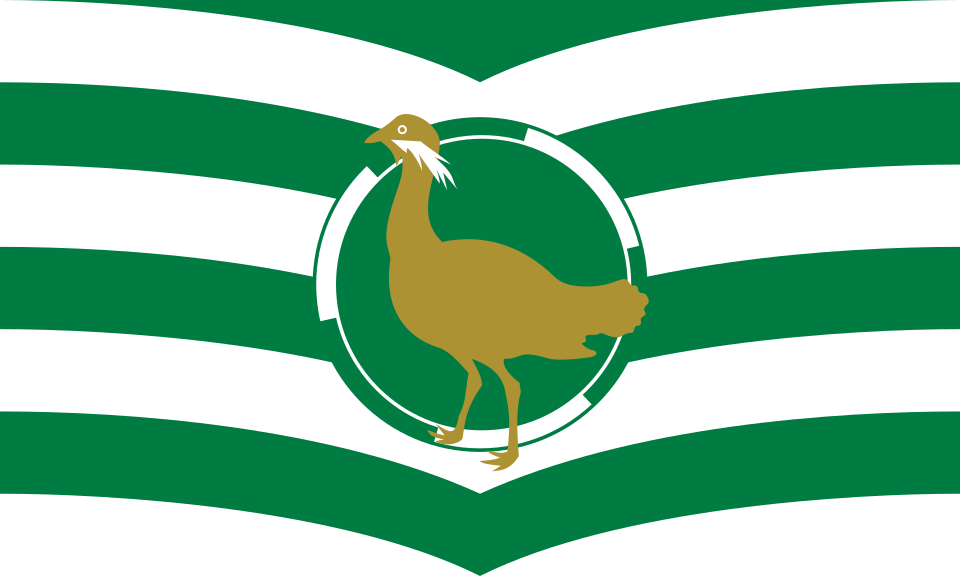
Wiltshire’s community flag combines one of its best-known birds with abstract imagery of the county’s prehistoric landscape. It differs from the crosses and heraldic roses of many other English county flags.
The Flag Institute’s Wiltshire entry directly identifies the great bustard, the meaning of the six-part rim and the chalk-downland symbolism of its wavy green-and-white pattern.
Wiltshire flag at a glance
| Feature | Details |
|---|---|
| Place | Wiltshire, southwest England |
| Flag type | County community flag |
| Main animal | Great bustard (Otis tarda) |
| Bird colour | Gold / ochre |
| Central field | Green disc |
| Disc rim | Six alternating green-white sections |
| Background | Green and white wavy bands |
| Designer | Mike Prior |
| Flag date | 1 December 2009 |
| Registry code | UNKG7419 |
| Ratio | 3:5 |
A county community flag is a regional symbol, not the national flag of a sovereign state. The historical roots of an emblem, the date of the modern design and its UK Flag Registry entry may be different events.
What does Wiltshire’s flag look like?
The flag is filled with alternating green and white wavy shapes. Over the waves is a large green circular badge showing a golden great bustard in profile, surrounded by a rim divided into six alternating white and green sections.
The flag’s design includes distinctive curves instead of straight stripes. The bird is a bustard—not an eagle, peacock, heron or goose. Its body and posture are best seen in a larger image rather than a small icon.
Why is there a great bustard on Wiltshire’s flag?
The great bustard (Otis tarda) was once part of the wildlife of southern England’s open grasslands. Wiltshire is associated with great bustard reintroduction work, making the bird a locally meaningful conservation symbol.
The illustration does not mean great bustards are found in every part of the county or that the bird is unique to Wiltshire globally. Instead, it evokes the county’s chalk grassland ecology and a remarkable species with an important local history.
What do the six sections around the circle mean?
The Flag Institute explains that the six alternating green-and-white sections evoke Wiltshire’s famous prehistoric stone circles, notably Stonehenge and Avebury, while also representing its six neighbouring counties.
The ring is therefore both a landscape and geographic symbol. It does not represent six separate birds, six districts of a modern council or the original stones in Stonehenge in a literal count.
Why are there green-and-white waves?
The green wavy areas evoke Wiltshire’s open grassland and fields. The white reflects the chalk geology of its downs and underlying landscape.
They are not intended as rivers alone or sea waves: Wiltshire is inland, and the Flag Institute explicitly links the bands to pasture and chalk. This is important when comparing the design with Oxfordshire, where white waves refer to waterways.
How are Stonehenge and Avebury connected to the flag?
Stonehenge and Avebury are internationally known prehistoric monuments in Wiltshire. The six-section rim provides a broad visual reference to their stone-circle forms, connecting the county flag to its archaeological heritage.
The ring is stylized, not a precise aerial plan of either monument. A flag guide should describe the archaeological reference without suggesting that the logo reproduces the exact number or layout of their stones.
Who designed the flag and when was it registered?
The Flag Institute credits Mike Prior with the design and records 1 December 2009 as its flag date. Its adoption route is listed as local council, giving Wiltshire a modern registered flag with distinct county identity.
The monuments and wildlife depicted are much older than 2009. The date is for the modern community flag, not the origin of Stonehenge, Avebury or the original presence of the great bustard.
Wiltshire compared with Dorset and Gloucestershire
Dorset has a red-edged white cross on gold, while Gloucestershire shows a blue cross edged cream on green. Wiltshire has no upright cross and no flower: it shows a bird in a circle on curved green-and-white bands.
The different devices reflect regional themes: Dorset’s patron saint, Gloucestershire’s River Severn and Wiltshire’s open landscape, ecology and prehistoric stone circles.
Is Wiltshire’s flag the same as the Wiltshire Council banner?
The registered Wiltshire design is a community flag with a great bustard inside its green medallion. Council logos and arms may use different typography, colours or supporting devices.
For educational or geographical use, the bird-in-circle flag is the one recorded by the UK Flag Registry. A council emblem should not replace it simply because it contains the name Wiltshire.
How to draw Wiltshire’s flag correctly
Begin with a rectangular field of alternating green and white wavy bands. Add a large central green circle, surround it with a six-part green-and-white segmented rim, and draw a golden great bustard in the centre.
Use a verified vector for the intricate animal silhouette. For a quiz, the clue ‘golden great bustard within a six-section green ring‘ uniquely identifies Wiltshire.
Frequently asked questions
What bird is on the Wiltshire flag?
The great bustard, Otis tarda.
When was Wiltshire’s flag registered?
1 December 2009.
Who designed it?
Mike Prior.
Why are there six sections around the bird?
They refer to Stonehenge and Avebury’s stone circles and to Wiltshire’s six neighbouring counties.
What do the green and white waves represent?
Open grassland and underlying chalk downs.
Does the emblem show Stonehenge exactly?
No. It evokes the form of prehistoric stone circles rather than reproducing a monument’s exact layout.
Is this a national flag?
No. It is a registered community flag for an English county.
How can I identify the flag quickly?
Look for a golden great bustard inside a circular badge on green-and-white wavy stripes.
Sources and illustration credits
Flag Institute — Wiltshire county flag specification
Wikimedia Commons — County Flag of Wiltshire vector
PNG sourced from Wikimedia Commons: Wiltshire flag artwork. Public-domain source artwork by Tango22, derived vector by Nik Naks via Wikimedia Commons. Rasterized to PNG without alterations to the flag design.
Independent educational guide. Flag information reviewed November 2026; publication does not imply governmental or Flag Institute endorsement.