Poland vs Czechia Flag: Colors, Stripes and the Blue Triangle
Compare the white-over-red fields, blue hoist triangle, official proportions and separate histories of these two Central European flags.
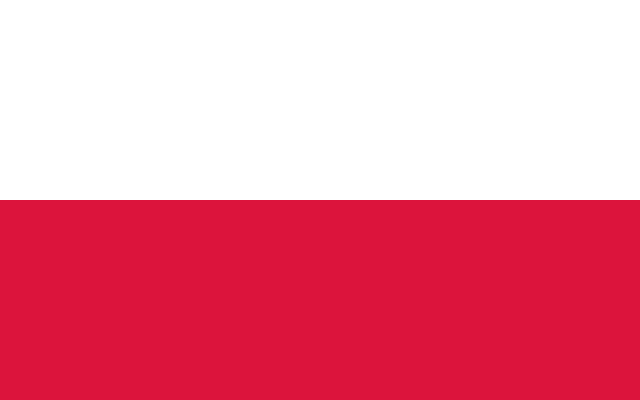

The difference at a glance
The easiest way to distinguish the two flags is to look at the edge attached to the flagpole. Poland uses two uninterrupted horizontal fields: white above red. Czechia uses the same basic upper and lower color arrangement, but a blue triangular field occupies the hoist and extends toward the center. A complete Czech flag therefore has three colors and two diagonal boundaries. A plain Polish flag has two colors and one horizontal boundary. You do not need to memorize the exact shade of red to tell them apart.
A comparison is especially useful when the flags are reproduced at the same height. At that size, the Polish design is slightly longer, because its official height-to-length ratio is 5:8 rather than Czechia’s 2:3. The difference in shape is much less obvious than the triangle, so treat proportions as a secondary clue. A manufacturer may sell both designs in the same commercial dimensions, and an online interface may place them inside equally sized boxes. Neither practice changes the specifications for the actual flag.
The table below describes the ordinary national designs, not every official banner or special-use flag associated with either state. In particular, Poland also has a version carrying its national emblem. That version must not be confused with the Czech triangular design.
| Feature | Poland | Czechia |
|---|---|---|
| Basic arrangement | White above red | White above red with blue hoist triangle |
| Height:length | 5:8 | 2:3 |
| Triangle | None | Tip halfway along length |
| Ordinary flag emblem | None | None |
| Modern design history | 1919 legislation | 1920 Czechoslovak design; retained in 1993 |
How the blue triangle changes the geometry
Imagine two sheets of paper of equal height. Divide each horizontally through the center. On the first sheet, leave the upper half white and fill the lower half red. This illustrates the Polish bicolor. On the second sheet, mark a point halfway along the horizontal centerline. Join that point to both corners on the left edge. Fill the resulting triangular shape blue, keeping the remaining top portion white and bottom portion red. This illustrates the Czech flag.
The Czech triangle is not merely a small decoration in the upper-left corner. Its vertical base occupies the entire hoist edge. Its tip reaches the midpoint of the flag’s length, and it meets the horizontal division between the white and red areas. This relationship is explicitly described by the Czech embassy’s national-symbols reference. A drawing with a triangle that stops well before the midpoint, or one with the point above the central boundary, is not an accurate geometric construction.
There is a useful mathematical consequence. In an ideal flat Czech flag, the triangle has a base equal to the flag height and a perpendicular altitude equal to half its length. The standard area formula for a triangle therefore gives one quarter of the whole rectangle. White and red divide the rest equally, so each occupies three eighths of the surface. By contrast, each of Poland’s two bands occupies exactly half of its rectangle.
These fractions describe the design, not the amount of each color visible in a photograph. Folds, shadows, overlap and camera angles can conceal areas of fabric. Use the calculation for artwork, classroom exercises and correctly flattened reference drawings, rather than trying to estimate percentages from a moving flag.
Official proportions and a classroom construction
Poland’s Ministry of the Interior and Administration describes the national flag as a rectangle with a height-to-length ratio of 5:8. Czech diplomatic guidance gives 2:3 for the Czech state flag. To avoid ambiguity, all ratios here put the vertical dimension first and the horizontal dimension second. Some suppliers reverse this convention, so a label such as 8:5 may refer to the very same Polish proportions when expressed as length divided by height.
For a side-by-side drawing, choose a common height of 10 centimeters. The Polish rectangle will be 16 centimeters long, while the Czech rectangle will be 15 centimeters long. Mark the horizontal midpoint of each at 5 centimeters from either long edge. On the Czech drawing only, locate the triangle’s tip 7.5 centimeters from the hoist, on that midpoint line. Its base connects the top and bottom hoist corners.
Use a ruler to make the boundaries meet precisely. Color the triangle first, then the red field below the midpoint, taking care not to cover any of the blue. Leave the upper field white. The Polish rectangle requires no triangle or diagonal line. If the white area blends into the paper, draw a faint pencil outline around the whole flag; that outline is a drawing aid rather than a stripe on either official flag.
This exercise isolates the geometry without relying on a particular printer or screen. It is not intended as a legally certified production specification for the exact national colors. For manufacturing, consult the applicable official color references and reproduction requirements, especially when matching paint, textile dye or printed ink. An attractive digital illustration can be suitable for learning without necessarily being suitable for a ceremonial flag order.
Different histories behind the shared colors
Polish national colors have a long association with the country’s heraldic tradition. The white eagle on a red shield provides an important historical context for the combination. The restored Polish state’s legislature established the national flag in legislation dated August 1, 1919. The official government account connects that decision with Poland’s regained independence. The design’s simplicity makes the historical colors recognizable without requiring a coat of arms on the ordinary flag.
The Czech design followed a different political history. The Czech embassy in Dublin dates its creation to 1920, after Czechoslovakia had been established as an independent state. The white and red fields connect with historic Czech lands, while the added blue brought a third color into the flag of the joint state. The embassy explains the historical connection of blue to Slovakia and describes its continuing symbolic role in Czechia.
When Czechoslovakia was divided at the beginning of 1993, the Czech Republic retained the existing three-color design. Slovakia adopted its own flag, which uses horizontal white, blue and red bands together with a shield. As a result, a present-day Czech flag should not be labeled a Slovak flag simply because the blue triangle historically had a Slovak association.
The two adoption dates are close, but chronological proximity does not establish that one modern flag was copied directly from the other. Both countries emerged from major political changes in Central Europe after the First World War. Their modern flags were created within that wider historical setting, with different national traditions and different design choices. The resemblance is a useful starting point for understanding regional history, rather than proof of an identical national story.
Recognizing the flags in photographs and sporting events
A flag photographed from the side may be difficult to identify if part of it is wrapped around its pole. Look for a diagonal edge of blue next to the white or red. Even a small visible portion of the Czech triangle can settle the comparison. If the only visible part is the far end of the flag, both designs can appear to be identical white-over-red bands. In that situation, the image alone may not provide enough evidence.
On sports scoreboards, national flags often occupy tiny standardized rectangles. The software may use a graphic with rounded corners, a circular crop or an icon that compresses the original aspect ratio. The triangle should still be recognizable in most complete Czech icons, but it may disappear in a very tight crop. The accompanying country abbreviation can then be more reliable than a guess based on the colors.
The official two-letter country codes commonly used for these flags are PL for Poland and CZ for Czechia. Three-letter abbreviations POL and CZE are also familiar in sporting contexts. The name Czech Republic refers to the same country as Czechia in this comparison. It is not a separate flag option. Avoid interpreting labels according to the language of the website alone: a Czech or Polish fan might be watching an event hosted elsewhere.
In a photograph showing the reverse of a flag, the hoist can be on the right rather than the left. The Czech triangle appears on that side because the flag is seen from behind. The white field remains above the red, provided the flag is hanging in its ordinary horizontal orientation. A reversed photograph is therefore not necessarily a misprint.
If you have only a folded piece of white and red fabric and no contextual information, the appropriate answer may be that its identity is uncertain. Being able to explain why an incomplete flag cannot be identified is part of flag literacy. A full design, a readable country label or a trustworthy photograph caption can resolve the ambiguity.
Polish eagle flags and Czech presidential symbols
The ordinary Polish flag does not contain a picture of an eagle. However, Polish official sources distinguish the plain bicolor from a flag with the national coat of arms placed in the upper white band. The historical government description of the 1919 legislation associates the emblem-bearing design with diplomatic use and merchant shipping. Modern permitted uses should be checked against current Polish law rather than inferred from a historical example.
For the purpose of visual identification, a white-and-red flag with a red shield and white eagle in the upper part is a recognizable Polish design. The shield does not turn it into a Czech flag. The Czech national flag has a geometric blue wedge at the hoist, not a centrally positioned eagle shield in the white field.
Czechia also has distinct state symbols beyond the national flag. Its presidential banner is an elaborate design incorporating the state arms and a motto. The Czech embassy lists it separately from the state flag. Photographs of government ceremonies may display the presidential banner, a national flag or other institutional symbols, so the context and design both matter.
Neither country’s national flag should be reconstructed by combining every symbol associated with the country. A common classroom mistake is to add a coat of arms because it appeared on a national emblem page, even when it does not belong on the ordinary flag. Keep a separate reference for the ordinary national flag, a separate reference for an authorized emblem-bearing variant and a separate reference for presidential or other special banners.
For digital educational images, use an accurate reference and identify the variant in the caption. For official public display or commercial merchandise, consider the relevant national rules and permissions. A freely licensed illustration is not a blanket authorization to use a state emblem in a way that implies government endorsement.
Other white and red flags you might encounter
Poland and Czechia are only part of a wider family of flag designs using white and red. Indonesia and Monaco both put red above white, which reverses the ordinary Polish order. Their red-over-white designs can be difficult to distinguish from one another when proportions are removed, but a normal complete image of either is easy to distinguish from the Czech flag because the blue triangle is absent.
Singapore also uses red above white, but includes a crescent and stars in the upper red portion. That is another reminder that color order and symbols should be checked separately. Looking only for a red-and-white palette can generate several plausible answers when the design itself would provide a clear result.
The Philippines offers a particularly useful comparison with Czechia because it also places a triangle at the hoist. However, the triangle on the Philippine flag is white and contains a sun and stars, and the arrangement of the remaining colored fields is different. A flag with a hoist triangle is not automatically Czech. Look at the color of the wedge and whether it contains a symbol.
Slovakia is historically connected with Czechia but has a different current flag. It uses three horizontal bands and a shield. Its blue appears as a stripe rather than a wedge. This distinction is especially useful when sorting modern Central European flags from a collection that includes historical Czechoslovak references.
A good recognition routine is to identify the basic arrangement before attempting to name the country: count the bands, note whether they are horizontal or vertical, identify triangles or crosses and look for emblems. Finally check the color order and the proportions if they are available. The method transfers to other flags and avoids dependence on a single color cue.
A practical comparison exercise
Use the flag pictures at the top of this page as your reference. Cover the country labels and describe each design aloud in a complete sentence. One description should mention two equal horizontal bands; the other should include the blue triangle and its position. Then uncover the names and check whether your descriptions match.
Next, draw two uncolored rectangles on a sheet. Divide both into two horizontal halves. Add the Czech triangle to only one. Before coloring, label each shape with the correct country. This tests whether you understand the structural difference rather than recognizing the flag only because it has a familiar shade of red.
For a more challenging exercise, cover the left half of both finished drawings. Ask someone to identify the country from the exposed right-hand portions. The intended lesson is that this task may be impossible from the visible color arrangement alone. Reveal the covered area and explain how the triangle supplies the missing information.
Finally, use a collection of flags at different display sizes and try identifying these two alongside Indonesia, Monaco, Slovakia and the Philippines. Give a reason for each choice. If you make a mistake, write down the missed feature rather than just copying the correct country name. For example, confusing a Czech and Philippine flag could indicate that you recognized the triangle but forgot to check its color and symbols.
Teachers can use the same activity as a short geography warm-up. The exercise does not require special materials beyond two reference images, paper and a ruler. Learners who have difficulty distinguishing colors can focus on shape, band orientation and the presence of an emblem. The accompanying labels and descriptions remain useful even when color alone is not accessible.
Frequently asked questions
Is the Czech flag the same as the Polish flag with a blue triangle? As a visual shorthand, that description is helpful. Both have white above red, and the Czech design adds a blue hoist wedge. However, the official rectangle proportions are different, so the statement is not an exact manufacturing instruction or a complete explanation of their history.
Which is longer at the same height? The ordinary Polish flag is slightly longer in its specified proportions. For a height of 100 units, the Polish length is 160 units and the Czech length is 150 units. Do not rely on this distinction in a standardized web icon.
Does Poland use a blue triangle in its national flag? No. The ordinary design consists of white and red horizontal fields. The official emblem-bearing version also does not introduce a blue triangular field.
Why does Czechia still use the flag of Czechoslovakia? The Czech Republic retained the design when the two countries became independent in 1993. The former state and modern Czechia therefore have a closely connected flag history, even though a modern image of the flag should be labeled according to its date and context.
What if I cannot see the triangle? Look at the whole hoist edge or find the country caption. If the flag is partly hidden, a confident identification may not be possible. Do not assume that every visible white-over-red section must belong to Poland.
Are the colors identical? Both designs use white and red, and Czechia additionally uses blue. That does not mean all official color specifications or reproductions match. Screens, fabrics and lighting can alter the appearance. Shape and arrangement are much more dependable identification features.
Sources and artwork
- Polish Ministry of the Interior and Administration: Flag Day and official dimensions
- Polish government: history and emblem-bearing flag
- Czech Embassy in Sofia: national flag geometry and dimensions
- Czech Embassy in Dublin: history and state symbols
- Flagpedia / FlagCDN artwork (supplier identifies these images as public-domain artwork). State-symbol rules may apply independently of image copyright.