Norfolk Flag: Yellow, Black & Ermine Diagonal Explained
Why is Norfolk’s flag divided yellow and black by an ermine diagonal? Explore Ralph de Gael, the ancient county banner and the council-arms difference.
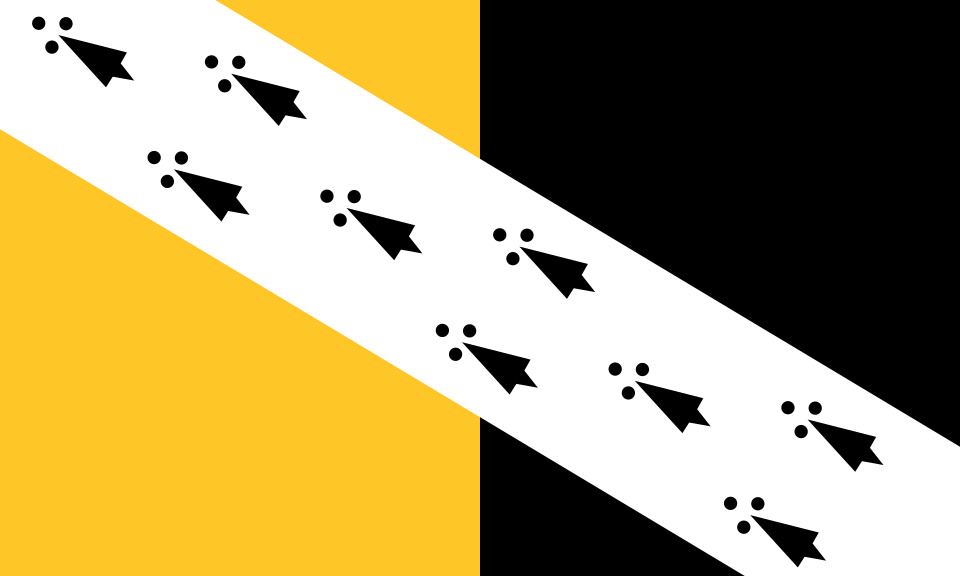
The Norfolk county flag tells a distinctive part of England’s regional story. The flag is divided into golden yellow and black areas by a broad white diagonal band descending from the upper hoist toward the lower fly. The white band is scattered with stylized black ermine spots, a traditional heraldic fur pattern. This guide separates its visible elements, historical origins and modern public use, with the Flag Institute’s registered specification as the primary reference.
Norfolk flag at a glance
| Feature | Details |
|---|---|
| Region | Norfolk, East Anglia, England |
| Type | Historic county community flag |
| Colours | Gold/yellow, black and white |
| Central device | White descending diagonal with black ermine spots |
| Historical association | Ralph (Ranulph) de Gael, Earl of Norfolk |
| Flag Institute date | Traditional design, 11th–17th centuries |
| Ratio | 3:5 |
| Council distinction | Norfolk County Council arms add a red chief |
This is a county community flag, not an independent sovereign national flag. Historic heraldic emblems, council armorial grants and modern public flag adoption dates can describe different stages.
What does Norfolk’s county flag look like?
The flag is divided into golden yellow and black areas by a broad white diagonal band descending from the upper hoist toward the lower fly. The white band is scattered with stylized black ermine spots, a traditional heraldic fur pattern.
Its strong black-and-gold contrast distinguishes Norfolk from the blue-and-gold banners of nearby Suffolk and Cambridgeshire. The diagonal is not a simple white line: its small ermine marks are essential parts of the registered flag.
What do the black spots on the white diagonal mean?
In heraldry ermine is a conventional fur pattern, usually white carrying black tail-like marks. The spots are deliberately stylized and do not represent a map of the county, islands or individual settlements.
The ermine bend makes Norfolk’s flag stand apart from ordinary two-colour diagonal designs. Replacing those marks with stars, dots or black crosses loses the historical heraldic identity.
Who was Ralph de Gael, and why is he mentioned?
The Flag Institute traces the design to arms attributed to Ralph, also called Ranulph de Gael, who held the earldom of Norfolk in the period 1071–1075. The symbolism became associated with the wider county.
An attribution to an eleventh-century nobleman is not proof that a standardized modern cloth flag of today’s dimensions was flown at that date. The registry describes a banner that developed through a long heraldic tradition.
Why yellow and black instead of the Norfolk council colours?
The yellow and black derive from the historic heraldic design. A white ermine band provides a contrasting diagonal, producing a flag with just three main colours.
Norfolk County Council’s arms, granted in 1904, build on the older banner but add a red chief bearing royal emblems at the top. That extra red strip is not part of the simple county community flag.
How old is the Norfolk flag?
The registry describes the pattern as traditional, with a flag date spanning the eleventh to seventeenth centuries. Over time the de Gael symbolism acquired a county-wide identity.
The Flag Institute notes that Norfolk family-history and Broads organizations supported its recognition, while the county council did not request to substitute its own banner. This explains why the traditional form, rather than the 1904 council arms, is used.
Is the Norfolk flag related to Norfolk Island?
No. Norfolk county is in eastern England; Norfolk Island is an Australian external territory in the South Pacific with a green-white-green flag showing a Norfolk Island pine.
Similar names can mislead flag search results. The English county’s black ermine marks and gold field have nothing in common with the Australian island’s tree emblem.
Norfolk compared with Suffolk and Cambridgeshire
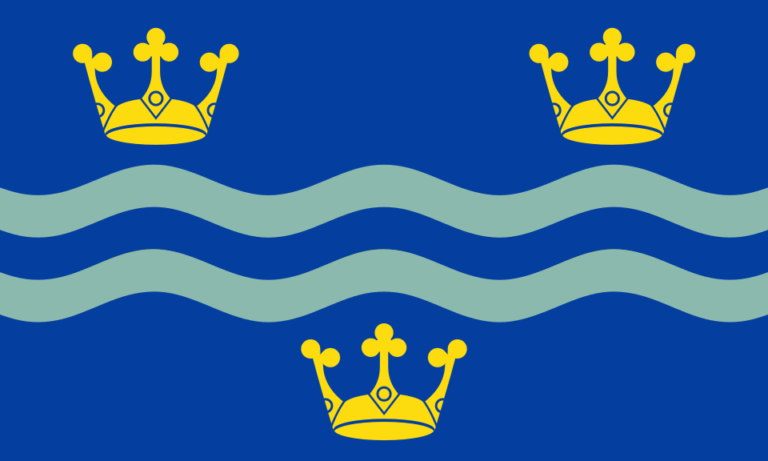
Suffolk has a gold crown with crossed arrows on blue, linked to St Edmund. Cambridgeshire uses three gold crowns and light-blue river waves. Norfolk uses an ermine diagonal on gold and black.
These East Anglian county symbols belong to different heraldic stories. The most reliable quiz clue for Norfolk is the white spotted diagonal, not the presence of gold alone.
Is the Norfolk banner a national flag?
Norfolk is a historic English county, not a sovereign country. This community flag can represent local identity in education, festivals, sport and privately flown displays.
It is distinct from England’s red St George’s Cross and from the United Kingdom’s Union Flag. Use the caption Norfolk county flag, England where a mixed country-and-region flag collection might otherwise create confusion.
How to draw and identify Norfolk’s flag
Begin with a gold rectangle; make a black contrasting area on the opposite side according to the historic banner layout. Lay a broad white diagonal from the upper-left toward the lower-right.
Add the repeated black ermine marks along the white diagonal. For correct relative shapes, use the credited flag vector rather than trying to construct the heraldic pattern from ordinary black dots.
Frequently asked questions
What are the black marks on the Norfolk flag?
Ermine spots, a traditional heraldic fur pattern.
Which colours appear?
Yellow/gold, black and white.
Who is associated with the earliest arms?
Ralph or Ranulph de Gael, Earl of Norfolk.
Is the Norfolk flag the same as its council’s arms?
No. The council’s 1904 arms add a red chief.
Does Norfolk have a national flag?
No; it has a county community flag within England.
Is the flag connected with Norfolk Island?
No; the Australian island uses a Norfolk pine on green and white.
What is the direction of the diagonal?
It descends from upper hoist to lower fly in the standard flag view.
What reference defines the flag?
The Flag Institute’s UK Flag Registry.
Official references and illustration credits
Flag Institute — Norfolk County Flag (UK Flag Registry)
Flag image attributionIllustration from Wikimedia Commons — Norfolk flag vector, converted into a PNG without changes to the underlying design. The file page identifies the creator and licence conditions; follow its attribution and share-alike terms where applicable. Official insignia may carry additional restrictions.
Source-checked November 2026. Educational article; no Flag Institute endorsement is implied.