Asturias Flag: Golden Victory Cross, Alpha and Omega Explained
What does the Asturias flag represent? Explore its precise design, colours, symbols, origins and differences from other Spanish regional flags.
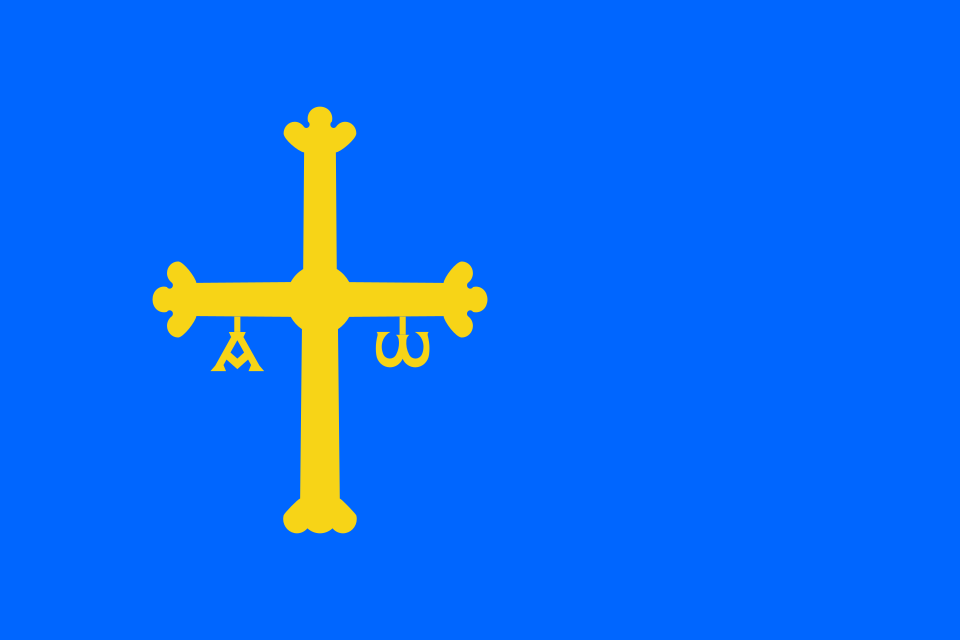
Asturias sits on Spain’s north coast along the Bay of Biscay. Oviedo is its capital, while Gijón and Avilés are important urban centres; its mountain and coastal heritage shape the region’s identity. This article explains how its historic emblem and modern regional flag fit together and how to avoid confusing its design with the national flag of Spain.
Asturias flag at a glance
| Region | Asturias, Spain |
|---|---|
| Capital / seat | Oviedo |
| Modern recognition | 1981 autonomy statute |
| Flag type | Autonomous-community flag |
| Design clue | Alpha and omega are historic Christian symbols hanging from the Cross of Victory. |
How to recognise the flag
Asturias flies a vivid blue flag with the yellow Cross of Victory positioned toward the hoist. The stylised cross has hanging Greek letters alpha and omega, a distinctive detail easily lost in very small images.
The precise arrangement matters more than superficial colour similarities with unrelated country flags.
What do its symbols mean?
The Cross of Victory is a treasured Asturian historical emblem, associated with the Christian Kingdom of Asturias. The surviving medieval cross, decorated with gold and gems, is traditionally connected with King Alfonso III and is kept at Oviedo Cathedral.
The hanging Greek letters can be read as the beginning and end of the Greek alphabet and have Christian theological associations. This is a heraldic religious reference, not a modern political slogan.
Why those colours?
Blue provides a contrasting background for the golden cross. It is not identical to the Scottish flag: Asturias uses an upright, ornamented gold cross with pendant letters rather than a diagonal white saltire.
Some colour explanations are customary interpretations rather than words explicitly stated in the law establishing the flag.
History and current status
The current flag is established in the Principality of Asturias’ 1981 Statute of Autonomy. The underlying Cross of Victory and the kingdom it symbolises predate contemporary Spanish regional government by over a thousand years.
A historical motif can be centuries old even when its present autonomous-community flag has been in use for only a few decades.
Geography and administrative identity
Asturias sits on Spain’s north coast along the Bay of Biscay. Oviedo is its capital, while Gijón and Avilés are important urban centres; its mountain and coastal heritage shape the region’s identity.
The banner belongs to the autonomous community, not to an independent state or merely to one municipal council.
Similar flags: how to tell them apart
Cantabria uses white and red horizontal bands and a detailed shield; neighbouring Galicia uses a blue diagonal stripe on white. Neither resembles Asturias’ blue field and Victory Cross.
Check symbols, stripe count and the arrangement of fields before deciding which region a flag belongs to.
How to draw the flag
Asturias flies a vivid blue flag with the yellow Cross of Victory positioned toward the hoist. The stylised cross has hanging Greek letters alpha and omega, a distinctive detail easily lost in very small images.
Start with the main bands or field; if the official design has a detailed shield, use the linked vector file as a reference rather than inventing small heraldic details.
Frequently asked questions
Why are there Greek letters on the Asturian flag?
Alpha and omega are historic Christian symbols hanging from the Cross of Victory.
Is Asturias an independent country?
No. Asturias is an autonomous community of Spain, with its own regional institutions.
What is the capital?
Oviedo.
When was the current autonomous flag recognised?
1981 autonomy statute.
Does it use the same flag as Spain?
Cantabria uses white and red horizontal bands and a detailed shield; neighbouring Galicia uses a blue diagonal stripe on white. Neither resembles Asturias’ blue field and Victory Cross.
Is the symbol older than the modern flag?
Often yes. Regional flags frequently reuse much older royal, religious or local heraldic devices.
Sources and image credit
Asturias flag: regional history, design and sources
Flags of the World — Spanish autonomous community reference index
Wikimedia Commons — Flag of Asturias.svg. The featured PNG is a scaled rendering of this original flag image. The original page records author and applicable licence for reuse.
See also Spain’s national flag for the red-yellow-red state banner.
Independent educational guide. Source review: 20 November 2026.