Rouergue Flag: Golden Lion on Red and Aveyron Heritage
Discover the flag design, heraldic history, distinctive symbols and modern status of Rouergue in France.
Rouergue developed as a historic territory in southern France, with Rodez an important centre. Much of its land corresponds to modern Aveyron, now part of Occitanie. Some depictions of departmental heritage use the old Rouergue lion, but department logos may differ. This article explains the pictured flag and distinguishes its historic identity from contemporary administrative jurisdictions.
Rouergue flag at a glance
| Historical place | Rouergue |
|---|---|
| Important centre | Rodez |
| Modern region / area | Occitanie (mainly Aveyron) |
| Flag category | Historical / cultural or former regional banner |
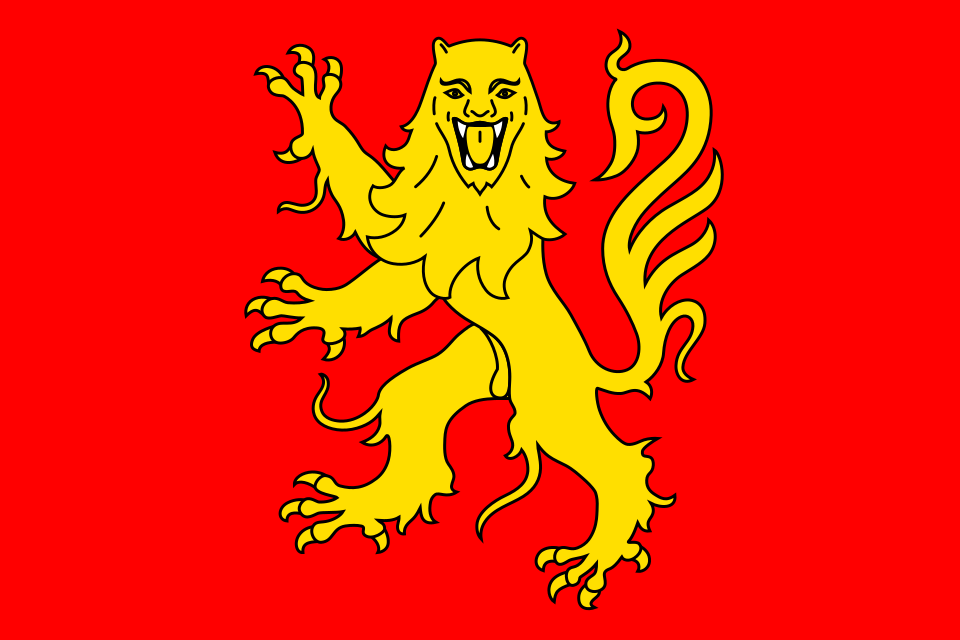
| Visual identity | The traditional Rouergue banner is a red field carrying a single large golden heraldic lion. Its upright posture and extended claws create a very simple animal-on-colour design. |
Flag design: what does it look like?
The traditional Rouergue banner is a red field carrying a single large golden heraldic lion. Its upright posture and extended claws create a very simple animal-on-colour design.
The illustration above shows a named heraldic, cultural or former-region banner. Do not automatically substitute it for the current flag or branding of the modern French regional administration.
Symbolism and historical origin
The lion appears in arms associated with the former County and Province of Rouergue. A heraldic lion expresses older local authority and noble lineages; it should not be understood as evidence that lions were native to the Aveyron landscape.
Traditional heraldic animals, crosses, bars and other charges can represent dynastic claims or older political territories. Their presence does not always prove a literal modern cultural meaning.
History and changes in political status
Rouergue developed as a historic territory in southern France, with Rodez an important centre. Much of its land corresponds to modern Aveyron, now part of Occitanie. Some depictions of departmental heritage use the old Rouergue lion, but department logos may differ.
Modern departmental and regional administrative boundaries are much newer than the medieval heraldry used by many French provinces.
Colours and important visual features
The traditional Rouergue banner is a red field carrying a single large golden heraldic lion. Its upright posture and extended claws create a very simple animal-on-colour design.
To identify a flag accurately, pay attention to the colour of the field and the direction or position of the central heraldic device, rather than relying on the place name alone.
Where was this historical area?
Rouergue is associated with Rodez. The relevant present-day French regional administration is Occitanie (mainly Aveyron).
Historical territorial borders and current government jurisdictions may overlap without matching exactly. The former province name should not be treated as a present-day independent state.
Comparison with similar designs
Lyonnais also shows a lion on red, but its lion is silver-white and a royal-blue chief with gold lilies sits above it. French Flanders has a black lion on gold. The colour of the lion and field readily distinguishes Rouergue.
Looking closely at animals, stripes, shields and their position will prevent confusing this banner with the flags of nearby French provinces, Belgium or other regions.
How to draw or reproduce this flag
The lion is shown rearing in a heraldic manner with its forepaws raised. If copying the emblem, the source illustration records its pose and claws; a generic lion silhouette may be misleading.
For complicated arms use the original image source instead of redrawing intricate curves from memory. For a striped flag, preserve the number and orientation of the bars.
Modern flag status and usage
This page describes a specific historical, cultural or former-administrative flag associated with Rouergue. A present-day regional council may use an entirely different official logo or standard.
For government or municipal purposes, confirm the current authority’s rules; historic provincial flag usage does not automatically indicate official administrative approval.
Frequently asked questions
What is the flag of Rouergue?
The traditional Rouergue banner is a red field carrying a single large golden heraldic lion. Its upright posture and extended claws create a very simple animal-on-colour design.
Where is Rouergue in France?
Rouergue is historically associated with Rodez. Today its territory relates primarily to Occitanie (mainly Aveyron).
Is it the official flag of a modern French region?
This article shows a historical/cultural or former administrative design. French regional flags vary in official status and the present council may use another logo.
Why does it feature these symbols?
The lion appears in arms associated with the former County and Province of Rouergue. A heraldic lion expresses older local authority and noble lineages; it should not be understood as evidence that lions were native to the Aveyron landscape.
How does it differ from similar provincial flags?
Lyonnais also shows a lion on red, but its lion is silver-white and a royal-blue chief with gold lilies sits above it. French Flanders has a black lion on gold. The colour of the lion and field readily distinguishes Rouergue.
Can this illustration be used commercially?
Check the source artwork credit and linked licence. The legal use of official symbols can also be separately restricted, even if the flag artwork is freely licensed.
Sources, licence and image credit
Flags of the World — traditional historical provinces of France
Wikimedia Commons — former and current French territorial flags
Original illustration: Flag of Rouergue.svg. Illustration by Ec.Domnowall (2011), Creative Commons Attribution-ShareAlike 3.0; PNG rendered from SVG with only scaling and conversion. Source licence and reuse terms. The SVG was converted to a scaled PNG without artistic edits.
For context, see the flag of France — the national blue-white-red tricolour.
Independent educational content; no claim of endorsement by current French regional authorities. Reviewed 20 November 2026.