How to Draw the Louisiana Flag: Pelican and State Motto
Measure the blue field, locate the official pelican crest, and understand its exact placement and state artwork requirements.
Use the Secretary of State’s official artwork without unauthorized alterations. This guide teaches geometry and placement.
View official artwork and specifications →Understand the flag before starting your drawing
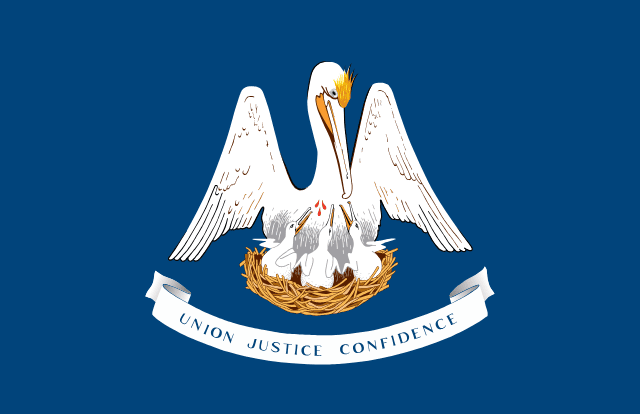
Louisiana’s state flag contains a centered crest on a dark blue rectangular field. The crest combines a mother pelican, three chicks in a nest, three red drops of blood and a white motto ribbon. The Louisiana Secretary of State supplies detailed instructions for the official artwork, including the overall flag proportions, the dimensions of the crest and the point to use when positioning it. This is a more reliable drawing reference than an image found without a caption or source.
The best approach is to separate the geometric construction from the official illustrated artwork. You can create a precisely measured rectangle, locate its center and prepare the correct placement guides. The intricate pelican, nest and ribbon should come from the Secretary of State’s official art when a complete official reproduction is required. The state directs users to preserve that artwork without unauthorized alterations. It would therefore be misleading to present a freehand cartoon bird or a retyped motto as a certified replacement for the crest.
This guide provides the measurements, placement calculations and a practice worksheet rather than a new downloadable imitation of the official crest. Open the state’s flag and seal reference alongside the tutorial. A student can study the pelican’s components and understand their positions without tracing individual elements into a new logo. For a complete reproduction, follow the authority’s instructions and obtain the official artwork at the appropriate quality.
The crest and the state seal are related but not identical objects. The flag’s motto is carried on a ribbon below the nest, whereas the circular seal surrounds its central illustration with text. Do not substitute a round Louisiana state seal simply because it contains a pelican. The flag requires the particular complete crest described on the official specifications page.
Materials and scale choices
For the measurement exercise, gather a pencil, ruler, set square, eraser and a sheet of paper. A dark blue colored pencil or marker is useful for a separate color swatch or for coloring the background of a permitted finished study. Keep the Secretary of State’s reference visible as you work. A digital drawing program with rulers, guides and a proportional scaling tool can be used instead of paper.
The published flag specification uses seven units of height and eleven units of length. Choose a unit that fits your available space. For an easy classroom model, let one unit equal two centimeters. The rectangle becomes fourteen centimeters high and twenty-two centimeters long. This size fits on A4 paper in landscape orientation with room for labels, although you should check the available printable area if using a template.
At that scale, the stated crest height becomes ten and a half centimeters and its stated width becomes twelve centimeters. These measurements correspond to the specified vertical and horizontal dimensions through the crest. They should not be interpreted as permission to redraw the entire crest inside a newly invented rectangle. The artwork has an irregular silhouette, and the state’s positioning point is not defined by the center of a simple bounding box.
A larger example can use three centimeters per unit, producing a field measuring twenty-one by thirty-three centimeters. A smaller notebook version can use one centimeter per unit, giving a seven-by-eleven-centimeter field. All corresponding measurements change by the same scale factor. Record the scale at the start so that the artwork measurements and the outside rectangle remain compatible.
For a print project, the available margin depends on the printer. The flag’s outline should fit within the printable area rather than be cut off by the device. If a software application automatically scales the page, inspect the print settings and measure the finished worksheet before treating its physical dimensions as exact.
| Measurement | Official units | Worked size |
|---|---|---|
| Field height | 7 | 14 cm |
| Field length | 11 | 22 cm |
| Crest vertical reference | 5¼ | 10.5 cm |
| Crest horizontal reference | 6 | 12 cm |
| Field center | 5.5 across, 3.5 down | 11 cm across, 7 cm down |
Step 1: Construct the seven-by-eleven rectangular field
Draw a horizontal baseline twenty-two centimeters long. Mark both ends, and use a set square to draw perpendicular lines fourteen centimeters high. Join their upper endpoints with another horizontal line. Check the four sides and the angles at each corner. The finished outline should have a height-to-length ratio of seven to eleven.
This is a different rectangle from the common two-to-three flag format. If you choose a fourteen-centimeter height and draw a twenty-one-centimeter length out of habit, you will have produced a 2:3 outline rather than the correct seven-by-eleven example. The one-centimeter difference in length may appear small on paper, but it changes the available space around the central artwork.
To check your rectangle, divide its length by eleven and height by seven. Both values should equal your chosen unit of two centimeters. This method works with any correctly scaled size. For instance, a flag thirty-three centimeters long should have a height of twenty-one centimeters at the same relative proportions. A height of twenty centimeters would not follow that relationship.
Next mark the midpoint of each side. At this scale the horizontal midpoint is eleven centimeters from either end and the vertical midpoint is seven centimeters from either long edge. Draw two light guidelines joining the opposite midpoints. Their intersection is the flag center. Use a pencil mark that can be removed later; these axes are not white or colored features of the official flag.
A useful verification is to draw the two diagonals lightly and confirm that they meet at the same center point. Their lengths should be equal. If the midpoint and diagonal methods do not agree, the rectangle may be skewed. Correct the outline before moving on to the crest. Otherwise even correctly scaled artwork will be placed in an incorrect field.
Step 2: Measure the crest as one design
The Secretary of State’s specification treats the mother pelican, chicks, nest and ribbon as one unified illustration. The vertical dimension is five and one-quarter units, measured from the top of the mother’s head to the lowest part of the banner. The horizontal reference is six units across the designated banner tips. Those are specific points on the artwork, not arbitrary dimensions chosen to fill the canvas.
In the two-centimeters-per-unit example, multiply five and one-quarter by two to obtain ten and a half centimeters vertically. Multiply six by two to obtain twelve centimeters for the specified horizontal reference. On your worksheet, draw a separate dimension bar beside the rectangle showing those distances. Label the vertical measurement from head to banner and the horizontal one across the specified ribbon-tip points. This communicates the relationships without constructing a substitute crest.
The vertical measurement is three quarters of the overall flag height: five and one-quarter divided by seven equals 0.75. The specified horizontal measurement is six elevenths of the total length, or approximately 54.5 percent. These percentages are useful when a vector drawing application lets you enter proportional sizes. However, check which feature the software measures. A generic bounding box may include transparent padding, fine outlines or other pixels outside the specified reference points.
Do not resize the pelican separately from the ribbon, or enlarge the chicks to fill empty space. That would change the official relationship between the parts. If the artwork requires scaling, apply one common scale factor to the entire crest. Keeping the group intact also prevents accidental changes to the typography or the positions of the blood drops.
A useful way to compare an existing flag illustration with the official description is to identify its head, banner and reference points first. Measure between the points described by the state, rather than measuring an arbitrary selection of colored pixels. The difference between a reference measurement and a general image bounding box becomes important when working from a scanned flag or a picture with transparent margins.
Step 3: Center the correct point of the artwork
The official Louisiana reference provides an unusual detail that is easily missed by an ordinary drawing tutorial. The positioning center of the crest is defined using the three drops on the mother’s breast. The center of the triangle formed by those drops is the reference point that aligns with the horizontal and vertical center of the flag. Therefore, simply centering the entire crest’s rectangular bounding box is not necessarily the correct placement method.
Return to the rectangle center marked at eleven centimeters across and seven centimeters down. When studying the official illustration, locate the three red drops and the triangle formed by their positions. The state uses the center of that triangle to describe the placement of the full artwork. The head, nest and motto ribbon extend above, below or around that point according to their official arrangement.
For a worksheet without the actual crest, mark the flag center and annotate it as the positioning reference. You can also add the vertical and horizontal dimension bars from the previous section outside the rectangle. These annotations show where and how the official artwork is meant to be measured. They do not establish the exact upper and lower offsets of a substitute silhouette.
In a digital application, import the authorized crest or complete flag art from the appropriate state source. If the official file already contains the correctly positioned crest and blue background, preserve those relationships instead of extracting pieces and rebuilding them unnecessarily. If the supplied file is intended for crest placement, scale it proportionally and align the specified reference point to the canvas center. Do not move individual drops to compensate for an incorrectly positioned graphic.
The main quality check is that the artwork’s own positioning reference agrees with the field center. A crest may look visually weighted toward the nest or head, but the official rule is more dependable than trying to balance the appearance by eye. Use the complete state reference as the final authority rather than a guessed visual center.
Step 4: Identify the pelican, chicks and motto
The current official crest shows the mother pelican with her head facing the viewer’s right. Below her are three chicks within a nest. Three red drops appear on the mother’s breast. The state flag law expressly calls for those drops, and the Secretary of State’s reproduction guide identifies the number of chicks and the orientation of the mother’s head. These are useful details to examine before evaluating a reference image.
Count the chicks individually rather than confusing nearby feathers, nest details or beaks with additional birds. The mother and young birds form a coordinated scene; the nest is not a separately floating badge. A simplified reference that reverses the direction of the mother or leaves out the drops should be checked against the state specifications before use in an educational resource.
The white ribbon below the nest carries the state’s motto, consisting of the three words Union, Justice and Confidence. The Secretary of State uses a particular hand-rendered lettering treatment as part of the artwork. Typing the words in a standard computer font may be helpful for a separate annotation, but it is not a faithful replacement for the illustrated ribbon. Keep a text transcription beside the worksheet if the words are too small to read in the official picture.
It is also important not to turn the pelican image into a general natural-history illustration. The state symbol is heraldic, and its composition has a particular history and meaning. A zoologically realistic picture of a pelican feeding its young would be an interesting separate drawing, but it would not reproduce the Louisiana flag crest. The emblem’s shape, details and layout belong to the official graphic.
For a school project, make a labeled list of these components and compare them with the official state reference. This demonstrates understanding of the design without needing to invent a new tracing. The individual flag history guide provides more context on the symbolism of the pelican, the drops and the motto.
Step 5: Use the correct blue background and preserve the crest colors
Louisiana’s law describes the field as blue. The Secretary of State goes further and publishes specific print-color references for the full artwork. Its background specification is Pantone 295C. The official crest includes gray tones, yellow, browns, orange tones, red, black outlines and white areas. Although the overall flag law describes a white pelican device, the detailed reproduction model contains a more elaborate color treatment.
For a classroom planning exercise, a dark blue swatch can identify the background. Do not assume that a pencil label such as navy gives a colorimetric match to the official print specification. Pantone references identify standardized print colors, while a computer’s RGB values depend on display and color-management decisions. A generic screen conversion should not be represented as a legally prescribed universal hexadecimal code.
If preparing a printed official reproduction, use the source artwork and the state’s specified reproduction process. Preserve the palette rather than recoloring it to match a school logo, website theme or preferred dark blue. The red drops should retain their specified appearance, not be removed because an image editor treats them as distracting red marks.
The state’s specifications also distinguish display decorations from elements of the field. A physical fringe at the outside edge may be acceptable when displayed without obscuring the design, but a border or decorative graphic placed within the actual field is not part of the specified flag. Keep measurement labels and illustrative arrows outside the finished field. A title printed across the top would modify the reference design.
When making a digital geometry worksheet, place the blue rectangle on its own layer and the center and measurement lines on another. That allows you to show or hide the guides without repainting the background. The result can serve as a placement aid. Label it clearly as a construction worksheet if the official crest is not included.
A digital sizing example using an eleven-hundred-unit canvas
A convenient vector canvas has a length of 1,100 units and height of 700 units. The unit in the state specification now corresponds to one hundred canvas units. The rectangle center is at horizontal coordinate 550 and vertical coordinate 350, measured from the top-left corner.
The crest’s specified vertical dimension becomes 525 units. Its horizontal reference becomes 600 units. These numbers follow directly from the published scale, so a student can calculate them before opening an image editor. Again, the horizontal measurement refers to the points identified by the state, not necessarily the width reported by a selection box around the entire file.
Use two temporary center guides at the specified coordinates. If the imported official artwork contains a correctly arranged complete flag, resize it uniformly until its field matches the chosen rectangle. Do not stretch the height and width separately. If the source is a crest intended for placement, measure it at the official reference points and use the center of the three-drop triangle for alignment. Preserve the official colors, lettering and arrangement.
A common software error is to measure the dimensions of an image including its blank transparent border. If the imported file is surrounded by transparent padding, its reported width may be greater than the relevant illustrated width. Zoom in and measure the actual designated points rather than relying on the full file bounds. Another error is to apply a crop that removes the tip of the ribbon or part of the bird’s head. Those are reference features and must remain intact.
Export a copy at a proportional size such as 550 by 350 pixels or 2,200 by 1,400 pixels if the source resolution is suitable and the use is authorized. The measurements then scale together. Keep the original official source separately so you can return to it rather than repeatedly resampling a small raster image. For a printed official flag, follow the Secretary of State’s production guidance instead of treating this numerical example as an independent authorization or manufacturing file.
Check the finished study for common mistakes
Before submitting a measurement worksheet, check that the field dimensions reduce to seven to eleven. Verify the center with both midpoint measurements. Next record the crest reference dimensions at the same scale. If your work uses two centimeters per unit, they should be ten and a half centimeters vertically and twelve centimeters horizontally at the specified points.
Compare the official artwork’s positioning reference with the center of the flag. Do not move the whole design merely because a bounding-box tool places it slightly differently. Inspect the three drops, the direction of the mother pelican, the chicks and the ribbon. Check that the motto remains intact and that a circular seal has not been substituted for the crest.
For another mathematics challenge, assume that the flag is forty-four centimeters long. Divide the length by eleven to obtain four centimeters per unit. The corresponding height is twenty-eight centimeters, the crest vertical reference is twenty-one centimeters and the horizontal reference is twenty-four centimeters. The center of the field is twenty-two centimeters across and fourteen centimeters down. These calculations demonstrate that the same state proportions can be applied at different scales.
Finally, check the source and caption. A geometry worksheet without the crest is an educational placement study, not the official state flag. If your project includes a complete official illustration, record the source and follow the state’s artwork requirements. This final check matters as much as the measurements: an accurate description should not misrepresent the status of an incomplete drawing or a modified emblem.
Frequently asked questions
What is the Louisiana flag’s ratio? The Secretary of State specifies seven units of height and eleven of length.
How large is the central crest? The reference dimensions are five and one-quarter units vertically and six units horizontally, measured at the specified points of the illustration.
Where is the crest centered? The state uses the center of the triangle formed by the three drops of blood as the placement reference. It aligns with the center of the field.
What direction does the pelican face? In the official flag artwork, the mother’s head faces the viewer’s right.
Can I replace the ribbon with ordinary typed text? Not for an official reproduction. The lettering belongs to the complete illustrated crest. Use a separate typed annotation for a classroom study.
Can I use a circular Louisiana seal instead of the crest? No. The official flag and state seal have different arrangements. The flag includes the white motto ribbon beneath the pelican and nest.
Where can I find the exact artwork? Use the Secretary of State’s flag and seal reference and its reproduction instructions. The geometry examples on this page explain the official placement without providing a newly altered version of the crest.
Sources and official artwork
- Louisiana Secretary of State – official flag artwork, colors, dimensions and placement
- Louisiana Revised Statutes §49:153 – state flag
- Louisiana Revised Statutes §49:151 – state seal
Worked dimensions are calculated from the official specifications. The state directs users to preserve official artwork; this guide links to that reference rather than distributing a new crest.