Romania vs Moldova Flag: Tricolors, Coats of Arms and Differences
The same blue, yellow and red bands, but different proportions and a distinctive Moldovan coat of arms.
Romania and Moldova: the difference at a glance
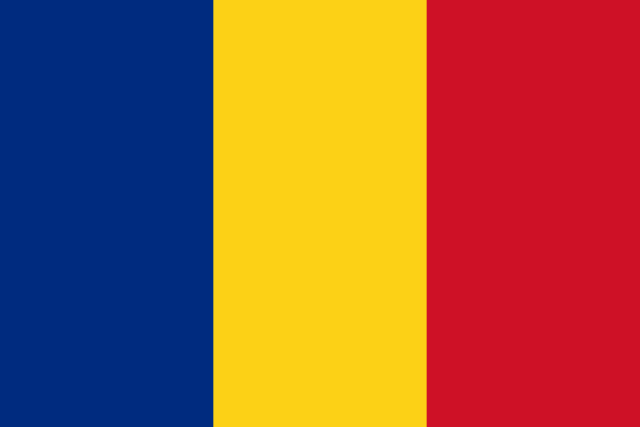
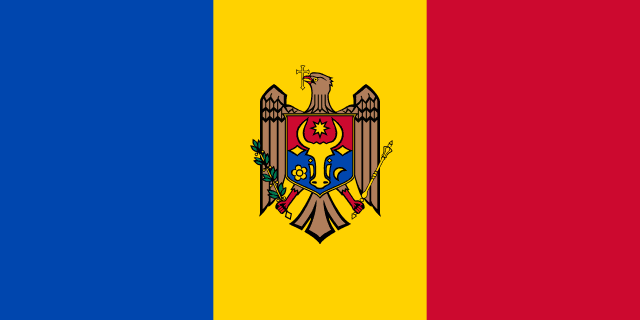
If two flags appear on a map with vertical blue, yellow and red stripes, first inspect the middle stripe. The ordinary Romanian national flag has a completely plain yellow field between the blue and red. Moldova’s national flag has its coat of arms in that same position. At ordinary viewing distance, the Moldovan emblem looks like an eagle holding a shield. At closer range, the details of the bird, shield and objects held by the bird become visible. The plain tricolor and the emblem-bearing tricolor identify two different sovereign states.
Both flags use vertical bands of equal width, arranged blue, yellow and red when viewed from the front with the pole on the left. Thus the order of colors does not resolve the comparison. Nor is it enough to decide that a particular shade of blue looks more Romanian or Moldovan. Even a faithful image can appear lighter or darker according to fabric, weather, photography and display calibration.
A second distinction is the shape of the rectangle. Romania’s standard national flag is shorter in relation to its height than Moldova’s. This is useful when selecting a correctly proportioned reference drawing or checking an educational diagram. In a photograph taken at an angle, it is far less useful. A visible coat of arms, correctly positioned in the yellow stripe, is the best first clue. If the middle of the flag is obscured, reserve judgment rather than guessing from the exposed outer colors.
| Feature | Romania | Moldova |
|---|---|---|
| Bands | Blue, yellow, red | Blue, yellow, red |
| Height:length | 2:3 | 1:2 |
| Center | Plain yellow | State arms |
| Best clue | Uninterrupted bands | Eagle and shield |
Compare the official proportions
Romanian Law No. 75 of 1994 specifies a height-to-length proportion of 2:3 and equal bands. Moldova’s diplomatic reference specifies 1:2, with the emblem width equal to one fifth of the overall length. These are proportions rather than fixed physical sizes. A flag made to the same design can be small enough for a desk or large enough for a ceremonial building without altering the relationship of the parts.
Consider a drawing exercise using a common height of six centimeters. Romania’s rectangle is nine centimeters long, and every stripe measures three centimeters across. Moldova’s rectangle is twelve centimeters long, giving each stripe a width of four centimeters. On that second drawing, the middle of the flag lies six centimeters from the left and three centimeters from the top. The reference width of the coat of arms is 2.4 centimeters. These numbers are mathematical consequences of the published ratios, not independent official tolerances.
Another way to compare them is to use a common length of thirty centimeters. The Romanian rectangle is twenty centimeters tall; the Moldovan rectangle is fifteen centimeters tall. In this exercise every stripe has the same ten-centimeter width in both drawings, but their heights differ substantially. It demonstrates why an icon library that forces every national flag into a uniform rectangle is not a suitable construction guide.
Never stretch the shorter image simply to make its outer corners line up with the longer one. Stretching can also distort the central heraldic device. Instead, place each image in an equally sized white container and let the picture retain its own proportions. This is the approach used in the visual comparison on this page. It allows a reader to compare the design rather than the sizing choices of the website.
What is on the Moldovan flag?
The Moldovan presidency describes a shield with a red upper section and blue lower section, carrying an aurochs’ head. An eight-pointed star sits between the horns. The larger heraldic design includes an eagle with the shield on its chest, a cross at its beak, and an olive branch and scepter in its claws. These elements belong to a single national coat of arms, not to a set of independent marks scattered across the flag.
The aurochs was a wild bovine, so describing the central shield simply as a picture of a modern domestic cow loses the heraldic context. For a young learner, the horned head is an accessible visual clue; for a reference drawing, the approved artwork supplies the required shapes and details. The emblem combines more colors and contours than the three rectangular background stripes.
In a tiny thumbnail, the outline of the eagle often survives better than the details on the shield. Enlarging a low-resolution picture may reveal that the middle stripe is decorated, but it cannot recover detail that the original image never contained. Download a larger reference picture when the shield itself is the object of study. Do not assume that pixelation around the bird represents an official alternate coat of arms.
Romania also has a national coat of arms. The fact that a country has an eagle emblem does not establish that its ordinary flag carries that emblem. Look at the two state symbols separately. A picture of Romanian arms superimposed on a tricolor by an illustrator should not be substituted for the official plain national flag. On the other hand, historical and institutional Romanian banners can carry devices, so an eagle in a picture does not alone settle the identity of an unknown historic object.
A careful caption distinguishes the background design from the specific emblem. For instance, describing the Moldovan flag as a blue-yellow-red tricolor with the Moldovan state arms explains both what it shares with Romania and what identifies it independently.
How the shared tricolor and separate flags developed
The two countries have intertwined cultural and historical connections, but their national symbols must be understood in the context of each state’s own institutions. The modern Romanian Constitution identifies its national colors in Article 12. The National Museum of History of Moldova documents the movement to restore the tricolor in the late Soviet period, including the demands expressed at the Great National Assembly in August 1989.
The museum dates Moldova’s adoption of the tricolor to April 27, 1990. That date precedes the country’s declaration of independence in August 1991. A reader encountering both dates should therefore distinguish adoption of the national symbol from the establishment of the independent republic. They answer two different historical questions. The museum also records the later decision to commemorate April 27 as State Flag Day.
Romania’s recent flag history includes an especially recognizable episode in December 1989. The Romanian Cultural Institute describes a surviving revolutionary flag from which the previous state emblem was cut. Photographs of that period may show an opening through the center of the yellow band. Such a photograph is not an illustration of the modern flag’s official geometry. The opening represents an action taken during a specific historical event, not a deliberate hole required by a present-day national design.
It is tempting to simplify the histories into a story of one flag merely being copied from the other. That explanation overlooks the different roles played by historical color traditions, political transitions, state symbolism and the choice of an emblem. The resemblance is real, but resemblance alone cannot establish a precise chain of design decisions. A museum caption, original law or dated photograph is better evidence than a visual inference.
The present flags can be displayed together to represent two distinct countries. Their shared colors do not mean that the countries have a common government, or that a tricolor can be used interchangeably to identify either delegation. When a map, event or history lesson involves both, use the proper national name and design for each.
Recognize both flags in photographs
On a still image of a full flag, start with the entire yellow stripe. A clear Moldovan emblem centered within it identifies the ordinary Moldovan national design. If the stripe is uninterrupted and the picture otherwise matches the Romanian tricolor, Romania is a plausible answer. This second observation becomes less conclusive when the image belongs to an unlabelled historical collection or when other similar national flags could be present.
A flag may fold along one of its vertical color boundaries. The fabric can then conceal the very part you need to inspect. An exposed blue stripe and a portion of red do not provide a reliable country identification. Wait until more of the flag becomes visible, or consult an independent label. If a flag hangs down from a pole and the fabric overlaps, do not mistake a fold across the center for a dark emblem.
Flags in sports broadcasting are commonly reduced to small screen icons. An eagle rendered at a few pixels across may appear as a brown or black spot. That spot can be useful as a prompt to look for Moldova’s name, but it should not be used to reconstruct the heraldic details. A country code such as ROU or MDA can be more dependable when it is displayed next to a heavily cropped graphic. Different sporting organizations may use different abbreviation schemes, so read the event’s own legend.
In a museum photograph, the date and description of an object carry special importance. A Romanian tricolor with a cut-out central emblem, a later plain flag, and a commemorative object are not the same evidence. Likewise, a Moldovan flag photographed during the transition to independence may need its own precise date. A photograph of a national-symbol display at an embassy normally answers a different question from a surviving protest banner.
For a school project, label each photograph with its source, date if known, and the type of flag illustrated. This simple record makes it possible to return to the original picture when a classmate asks why a historical image differs from the current reference design.
Distinguish the tricolors from Chad and Andorra
The flag of Chad is a particularly important additional comparison because it also uses blue, yellow and red in vertical bands without a central emblem. Therefore, the absence of an emblem can distinguish a complete ordinary Romanian flag from Moldova’s but does not uniquely identify Romania among all countries. The separate Romania versus Chad comparison on this website explains why their designs are so difficult to separate using a small screen image.
Andorra likewise uses the blue-yellow-red sequence with a central coat of arms. If you see an unknown complete tricolor with a shield, do not automatically select Moldova. Examine the actual device. Andorra’s arms use a quartered shield, while Moldova’s national arms have the recognizable eagle and horned head. These shapes remain informative even when the details are too small for you to read a motto or distinguish the precise colors of individual compartments.
Other flags contain an eagle or a shield without sharing this vertical stripe pattern. Instead of memorizing a separate trick for every possible pair, create a decision sequence. First determine orientation of the bands. Then identify the complete order of the colors. Next determine whether a device is present and whether it is a geometric mark, lettering or heraldic arms. Finally use context and proportions where appropriate.
This method makes a useful sorting exercise. A learner can put all plain vertical blue-yellow-red references in one group, emblem-bearing versions in a second, and flags with a different color order in a third. Within each group, a second round of inspection can identify specific countries. The groups are a study aid, not an official classification of political or historical relationships.
A practical flag drawing and identification exercise
Make two reference cards using the common-height construction described above. Keep the rectangular backgrounds uncolored at first. Label the hoist side, mark the three equal divisions and identify the exact center of the middle field. On the Romanian card, leave the entire central field unobstructed. On the Moldovan card, mark a temporary rectangle representing the width of the state arms, then refer to the official emblem image to place the artwork accurately.
If the task is simply to learn recognition, a clearly labeled temporary silhouette can stand in for the coat of arms during the planning stage. Do not submit the silhouette as a finished official reproduction. Remove construction guidelines and temporary outlines before presenting a finished drawing. A teacher may find it more effective to provide a correctly sourced emblem image separately than to expect a beginner to reproduce complicated heraldry from memory.
Now ask a partner to describe the differences without naming either country. A satisfactory description should mention that both use the same stripe orientation and color order, but only one of the ordinary national designs contains the Moldovan arms. It should also recognize that the official ratios are different. A learner who answers only that one blue looks darker has missed the most reliable visual distinction.
For a second exercise, cover the center of both cards. Ask the partner to identify the flags again. This time explain why there may not be enough visible information for a confident answer. Uncover the middle and repeat the exercise with a smaller copy. If the learner can still identify the emblem at reduced size, the central design has become a useful recognition cue.
Finally, introduce references of Chad and Andorra. Ask the learner to explain why the original two-country rule is insufficient for the four-country task. This exercise encourages careful observation and qualified answers instead of relying on a memorized association between a single color and one country’s name. The same approach works with many of the flag comparisons in the directory.
Frequently asked questions
Are Romania and Moldova’s flags identical? No. Their basic stripe order is the same, but the ordinary Moldovan flag contains a national coat of arms and uses a different rectangle proportion. A complete ordinary Romanian flag is plain. Compare the central field before attempting to use shade differences.
Why is the Moldovan flag longer? The two countries specify different ratios. Moldova’s is twice as long as it is high, while Romania’s length is one and a half times its height. This is a description of official geometry, not a claim that every flag sold or photographed follows the ideal proportions.
Does a Moldovan tricolor without the eagle still identify Moldova? Historical objects and unofficial renderings must be identified with their own context. For the current ordinary national flag, the emblem is part of the official design. Leaving it out produces an incomplete reference drawing. Do not label an unverified plain tricolor as Moldova based on a guess.
When did Moldova adopt its tricolor? April 27, 1990 is the adoption date recorded by the National Museum of History of Moldova. The date is distinct from the declaration of independence in 1991.
Which flag appeared with a hole during the 1989 revolution? Romanian revolutionary flags sometimes had the previous emblem removed from their center. This is historical evidence, not a characteristic of the current ordinary Romanian national flag.
Can these images be used to manufacture official flags? Treat the reference images as educational illustrations. For manufacturing, consult official color and construction references, the applicable law and rules concerning national emblems. An image supplier’s copyright statement does not eliminate separate national-symbol regulations.
Sources and artwork
- Romanian Chamber of Deputies – Constitution, Article 12
- Romania Law 75/1994, reproduced legislative text
- Moldovan Embassy in the USA – flag proportions and state symbols
- Moldovan Presidency – state symbols
- National Museum of History of Moldova – adoption history
- Romanian Cultural Institute – 1989 revolutionary flag
- Flagpedia / FlagCDN – artwork terms
Flagpedia identifies its flag images as public domain; national-symbol rules remain separate from copyright. Illustrations are educational references.