Languedoc Flag: Golden Occitan Cross on Red & History
Discover Languedoc’s historical banner, heraldic symbols, distinctive colours and how the old province relates to today’s French administrative regions.
Current status: Historical cultural region in southern France, now distributed across the Occitanie administrative region and adjacent historical areas. Languedoc refers to a broad historical area of southern France associated with Toulouse, Montpellier, Nîmes and the lower Rhône and western Mediterranean. Its exact borders varied in different historical periods. The article focuses on this distinct traditional emblem, rather than relabelling a modern French regional council’s logo.
Languedoc flag at a glance
| Historic area | Languedoc, France |
|---|---|
| Flag classification | Traditional / historical province or cultural flag |
| Key places | Toulouse; Montpellier |
| Origins | Medieval Counts of Toulouse, Occitan cross tradition |
| Main design | It is the same closely related heraldic cross of Toulouse, widely used as a symbol across Occitan-speaking southern France. |
| Modern administration | Historical cultural region in southern France, now distributed across the Occitanie administrative region and adjacent historical areas |
What does the traditional flag look like?
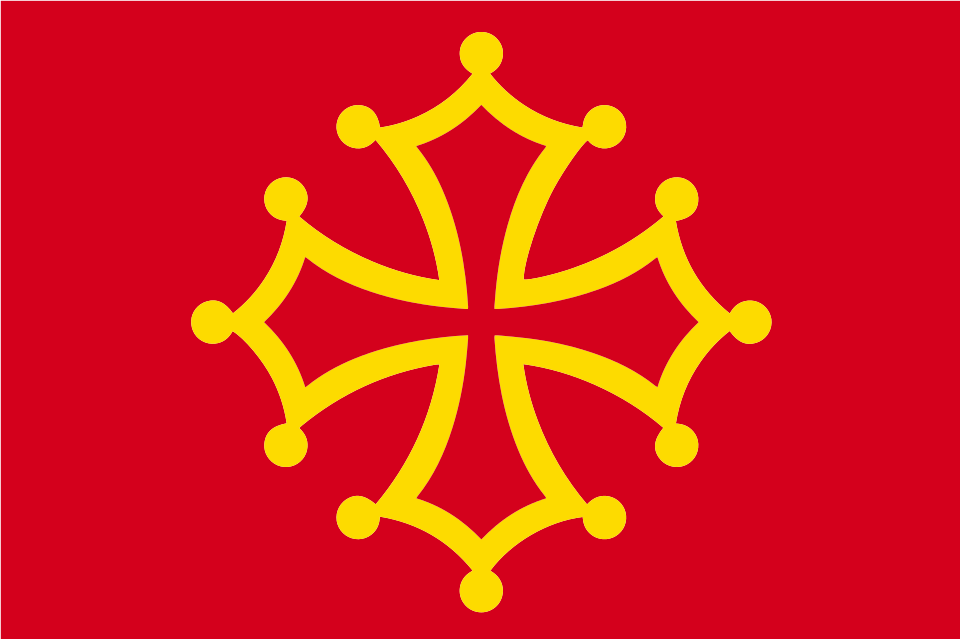
The Languedoc banner is a vivid red field carrying a large golden Occitan or Toulouse cross. The heraldic cross has equal arms and rounded openings or circles at its ends, creating a characteristic twelve-circle silhouette in traditional versions.
The exact pattern shown on the illustration should be named, since many historical French areas have more than one provincial arms banner or later cultural flag.
What do the symbols mean?
The cross is often called the Cross of Toulouse or Occitan cross and is linked to the medieval Counts of Toulouse and southern French Occitan-speaking communities. It is a regional heraldic symbol, not an ordinary straight white Christian cross.
The name ‘Languedoc’ comes from the phrase langue d’oc, referring to Occitan language traditions. The emblem predates the present Occitanie administrative region by centuries.
Meaning of the colours
Gold-yellow and red are the banner’s two main colours. This differs from the red and yellow bars used by historic Provence, even though the areas are geographically close and share wider Mediterranean histories.
Heraldic colours identify families, territories and political traditions. Not every conventional colour can be reliably translated into a modern value or environmental association.
History of this regional emblem
The cross developed in the arms and seals of medieval lords of Toulouse. The historical province of Languedoc later became a major province of the French monarchy. Today the Occitanie regional administration covers territories beyond historic Languedoc and uses its own political and corporate identity designs.
The age of an old coat of arms and the much later administrative reforms that reshaped French regions are separate historical questions.
Where is the historical area?
Languedoc refers to a broad historical area of southern France associated with Toulouse, Montpellier, Nîmes and the lower Rhône and western Mediterranean. Its exact borders varied in different historical periods.
French historical provinces have never had perfectly fixed modern boundaries. A name on a heritage flag does not automatically name today’s elected regional council.
Traditional flag vs current French region
Historical cultural region in southern France, now distributed across the Occitanie administrative region and adjacent historical areas
This featured banner is explained as a historical or cultural design. Current regional administrations may use other flags, official logos, coats of arms and civic branding.
Similar French flags compared
The Occitan flag often uses a related gold cross on red, sometimes with an added seven-pointed star in cultural movement variants. A flag with only the red field and gold cross can be a traditional Languedoc/Toulouse heritage design; it should not automatically be called the official modern Occitanie logo flag.
For identifying a historical French flag, look closely at the placement of lilies, the shape of any red border, the number of animals or castles, and whether the background is quartered.
How to reproduce the illustrated flag
The Languedoc banner is a vivid red field carrying a large golden Occitan or Toulouse cross. The heraldic cross has equal arms and rounded openings or circles at its ends, creating a characteristic twelve-circle silhouette in traditional versions.
Download the original vector artwork from Wikimedia Commons if precise curves, medieval charges or heraldic border details are important. Do not substitute an unsourced illustration of a different historical variant.
Frequently asked questions
Is the Languedoc cross the same as the Occitan cross?
It is the same closely related heraldic cross of Toulouse, widely used as a symbol across Occitan-speaking southern France.
Is this currently an official French region flag?
Historical cultural region in southern France, now distributed across the Occitanie administrative region and adjacent historical areas The artwork above is a historical or traditional design.
Which city helps locate the historic region?
Toulouse; Montpellier.
What is the origin of the emblem?
Medieval Counts of Toulouse, Occitan cross tradition.
Is this France’s national flag?
No. France uses the blue-white-red vertical tricolour as the national flag. This is a local heritage design.
Is the image freely reusable?
Check the linked Commons file for the specific artist’s licence, any required credit and separate restrictions governing official symbols.
Sources and image credit
Languedoc traditional flag: historic and heraldic sources
French territorial flag index — historical and current designs
Traditional flags versus flags and logos of modern French regions
Wikimedia Commons image: Flag of Languedoc.svg. Scaled SVG-to-PNG rendering. Verify creator, licence and any attribution requirements from the original file before reusing the image.
French national flag — blue, white and red explained.
Independent educational guide. It does not claim to be an official publication of a regional council. Reviewed 20 November 2026.