Mercia Flag: Golden Saltire on Blue & Cross of St Alban
Understand Mercia’s golden diagonal cross on navy blue, its connection with St Alban, King Offa, John Speed’s maps and Tamworth Castle.
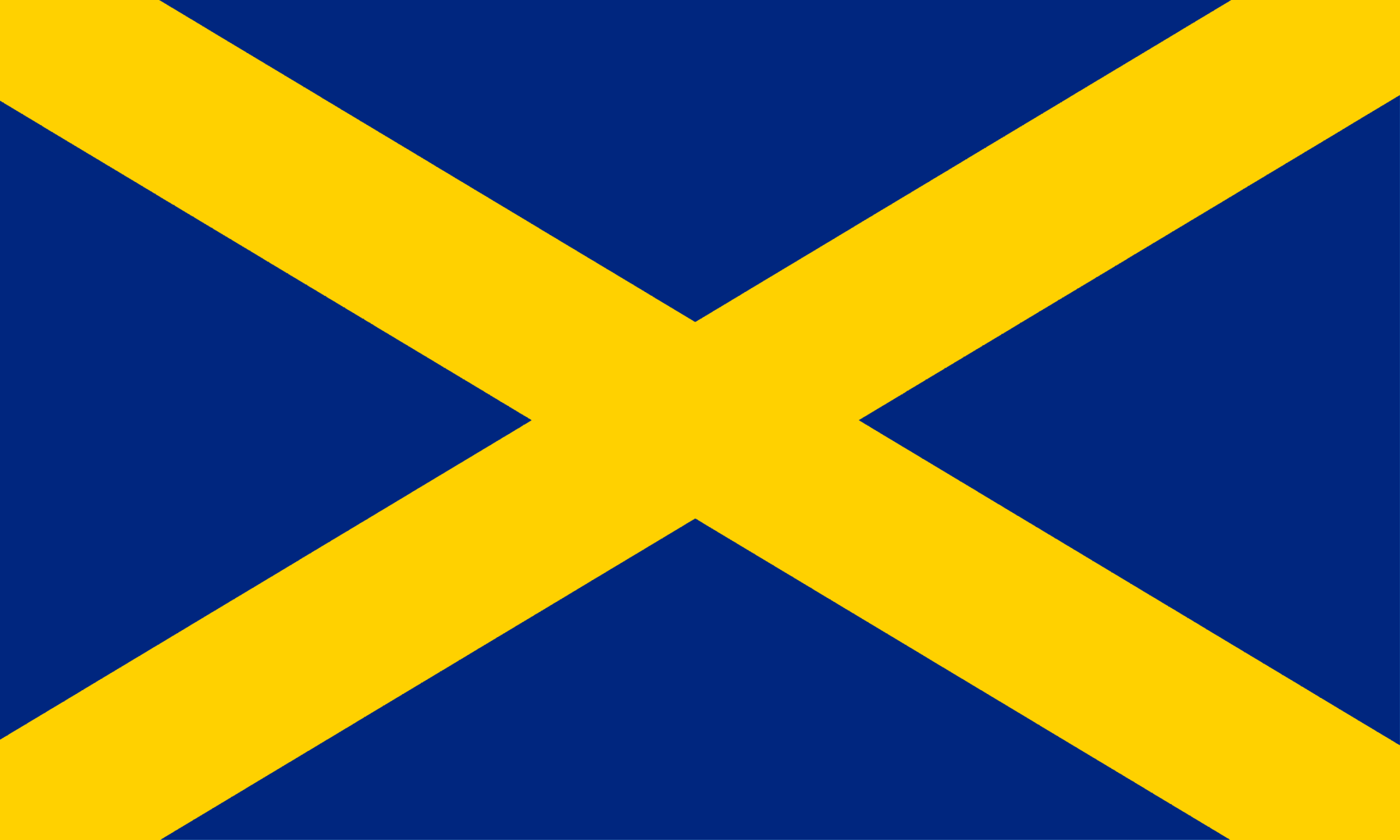
Understand Mercia’s golden diagonal cross on navy blue, its connection with St Alban, King Offa, John Speed’s maps and Tamworth Castle. The history and registered design were checked against the UK Flag Registry.
Mercia flag at a glance
| Region | Historic Mercia, English Midlands |
|---|---|
| Design | Golden saltire on dark blue |
| Cross name | Cross of St Alban in regional heraldry |
| Colour reference | Blue 280, yellow 109 |
| Historical ruler | Offa of Mercia (757–796) |
| Documented regional use | John Speed’s seventeenth-century maps |
| Present landmark | Tamworth Castle |
| Ratio | 3:5 |
Appearance
A wide yellow or golden diagonal cross spans a dark-blue background, forming the shape of an X. No other charges, shields, lettering or borders appear in the registered regional design.
The strong navy-and-gold combination makes it distinct from Scotland’s white saltire on medium blue or England’s upright red cross on white.
The gold saltire
This saltire is linked with St Alban, traditionally regarded as Britain’s first Christian martyr. Its heraldic form was subsequently associated with Mercia.
The Cross of St Alban also appears in local St Albans heraldry, although that version commonly uses a lighter blue than the registered Mercian flag.
King Offa’s association
Offa, a powerful eighth-century ruler of Mercia, supported religious institutions associated with St Alban. Later writers related the saltire’s identity to that royal connection.
The Flag Institute treats the early-medieval link as tradition, not definitive proof that a modern standardized gold-on-blue flag was flown by Offa himself.
Historical records
John Speed’s early-seventeenth-century maps depict Mercia using the golden saltire. This provides a concrete early-modern visual reference for the regional emblem.
The earlier documented use of the cross within St Albans is more difficult to establish, and interpretations of its origin should be described with due caution.
Tamworth Castle
Tamworth was an important Mercian royal centre, and Tamworth Castle continues to fly the regional flag. It is a distinctive site connecting modern flag display with early English heritage.
The display does not make Tamworth the capital of a present-day separate state; the flag is a cultural and historical emblem.
Where was Mercia?
Mercia was one of the principal Anglo-Saxon kingdoms and at times extended across much of the English Midlands. Its political reach changed over several centuries.
The name continued to describe people from middle England after the medieval kingdom disappeared as an independent power.
Why dark blue?
The Flag Institute specifies Pantone Blue 280, darker than the St Albans version, with yellow 109 for the cross.
This colour distinction helps flag collectors avoid assuming any yellow X on a pale-blue field must be Mercia.
Mercia vs other Anglo-Saxon flags
East Anglia uses a red cross on white with a blue shield containing three golden crowns. Wessex uses a golden wyvern on red, while Northumbria uses gold and deep-red bars.
Mercia is unique among those regional emblems for its entirely geometric gold diagonal cross on navy blue.
Drawing instructions
Fill a 3:5 rectangle dark blue, then draw a broad yellow saltire from all four corners to the centre, keeping the diagonal arms symmetric.
Do not add a shield or crown. The most useful quiz clue is a golden X on navy blue.
Frequently asked questions
What appears on Mercia’s flag?
A golden diagonal saltire.
Which saint is associated with it?
St Alban.
What is the field colour?
Dark blue.
Which king is linked to the history?
Offa of Mercia.
When was the regional emblem documented?
In John Speed’s early-seventeenth-century maps.
Where is it flown today?
Tamworth Castle.
Is Mercia an independent kingdom now?
No.
How is it different from Scotland’s flag?
Scotland has a white, not golden, saltire.
Sources and image credits
Registered flag image sourced from the Flag Institute’s downloadable reusable artwork. Reproduction for independent educational reference; not endorsed by the Flag Institute. Verified 20 November 2026.