North Riding Flag: Blue Cross, Gold Border & Yorkshire Rose
Why does the North Riding of Yorkshire flag have a gold-edged blue cross and white rose on green? Learn the North York Moors, St Wilfrid and 2013 vote.
Why does the North Riding of Yorkshire flag have a gold-edged blue cross and white rose on green? Learn the North York Moors, St Wilfrid and 2013 vote. This guide identifies the precise flag pattern and distinguishes documented contemporary symbols from older legend or heraldic tradition.
The principal reference is the Flag Institute UK Flag Registry, which records the design, proportions and historical description. Public flag registration and governmental national-flag recognition are different categories.
North Riding of Yorkshire flag at a glance
| Feature | Details |
|---|---|
| Historic region | North Riding of Yorkshire, England |
| Flag category | Regional riding community flag |
| Adoption | 4 May 2013 |
| Designer | Jason Saber |
| Field | Green |
| Main geometry | Blue upright cross outlined gold |
| Centre | White Yorkshire rose |
| Heritage | North Riding Council arms and St Wilfrid tradition |
| Registry code | UNKG7434 |
| Ratio | 3:5 |
The regional or island designation used here follows the UK Flag Registry’s own categorization. The flag can be recognized and displayed as a community symbol without changing the region’s constitutional status.
appearance
What does the North Riding flag look like?
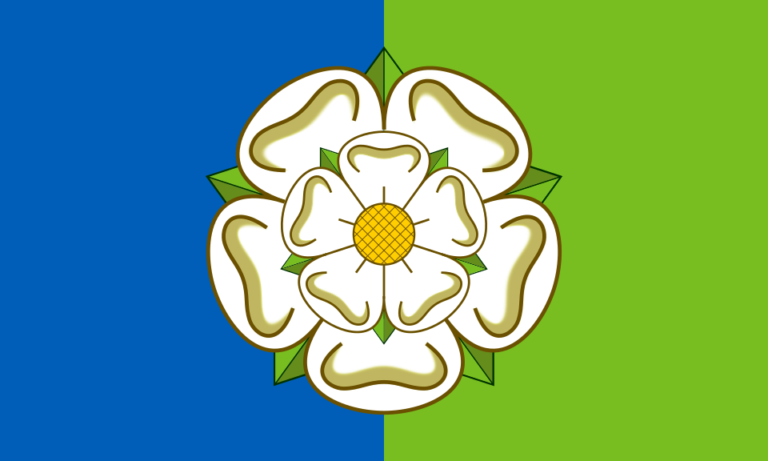
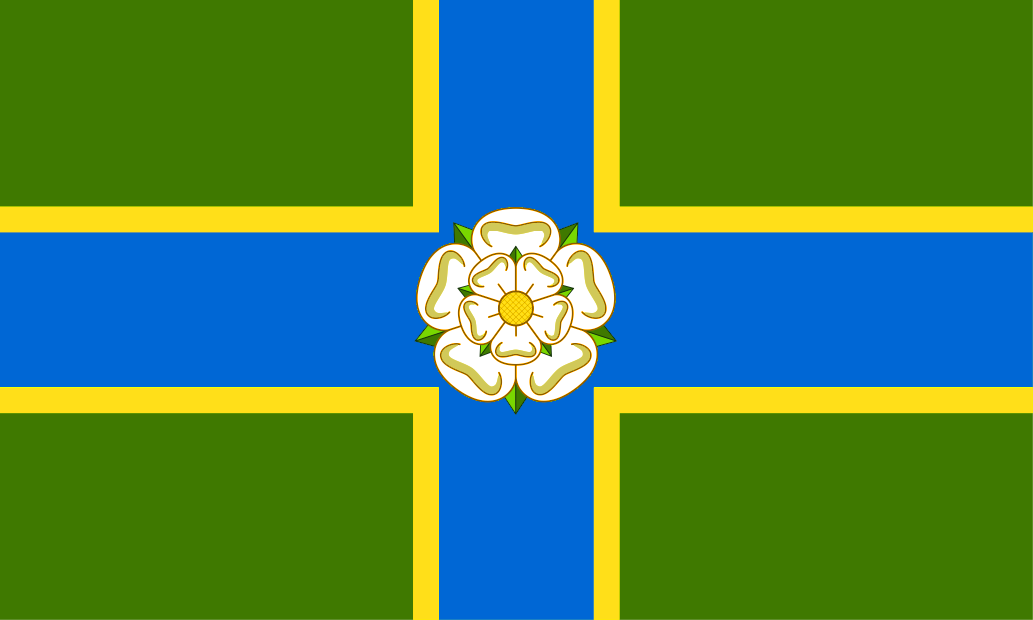
The field is green with a broad blue upright cross outlined in gold. A large white Yorkshire rose lies at the cross’s centre.
cross
Why is the cross blue and outlined gold?
The colour arrangement recalls the arms borne by the former North Riding Council between 1928 and 1974, and older attributed arms of St Wilfrid with gold stars on blue.
green
What does the green background symbolize?
The Flag Institute links green to the open landscape of the North York Moors, an important natural feature of the historic riding.
rose
Why is there a Yorkshire white rose?
The white rose shows that the North Riding is part of historic Yorkshire. The same emblem featured in the former North Riding Council’s arms.
wilfrid
Who was St Wilfrid?
St Wilfrid was an early medieval church figure important to northern English history. The flag’s cross and colours partly echo arms later attributed to him.
2013
How was the North Riding flag chosen?
A competition was announced by the Teesdale Mercury in January 2013, followed by judging and a public vote on six shortlisted entries.
riding
What is a historic riding of Yorkshire?
Yorkshire traditionally had North, East and West Ridings, regional divisions with identities predating modern local-government boundaries.
comparison
North Riding vs West and East Riding flags
West Riding uses a red offset cross on white with the rose in a golden sun; East Riding places a white rose over blue and green vertical fields.
drawing
How to draw the North Riding flag
Fill a green field, add a thick yellow upright cross, overlay a slightly narrower blue upright cross and centre a white Yorkshire rose.
Frequently asked questions
When was North Riding’s flag adopted?
4 May 2013.
Who designed it?
Jason Saber.
What does the green represent?
The North York Moors and countryside.
Why is the blue cross edged gold?
It recalls council heraldry and references local rivers and coastline.
What is the flower in the centre?
The white Yorkshire rose.
Is this identical to Yorkshire’s main flag?
No, the county-wide flag is white rose on plain blue.
How is it different from West Riding?
West Riding has a red offset cross and golden sun around the rose.
Is North Riding a country?
No, it is a historic regional division of Yorkshire.
References and image credits
Flag Institute — North Riding of Yorkshire flag, UK Flag Registry
Featured flag artworkRegistered PNG artwork reproduced from the same Flag Institute flag page. The Registry states its illustrations are free to download and reuse. Used for educational flag identification, without any implied governmental endorsement.
Factual review dated November 2026. Historical and symbolic claims are attributed to the Registry and, where relevant, labelled as tradition.