Kirkcudbrightshire Flag: Green-White Quarters & St Cuthbert
Why is Kirkcudbrightshire’s flag green and white with a counterchanged St Cuthbert’s Cross? Discover its stewardry, tax-counting cloth and 2016 grant.
Why is Kirkcudbrightshire’s flag green and white with a counterchanged St Cuthbert’s Cross? Discover its stewardry, tax-counting cloth and 2016 grant. This guide identifies the precise flag pattern and distinguishes documented contemporary symbols from older legend or heraldic tradition.
The principal reference is the Flag Institute UK Flag Registry, which records the design, proportions and historical description. Public flag registration and governmental national-flag recognition are different categories.
Kirkcudbrightshire flag at a glance
| Feature | Details |
|---|---|
| Historic county | Kirkcudbrightshire / Stewartry of Kirkcudbright, Scotland |
| Adoption | 11 June 2016 |
| Designer | Philip Tibbetts |
| Main field | Green and white quarters |
| Centre | Counterchanged St Cuthbert’s Cross |
| Historical title | Stewartry of Kirkcudbright |
| Reference | Stewards of the Lords of Galloway |
| Certification | Lord Lyon King of Arms |
| Registry code | UNKG7454 |
The regional or island designation used here follows the UK Flag Registry’s own categorization. The flag can be recognized and displayed as a community symbol without changing the region’s constitutional status.
appearance
What does the Kirkcudbrightshire flag look like?
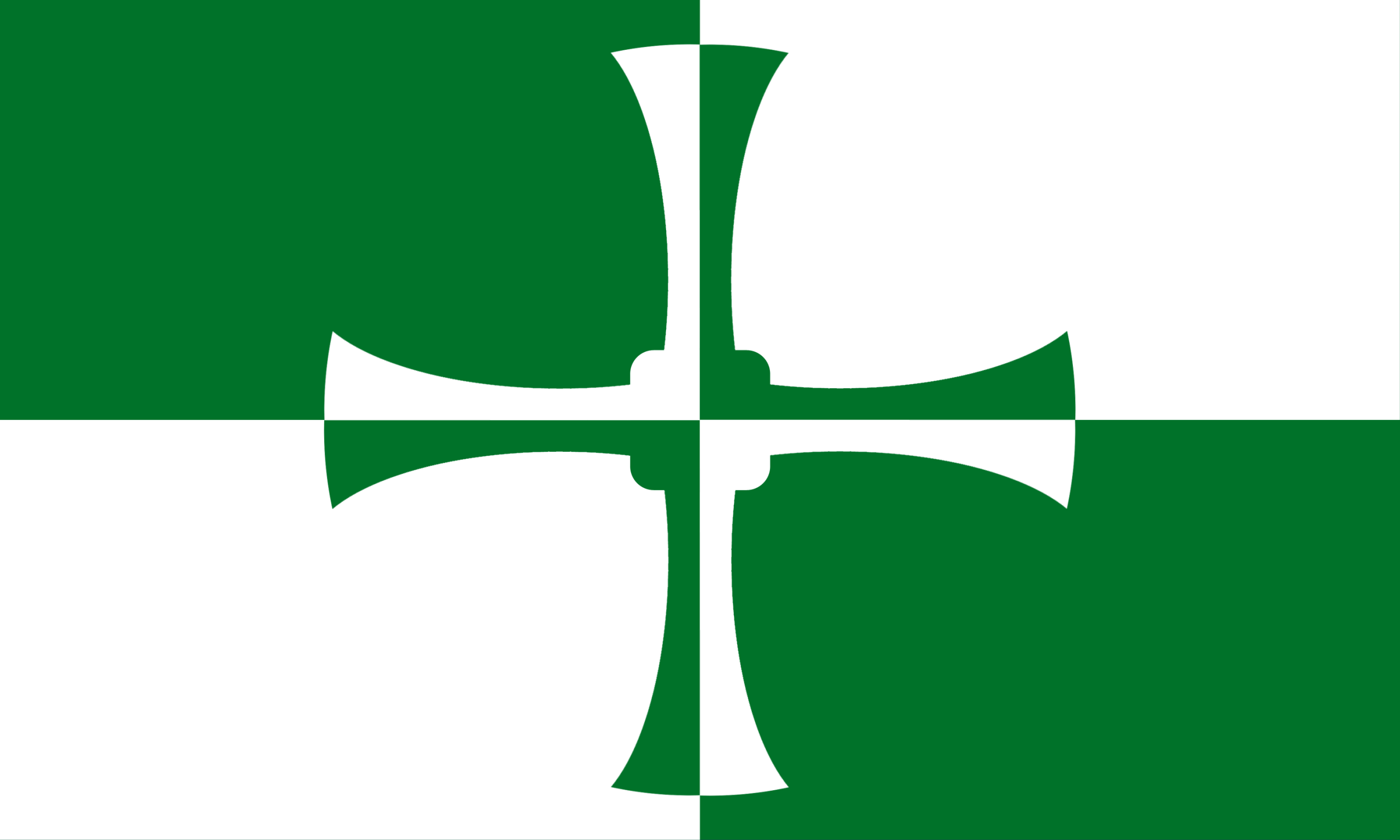
The field is divided into green and white quarters in a chequer-like arrangement. A broad St Cuthbert’s Cross spans the centre, with its green and white colours reversed against the background.
cross
Why is St Cuthbert’s Cross used here?
The place-name Kirkcudbright is rooted in the Gaelic Cille Chuithbeirt, commonly interpreted as the church or chapel of Cuthbert.
quartered
What do the green and white quarters represent?
The Flag Institute links the pattern to checked cloth used by stewards to count taxes, recalling the region’s administrative and economic history.
stewartry
Why is Kirkcudbrightshire called the Stewartry?
Kirkcudbrightshire is also called the Stewartry of Kirkcudbright, a title connected with stewards serving the Lords of Galloway.
cuthbert
Who was St Cuthbert?
St Cuthbert was a seventh-century Christian saint important to northern Britain. His relics were moved over time, passing through communities before reaching Durham Cathedral.
2016
When was the flag adopted?
The Flag Institute lists 11 June 2016 and credits designer Philip Tibbetts. The flag received a Letter Patent from the Lord Lyon King of Arms.
local
Where is historic Kirkcudbrightshire?
Kirkcudbrightshire is in southwest Scotland, historically associated with Galloway. Its settlements and countryside now fall within modern local-government arrangements such as Dumfries and Galloway.
comparison
Kirkcudbrightshire vs County Durham and Sutherland
County Durham’s St Cuthbert Cross is yellow-blue. Sutherland has a black saltire and Nordic cross with a yellow star on white.
drawing
How to draw Kirkcudbrightshire’s flag
Create four green-white alternating quarters. Place a centrally positioned St Cuthbert cross over them, reversing the colours in each quadrant so green is on white and white is on green.
Frequently asked questions
When was Kirkcudbrightshire’s flag adopted?
11 June 2016.
Who designed it?
Philip Tibbetts.
Why is there a St Cuthbert’s Cross?
The town and county name connects to St Cuthbert’s chapel and local history.
What do the green-white quarters mean?
They recall tax-counting cloth used by the historic stewards.
What is another name for the county?
The Stewartry of Kirkcudbright.
Is its flag the same as County Durham’s?
No; County Durham uses blue and yellow.
What does counterchanged mean?
The cross colours reverse against the field below.
Is it a separate nation?
No, it is a historic Scottish county.
References and image credits
Flag Institute — Kirkcudbrightshire flag, UK Flag Registry
Featured flag artworkRegistered PNG artwork reproduced from the same Flag Institute flag page. The Registry states its illustrations are free to download and reuse. Used for educational flag identification, without any implied governmental endorsement.
Factual review dated November 2026. Historical and symbolic claims are attributed to the Registry and, where relevant, labelled as tradition.