Huntingdonshire Flag: Golden Hunting Horn, Green & History
What does Huntingdonshire’s golden ribboned horn represent? Explore the 1937 county council crest, 2009 public flag recognition and the difference from nearby counties.
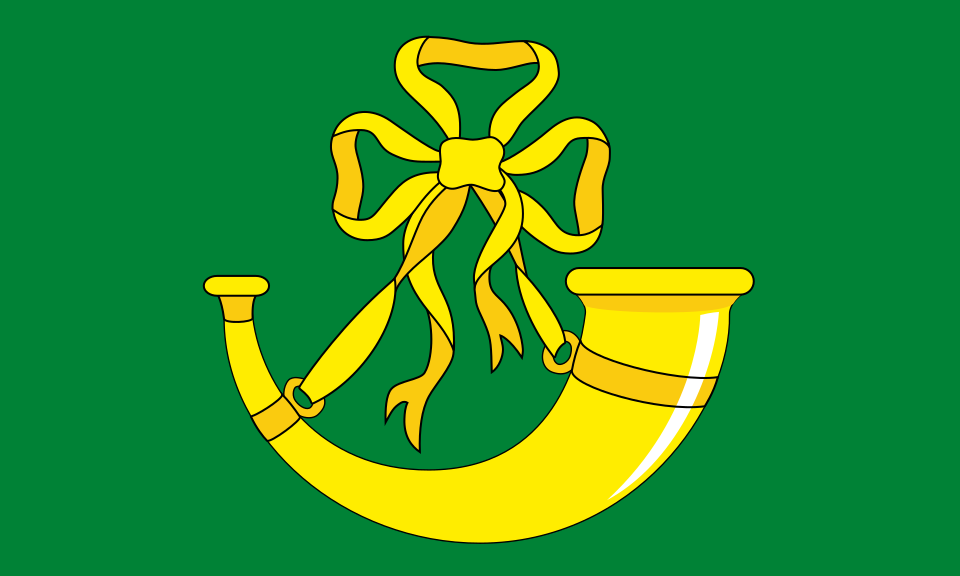
Huntingdonshire has a distinctive flag whose details are often lost in small icons or confused with neighbouring county designs. The flag has a rich green field with a single large golden hunting horn, curved into a broad U-like shape and decorated with a flowing golden ribbon. This guide explains the main motifs, supported historical milestones and its place in the UK Flag Registry.
Huntingdonshire flag at a glance
| Feature | Details |
|---|---|
| Place | Historic Huntingdonshire, eastern England |
| Flag type | Registered historic county community flag |
| Flag date | 25 June 2009 |
| Organizer / designer | Huntingdonshire Society |
| Field | Green |
| Central device | Golden hunting horn with ribbon |
| Earlier emblem | County council crest, 1937 |
| Other historical use | Huntingdon and Godmanchester civic arms |
| Ratio | 3:5 |
Historic county identities, modern geographic regions and local-government authorities are different things. The dated flag reference below distinguishes inherited heraldic designs from modern public flag registrations.
What does Huntingdonshire’s flag look like?
The flag has a rich green field with a single large golden hunting horn, curved into a broad U-like shape and decorated with a flowing golden ribbon.
The horn is a traditional instrument, not a horseshoe or a drinking vessel. Its tied ribbon and mouthpiece give the emblem an easily recognizable silhouette.
Why does Huntingdonshire use a hunting horn?
A hunting horn is an established emblem in the area’s civic heraldry. The registered flag draws it from the former Huntingdonshire County Council crest, where a rampant lion held the horn.
The name ‘Huntingdonshire’ makes the horn a memorable local symbol, but the Flag Institute emphasizes actual heraldic use rather than simply a modern pun invented for the flag competition.
What is the ribbon around the horn?
The gold ribbon is part of the heraldic depiction of a beribboned horn, distinguishing it from a plain semicircular brass instrument.
Its curves and loose tails are included in the registered flag image. Simplifying it into a gold horseshoe can cause confusion with the green-and-gold county flag of Rutland.
Why is the background green?
The green field provides contrast for the golden emblem and fits a historic county with rural and market-town associations.
The Flag Institute gives Green 355 as its colour reference; it does not assign different county districts or forests to invisible stripes, because the flag has none.
Where did the design originate in 1937?
Huntingdonshire County Council was granted arms in 1937, with a lion holding the beribboned hunting horn in its crest.
The 2009 public flag takes the horn alone, omitting the heraldic lion. The flag is therefore simpler than the full arms and easier to identify at distance.
What other local heraldry uses a horn?
Hunting horns appear in historic civic arms, including those used by Huntingdon and Godmanchester. They were associated with traditional regional identity before the modern community flag was registered.
That continuity explains why the Huntingdonshire Society selected a familiar heraldic motif rather than an entirely new logo or a map outline.
When did Huntingdonshire gain its registered county flag?
The Flag Institute lists 25 June 2009 and names the Huntingdonshire Society as the design organization.
The modern county-flag date differs from the earlier 1937 crest. The distinction is useful because the county’s administrative status also changed during twentieth-century local-government reorganizations.
Huntingdonshire vs Rutland and Cambridgeshire
Rutland has an inverted golden horseshoe surrounded by thirteen acorns on green. Cambridgeshire shows three gold crowns and light-blue waves on royal blue.
Huntingdonshire’s identifying device is a single ribboned golden horn on green. It has no acorns, crown or river waves.
How to draw and identify the Huntingdonshire flag
Fill a 3:5 rectangle green and draw one gold hunting horn with a curved body, distinct mouthpiece and decorative ribbon knot above.
For accuracy, use the cited vector. The best quiz clue is ‘gold ribboned hunting horn on green’, not merely ‘yellow horseshoe’.
Frequently asked questions
What object appears on Huntingdonshire’s flag?
A golden hunting horn decorated with a ribbon.
Why was the horn chosen?
It comes from the county’s established civic heraldry and 1937 council crest.
When was the modern flag adopted?
25 June 2009.
Who is credited with its design?
The Huntingdonshire Society.
What is the field colour?
Green.
Is the gold shape a horseshoe?
No; it is a ribboned horn with a mouthpiece.
How is it different from Rutland’s flag?
Rutland has a horseshoe with thirteen acorns; Huntingdonshire has only a hunting horn.
Is Huntingdonshire a separate country?
No, it is a historic county identity within England.
Official references and illustration credits
Flag Institute — Huntingdonshire county flag
Image rights and attributionFlag illustration: Wikimedia Commons — Huntingdonshire flag. The displayed PNG is a raster conversion of the Commons SVG. See the linked source for artist, copyright licence and applicable attribution/share-alike terms; official insignia may be subject to additional restrictions.
Independent educational guide. Research checked November 2026; no endorsement by the Flag Institute or local authorities is implied.