Sint Eustatius Flag: The Quill Mountain, Star & 2004 History
The Sint Eustatius flag shows an island mountain silhouette and gold star inside a white diamond on blue. Explore its unusual geometry, Statia Day and history.
Sint Eustatius, often called Statia, is an island of the Caribbean Netherlands. Its local flag is particularly recognizable among Dutch Caribbean designs because the central symbol is a miniature landscape rather than just a star or abstract diagonal stripe.
An official Sint Eustatius island ordinance establishes the design, and the flag-history record documents the July decision and November first raising. A newer 2020 flag ordinance governs display of the flag in the public body.
Sint Eustatius flag at a glance
| Feature | Details |
|---|---|
| Region | Sint Eustatius (Statia), Caribbean Netherlands |
| Political status | Public body of the Netherlands |
| Administrative centre | Oranjestad |
| Decision date | 29 July 2004 |
| First raised | 16 November 2004 |
| Flag ratio | 2:3 |
| Colours | Blue, red, white, green and yellow |
| Central scene | The Quill and island hills beneath a five-pointed golden star |
The flag’s historic adoption, its role in local identity and the territory’s constitutional status are distinct questions. Refer to the dated primary sources below where precise legal status matters.
What does the Sint Eustatius flag look like?
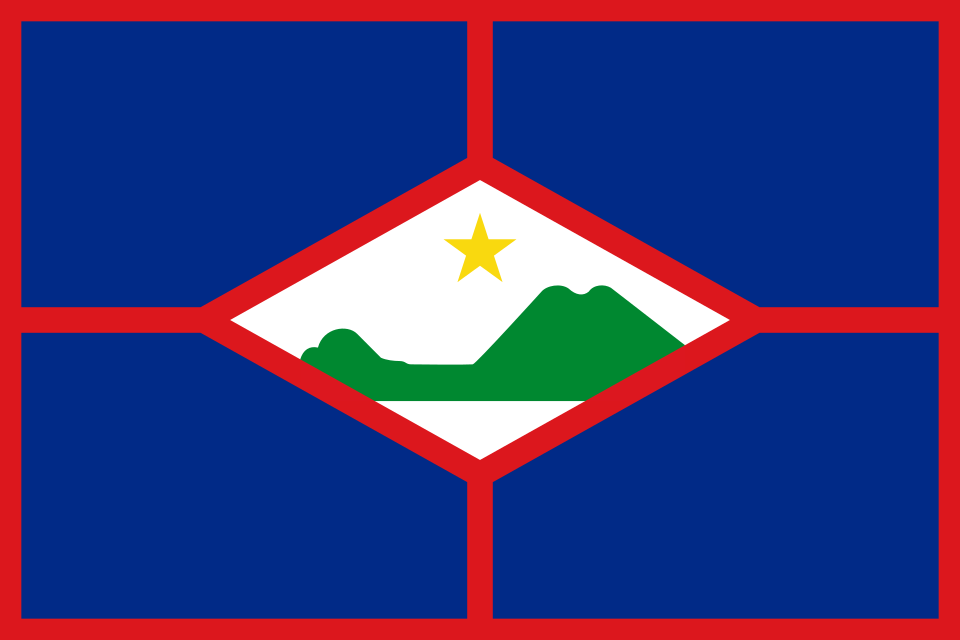
A rich blue background is crossed by narrow red horizontal and vertical divisions and bounded by a red border. In the middle is a large white diamond, itself outlined in red. Within it, a green silhouette of the island rises beneath a gold star.
The flag does not have four independent national stars or the Dutch tricolour. Its four blue outer areas are interrupted by the central diamond, so a reproduction should show the red dividing lines meeting the diamond at its sides and top and bottom.
What mountain is shown inside the white diamond?
The landscape is associated with The Quill, a volcanic mountain that dominates the island’s south-east. Its familiar silhouette, together with the island’s lower ridges, gives Statia’s flag a concrete geographic subject.
This is not a drawing of Mount Scenery on nearby Saba or a random mountain borrowed from mainland Europe. The original ordinance describes the island and mountain contour; the green silhouette communicates Statia’s landscape rather than a separate national coat of arms.
Why is there a golden five-pointed star?
A single golden five-pointed star appears high inside the central white diamond, above the green slopes. It emphasizes the island’s distinct identity and provides an easily recognizable focal point.
Some educational descriptions connect the gold star with the islanders’ sense of belonging and their outlook. The law establishes its location and colour; it does not require an invented interpretation for each of the star’s five points.
What do the red lines and blue field mean?
Blue is the dominant field colour, with a bright red edge and dividing lines framing the white diamond. The colours combine a familiar Caribbean marine palette with the landscape’s green.
Local interpretations can associate blue with the sea and sky and red with the people’s historic spirit. For exact use, the island ordinance is a safer reference than attempts to assign a separate meaning to every one of the red border segments.
When was the Sint Eustatius flag adopted?
The Island Council selected the design on 29 July 2004, during the Netherlands Antilles period. It was publicly raised on 16 November 2004, the island’s Statia Day. Some flag references call the latter date adoption; both dates refer to real, but different, stages.
In 2010, after the Netherlands Antilles were dissolved, Sint Eustatius became a public body of the Netherlands. The earlier local flag continued in use. The current island flag is therefore older than the territory’s present constitutional structure.
Why is November 16 important to Statia?
Statia Day falls on 16 November, commemorating an episode in 1776 when a fort on Sint Eustatius fired a salute to an American ship, later remembered as an early international salute to the new United States flag.
The 2004 flag was first raised on that same date, making the annual occasion especially appropriate. Historic accounts of the 1776 salute should be treated as an event in the island’s history, not as proof that the modern Statia flag existed at the time.
Does Sint Eustatius belong to the Netherlands?
Yes. Sint Eustatius is one of three Caribbean public bodies of the Netherlands, along with Bonaire and Saba. Its political status is different from that of Curaçao, Aruba and Sint Maarten, which are constituent countries within the Kingdom.
Having its own flag recognizes local identity and administration; it does not establish a separate sovereign state. The Sint Eustatius flag may be flown with the Dutch national tricolour under local flag protocols.
Sint Eustatius vs Saba, Bonaire and Sint Maarten
Saba’s flag contains a white diamond and gold star too, but it has red upper triangles and blue lower triangles, not a central green mountain. The Bonaire flag has a compass rose and red six-pointed star.
Sint Maarten uses red and blue horizontal bands with a white triangle containing a courthouse and pelican emblem. Sint Eustatius is the one whose central white diamond holds a green volcanic landscape.
How to draw and recognize the Statia flag
Draw a blue rectangle with a narrow red outline. Add red vertical and horizontal lines dividing the outer blue areas and surround a central white diamond with a red edge. Within the diamond draw the green outline of The Quill and adjacent hills, then a gold five-pointed star above.
A helpful quiz prompt is ‘white diamond, green volcanic island and golden star on blue‘. If the diamond contains only a star with no landscape, it is closer to the flag of Saba than that of Sint Eustatius.
Frequently asked questions
What is on the Sint Eustatius flag?
A blue field divided by red lines, with a white diamond containing a green outline of The Quill and a golden star.
Why is The Quill on the flag?
The Quill volcano is a distinctive landmark of Sint Eustatius.
When was the flag approved?
The Island Council decided on the design on 29 July 2004.
When was it first raised?
16 November 2004, on Statia Day.
What does the star look like?
One yellow or gold five-pointed star.
Is Sint Eustatius an independent country?
No. It is a public body of the Netherlands in the Caribbean.
Is it the same as the Saba flag?
No. Saba has a star in a white diamond but no green mountain; its upper panels are red.
Why is 16 November celebrated?
Statia Day commemorates a 1776 salute to an American ship and is the date of the flag’s 2004 first raising.
Official references and illustration credits
Dutch legislation — St Eustatius original flag ordinance
Dutch legislation — 2020 Statia flag protocol
Flags of the World — Statia flag history and design
The displayed PNG was rendered from the Wikimedia Commons flag vector for Sint Eustatius. Flag vector by Wikimedia Commons contributor Andrwsc, with subsequent vector refinements by Commons contributors. PNG rendering; source is licensed CC BY-SA 4.0 (attribution and share-alike). No substantive change to flag design.
Images provided for education and identification only; no government endorsement is implied. Source material reviewed November 2026.