Ceuta Flag: Black and White Triangles & Portuguese Shield
Ceuta’s black-and-white triangular flag is unlike Spain’s red and yellow national banner. Explore its Portuguese-inspired heraldry and legal description.
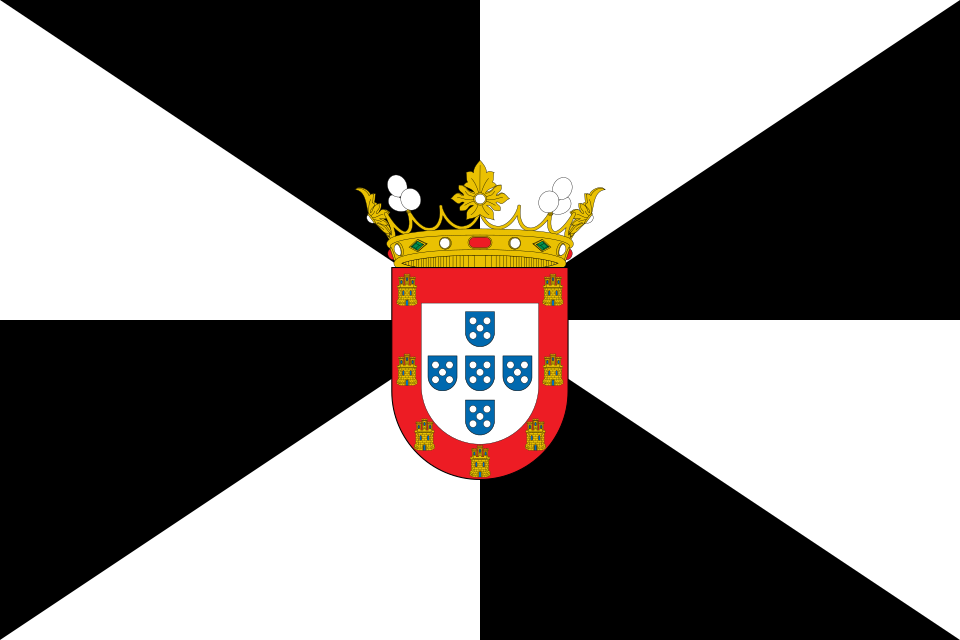
Ceuta is a Spanish autonomous city on the North African coast beside the Strait of Gibraltar. Its unusual geometric flag reflects historical connections with Portugal, while its present political status is part of Spain.
The City of Ceuta’s Statute of Autonomy sets out the precise triangles and the central shield. Its official emblems page explains how the shield differs in heraldic detail from Portugal’s national arms.
Ceuta flag at a glance
| Feature | Details |
|---|---|
| Place | Ceuta, on the North African coast |
| Political status | Spanish autonomous city |
| Design | Eight alternating black and white triangular sectors |
| Heraldic term | Gyronny (gironné) |
| Shield | Portuguese-derived municipal arms |
| Historical connection | Portuguese capture in 1415 |
| Statutory basis | Organic Law 1/1995, Article 3 |
| Same as Spanish flag? | No; Spanish national colours are red and yellow |
The quick facts distinguish the flag’s design from separate heraldic history and constitutional status. Official sources and artwork credits are included below for readers who need to check a legal description or specific emblem detail.
What does the Ceuta flag look like?
The field has four black and four white triangular panels radiating around its centre. Each corner and side midpoint is part of the pattern, producing eight wedges that alternate dark and light like a pinwheel. A shield appears above the central junction in the familiar official version.
Ceuta’s legal definition specifies a black triangle beside the upper-left corner, which fixes the pattern’s orientation. Without this orientation rule, two different black-and-white diagrams could both be called ‘eight triangles’ even though one is a mirrored version.
Why is the Ceuta flag black and white?
The black-and-white gyronny pattern is closely associated with historic Portuguese civic flag traditions, notably the banner of Lisbon. The arrangement is striking because it is neither a conventional horizontal bicolour nor a simple checkerboard.
The legal description fixes the actual colours and structure. Popular interpretations sometimes assign each triangle to a particular religious community or historical ruler, but this is not substantiated by the core statutory text. The Portuguese historical connection is better documented than a symbolic interpretation for every single wedge.
What does the shield in the middle represent?
The shield is descended from Portugal’s heraldic arms. It contains five small blue shields with white bezants, surrounded by a red border displaying seven golden castles, beneath a crown.
Ceuta’s official institutional page explains a subtle distinction from the arms of Portugal: the arrangement of castles differs, reflecting Ceuta’s separate municipal heraldry. It is therefore more precise to call the shield Portuguese-derived than to describe it as an identical copy of the present Portuguese national coat of arms.
How did Ceuta acquire Portuguese connections?
Portuguese forces took Ceuta in 1415, a major episode in Portugal’s early overseas expansion. The city remained linked to Portuguese rule for centuries before becoming Spanish. Those events explain why Portuguese heraldic elements remained in Ceuta’s emblems.
This history should not be simplified into an unsupported claim that the exact current eight-sector flag was officially drawn and adopted in 1415. Specialists distinguish long-standing heraldic inspiration from the modern documentation and regulation of the municipal flag.
What does Ceuta’s 1995 autonomy law say about its flag?
Organic Law 1/1995, establishing Ceuta’s autonomous-city statute, describes the traditional flag using four white and four black triangles formed from the flag’s corners and midpoints. It identifies the shield as Ceuta’s own coat of arms.
That is a direct legal source for the pattern, not a speculative interpretation of pictures. It helps clarify the flag’s official status without claiming that a previously existing flag was newly invented in 1995.
Does the Ceuta flag always have the coat of arms?
The city statute describes the traditional geometric field and identifies the municipal arms. In photographs and reference works, one may encounter both a plain black-and-white gyronny and a version with the shield in the centre.
For articles about Ceuta’s official civic identity, the shield-bearing version is most informative. For a geometry or flag-pattern lesson, the plain background can make the alternating sectors clearer. Label any variant explicitly rather than claiming that one image explains every context of use.
Ceuta vs Melilla and Gibraltar: which flag is which?
Both Ceuta and Melilla are Spanish autonomous cities on the North African coast. Ceuta uses black-and-white sectors and a Portuguese-style shield; Melilla uses sky blue with a complex Medina Sidonia coat of arms.
Nearby Gibraltar is a British Overseas Territory and uses a red castle and golden key on white and red. Geographical proximity does not make their flags or constitutional arrangements interchangeable.
How to draw the Ceuta flag without changing the pattern
Draw a rectangle and mark its centre plus the midpoints of all four sides. Connect each corner to the centre and the nearest side midpoints to create eight triangular regions. Fill them alternately black and white, beginning with the legally specified black sector by the upper-left corner.
If preparing a faithful civic illustration, add Ceuta’s Portuguese-derived shield at the centre using a verified artwork file. Keep the geometric pattern visible around the emblem. For a quiz, eight alternating black-and-white wedges identify Ceuta.
Frequently asked questions
Why does Ceuta’s flag have black and white triangles?
It is a traditional gyronny design associated with Portuguese civic flag traditions.
How many triangles are on the flag?
Eight: four black and four white, alternating around the centre.
What is the coat of arms?
A Portuguese-derived shield with five small blue shields, white bezants and seven golden castles.
Does Ceuta belong to Spain or Portugal?
Ceuta is a Spanish autonomous city, although its heraldry reflects earlier Portuguese rule.
Was the flag invented in 1415?
The 1415 Portuguese capture explains the historical connection but does not securely date the current exact flag design.
Does the flag always have a shield?
Reference and display versions appear both with and without the shield; the geometric pattern defines the flag’s distinctive field.
Is Ceuta in Europe?
Geographically Ceuta is on the African coast, while politically it is a Spanish autonomous city.
How is Ceuta different from Melilla?
Ceuta is black-and-white gyronny; Melilla is sky blue with a ducal coat of arms.
Official references and illustration credits
City of Ceuta — Autonomy Statute, preliminary title and symbols
City of Ceuta — Institutional emblems and coat of arms
Spain BOE — Organic Law 1/1995, Ceuta autonomy statute
Spanish Society of Vexillology — Ceuta
Flag drawing derived from Wikimedia Commons — Ceuta flag vector. Flag vector by Ulaidh, Wikimedia Commons, CC BY-SA 4.0. Rasterized PNG conversion, shared under CC BY-SA 4.0: https://creativecommons.org/licenses/by-sa/4.0/. Civic insignia rules may also apply.
All flags are shown for educational identification. This article is independent of the government or institution represented. Information and source descriptions reviewed November 2026.