Alberta Flag: Rocky Mountains, Wheat, Shield & Meaning
Why does Alberta’s flag show snowy mountains, wheat fields and a red St George cross? Learn its landscape symbolism, 1907 shield and June 1968 adoption.
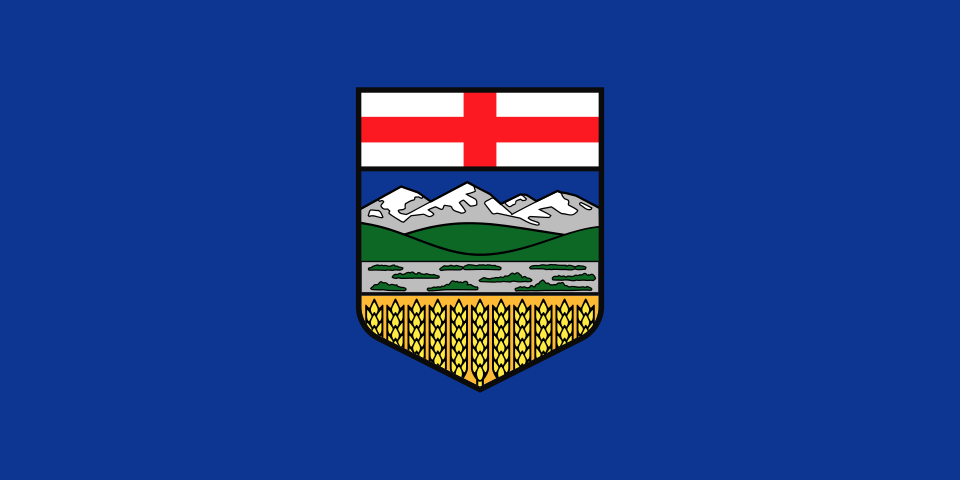
Alberta sits between the Rocky Mountains and Canada’s broad Prairie region, and its provincial flag is designed like a small landscape painting within a heraldic shield. Unlike the Canadian national maple-leaf banner, it uses no large red side panels or central red maple leaf. Unlike neighboring British Columbia’s provincial flag, it contains no Union Jack.
The Government of Alberta’s official emblem guide gives the adoption date, flag proportions and each part of the shield. Canadian Heritage confirms that the shield represents the contrast between mountains, green foothills and prairie grain fields. The province’s historic coat of arms began in 1907, long before the flag itself was adopted in 1968.
The key to identifying the flag is the small picture of the landscape in the center of a broad blue field. This guide explains its symbols and distinguishes the provincial shield from the full coat of arms with supporters.
Alberta flag at a glance: a landscape shield on blue
The flag shows Alberta’s provincial shield at the center of an ultramarine-blue rectangle with a 2:1 ratio. The shield combines English heraldry at the top and western Canadian geography below. The province used the design informally in 1967 and formally adopted it the following year.
| Feature | Description |
|---|---|
| Province | Alberta, Canada (capital Edmonton) |
| Field | Royal ultramarine blue |
| Centre | Provincial shield of arms |
| Top of shield | Red St George’s cross on white |
| Landscape | Snowy mountains, green foothills, prairie and wheat |
| Provincial shield history | Arms granted in 1907 |
| Flag adopted | June 1, 1968 |
| Proportions | 2:1, length to height |
What do the Rocky Mountains symbolize on the flag?
The mountains inside Alberta’s shield refer to the Canadian Rocky Mountains on the province’s western side. Snow-capped peaks rise behind green hills, making the range recognizable even in a small design. The scenery is not a depiction of one particular photograph of Banff or Jasper.
The Alberta Government and Canadian Heritage describe the mountains and foothills as part of the shield’s representation of the varied provincial landscape. A state or provincial flag often compresses large geographical areas into symbolic elements: here, snow, slopes and green land are shown together rather than as geographically exact map contours.
The mountains are paired with prairie land and wheat because Alberta extends well beyond the high Rockies. Someone who sees the flag in Edmonton or Calgary is looking at a design intended to represent the province as a whole, not only a mountain resort.
Why are there green hills beneath the mountains?
The green foothills are a transition between the mountain range and the prairie. They add an important visual layer to the shield. The progression from mountains to foothills to farmland expresses Alberta’s geographical variety.
Why are wheat and prairie fields on Alberta’s flag?
The foreground shows a wheat field in gold, reflecting Alberta’s long association with grain farming on the Prairie. Wheat has been important to the province’s agricultural economy since the expansion of settlement and railways, although this history also includes substantial changes to Indigenous lands and communities.
The government describes the lower shield as prairie and wheat land. The wheat is an agricultural emblem, not a separate yellow stripe of the provincial flag. It appears within the shield, surrounded by the blue flag field.
A viewer might mistake the yellow foreground for a rising sun when the shield is shown very small. In an accurate drawing, the gold should read as tall grain stalks, with broad prairie behind them. The sun and waves are much more characteristic of the British Columbia provincial flag.
Why does Alberta’s shield include St George’s cross?
The shield’s upper section contains a red upright St George’s cross on white. In Alberta’s heraldic history it refers to English and British connections. The Canadian Heraldic Authority also notes its association with the Hudson’s Bay Company, which held important trading rights in western Canada.
This is not a Union Jack: it is only one red upright cross in the upper portion of the shield. It also does not turn Alberta’s flag into England’s national banner. The overall provincial flag remains blue and is distinguished by the mountain-and-wheat landscape.
Historical heraldry and contemporary civic identity are different things. The cross is a legacy of the shield’s original design and should not be used to infer the beliefs of every Alberta resident. The flag serves the province’s entire population.
Why is the Alberta flag blue?
The flag uses a dark royal ultramarine blue background. Official Alberta and Canadian government descriptions use that wording for the field surrounding the central shield. The solid blue gives strong contrast with the miniature landscape’s white, green and gold colors.
Although the shield itself depicts blue skies, the solid blue field is not simply a large sky panel. It is a separate heraldic flag background selected for the provincial emblem. Flag manufacturers may show minor shade variations from material or lighting, but the basic design is blue with a centered shield.
The official ratio is twice as long as it is high. This gives the landscape shield plenty of open space around it, avoiding the cramped appearance of a square banner. A design placing the shield at the hoist rather than in the centre should not be labeled the standard flag.
1905, 1907, 1968 and 2013: the different key dates
1905: Alberta became a province of Canada. The province’s new institutions soon needed recognizable symbols. The province’s first coat of arms was granted by Royal Warrant of King Edward VII on May 30, 1907.
1967–1968: Alberta began using its shield on blue as a provincial flag and then formally adopted the flag on June 1, 1968. This was more than sixty years after the original shield had been granted.
1980: The full coat of arms gained additional elements, including a beaver crest, supporters and a motto. 2013: The central shield was recognized separately as an official provincial emblem. The flag still uses the shield, not the entire expanded coat of arms.
These milestones are sometimes confused in summary charts. The flag’s adoption is 1968, not 1907 or 2013. The older heraldic dates explain why its central landscape design had already become familiar when the flag was created.
Flag shield vs. full Alberta coat of arms
The Alberta flag contains only the provincial shield, a vertically divided heraldic device with the red cross at the top and landscape underneath. The full Alberta coat of arms is more elaborate: it includes a beaver, a lion, a pronghorn antelope, wild roses and the motto Fortis et Liber, meaning “Strong and free.”
Those external elements are official symbols but they do not appear in the middle of the standard Alberta provincial flag. If a flag illustration includes a lion and pronghorn holding a shield, it may be a decorative banner of the full arms rather than the prescribed blue provincial flag.
The distinction is useful in educational charts because both designs can legitimately be called Albertan emblems. One is a complete coat of arms; the other is the simplified shield used on the flag.
Alberta vs. British Columbia, Ontario and Canada
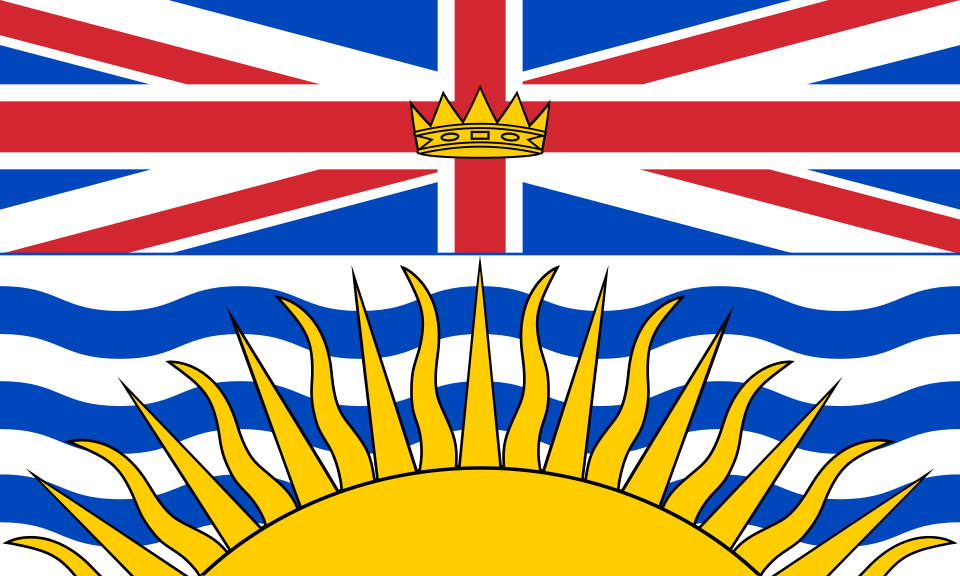
Alberta is visually distinct from the two Canadian provincial flags most likely to be compared with it. British Columbia uses the Union Jack, a gold crown, sun and waves; Ontario uses a red ensign with a Union Jack canton and a shield containing three maple leaves.
Alberta’s flag has no Union Jack in the upper-left corner and does not use Ontario’s red background. It has a single centered shield with a mountain-and-wheat landscape on a solid blue field. Those are the quickest ways to identify it in a quiz.
The Canadian national flag instead shows a red eleven-pointed maple leaf on white between two red vertical bands. Canada’s provinces use distinct flags in addition to the national banner. The flags represent different levels of government and shared heritage.
How to draw and identify Alberta’s flag accurately
Draw a dark blue rectangle with a width twice its height. In the center, add a shield. Across the shield’s top, draw a red upright cross on a white panel. Below it draw blue sky, white snow-capped Rocky Mountain peaks, green foothills, prairie and golden wheat stalks.
Leave a generous blue margin around the shield rather than filling the entire banner with the landscape. The flag does not include a red maple leaf or a Union Jack. For an exact flag graphic, consult the Government of Alberta’s downloadable emblem files because small heraldic landscape details should follow the official artwork.
One useful learning activity is to compare Alberta with B.C. and ask learners which design shows mountains and wheat versus sun and ocean. This reinforces geography while encouraging accurate identification rather than relying only on the blue color.
Frequently asked questions
What does the Alberta flag look like?
An ultramarine-blue rectangular flag with Alberta’s heraldic shield centered on it.
What do the mountains mean?
They represent Alberta’s Rocky Mountains, with the green foothills and prairie landscape below.
Why is there wheat?
The wheat field represents Alberta’s Prairie agricultural heritage.
What does the red cross symbolize?
St George’s cross reflects English and Hudson’s Bay Company historical heraldry in the provincial shield.
When did Alberta adopt its flag?
June 1, 1968.
Why is 1907 associated with Alberta’s flag?
1907 was when the original shield of arms was granted, not the flag’s adoption year.
What is the flag ratio?
2:1, twice as long as it is high.
Does the Alberta flag show the full coat of arms?
No. It shows the central shield; the full arms add a beaver crest, supporters, wild roses and a motto.
Is Alberta’s flag the same as British Columbia’s?
No. British Columbia has a Union Jack, crown, sun and waves; Alberta has mountains and wheat in a central shield.
Neighbouring Saskatchewan uses a green-and-gold flag with a western red lily, whereas Alberta has a royal-blue field and a central mountain-and-wheat shield. Both describe Prairie geography through different visual designs.
Official sources and illustration credits
Government of Alberta — Alberta emblems, shield and flag
Canadian Heritage — Provincial symbols of Alberta
Governor General — Alberta Heraldic Register
Wikimedia Commons — Flag of Alberta vector
Government of Alberta — Corporate Identity Manual
Main Alberta flag artwork is a public-domain vector from Wikimedia Commons; rasterized to PNG. British Columbia comparison from Commons. Shield and flag descriptions checked against the Government of Alberta and Canadian Heraldic Authority.
Flag diagrams are rasterized versions of credited Wikimedia Commons artwork uploaded to the FlagExplorers library. Graphic licenses and official emblem-use restrictions can differ. Historical details checked November 2026.