Connecticut State Flag: Three Grape Vines & Motto
The current Connecticut state flag explained with a clear picture, historical context, design details and tips for identification.
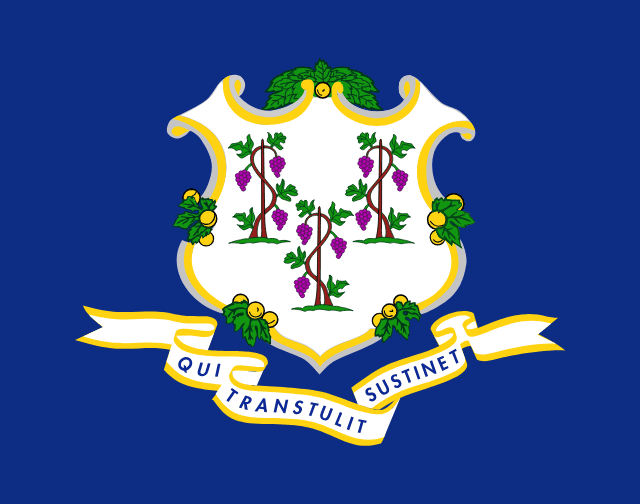
Connecticut state flag at a glance
| Detail | Answer |
|---|---|
| State | Connecticut, United States |
| Adoption and updates | 1897 (legal details updated later) |
| Key feature | Three grapevines and the Latin motto Qui Transtulit Sustinet |
| Image source | Flagpedia / Wikimedia Commons |
What does the Connecticut state flag look like?
Connecticut’s flag places a decorative white shield on an azure-blue field. Inside the shield are three grapevines bearing clusters of grapes. Below, a ribbon bears the Latin inscription QUI TRANSTULIT SUSTINET. Gold and silver edging and oak foliage ornament the arms.
What do the symbols on Connecticut’s flag mean?
The motto is commonly translated as He who transplanted still sustains, with religious roots in the colonial state’s imagery. The three grapevines derive from Connecticut’s longstanding colonial and state seal traditions. Explanations linking each vine conclusively to a specific town should be treated with caution because different historical interpretations circulate.
The most important details to notice
Connecticut’s grapes are important, but the flag should not be mistaken for a wine region’s banner. Unlike most seal-on-blue designs, the white curving shield and three green vines create a highly distinctive central composition, and the motto appears outside the shield on a white streamer.
When was the Connecticut flag adopted?
Connecticut formally adopted a state flag design in 1897, drawing on a much older emblem with grapevines and a Latin motto. The current statutory wording spells out the shield’s shape, decorative border, colors and ribbons. Details were clarified in 1990, while the central symbol continued unchanged.
Why this design matters to Connecticut’s history
The three grapevines carry a longer history than the formal state flag, appearing in Connecticut’s colonial seal tradition. Its Latin motto suggests enduring care for those who have been transplanted, commonly understood in the context of colonial religious settlement. The precise identities assigned to individual vines vary in secondary accounts, so it is safer to describe the established emblem without presenting an unverified one-vine-one-town mapping as law.
Colors, proportions and how to draw the flag
Fill the field blue. Put the white shield with gold/silver border in the center and three fruiting grapevines inside it. Under the shield, add a ribbon with QUI TRANSTULIT SUSTINET. Avoid replacing the motto with the English translation on an image presented as the official flag.
For a classroom printout, keep the original aspect ratio of the official image instead of stretching it to fill a convenient box. Use a high-resolution or vector-derived source for detailed emblems. Commercial reproductions and governmental displays may require stricter specifications than educational illustrations, particularly where colors, lettering, dimensions or the seal artwork are defined by law.
How to identify Connecticut in a state-flag quiz
Look for the shape of the white ornate shield and the hanging bunches of grapes. The scroll below reads QUI TRANSTULIT SUSTINET. The blue field itself is relatively plain, and the emblem has a bright, natural green and purple center. At thumbnail size the three vine shapes provide a better clue than the tiny Latin lettering.
How is Connecticut’s flag different from other U.S. state flags?
Rhode Island’s white flag is dominated by a gold anchor and a short HOPE ribbon, whereas Connecticut’s blue field has a large white shield and grapes. Massachusetts also has a central shield but uses a white background and a Native American figure. Grouping these New England flags helps demonstrate that their historic insignia are visually distinct despite a shared colonial era.
Quick study notes and common mistakes
A literal English translation should be labeled as a translation and not substituted into an official flag drawing. For younger readers, count three separate vine arrangements and look for grapes, not trees or flowers. In historical discussion, separate the adoption of the flag in 1897 from the much older usage of grapevines on the state seal. The central motif persisted across those periods.
Frequently asked questions
When was the Connecticut state flag adopted?
1897 (legal details updated later)
What is the most recognizable symbol on Connecticut’s flag?
Three grapevines and the Latin motto Qui Transtulit Sustinet.
What do the main emblems mean?
The motto is commonly translated as He who transplanted still sustains, with religious roots in the colonial state’s imagery. The three grapevines derive from Connecticut’s longstanding colonial and state seal traditions. Explanations linking each vine conclusively to a specific town should be treated with caution because different historical interpretations circulate.
Is the flag pictured here the current flag?
Yes. The image depicts the present official design as shown by the referenced flag illustration source. Historical or proposed alternatives are discussed separately when relevant.
Where can I find all 50 current state flags?
The FlagExplorers all 50 U.S. state flags gallery provides images, names and links to individual state guides.
Connecticut General Statutes §3-107
Connecticut General Statutes — arms and shield detail
Flagpedia — U.S. state flag illustrations
Flag artwork sourced from FlagCDN/Flagpedia, based on Wikimedia Commons vector graphics and reproduced in the FlagExplorers library. Information reviewed November 2026.