How to Draw the Hawaii Flag: Step-by-Step Construction Guide
A measured construction tutorial with practical drawing examples, geometry and accuracy checks.
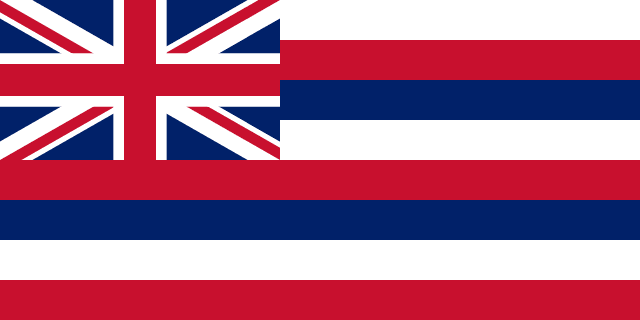
Draw the Hawaii state flag on a rectangle twice as long as it is high. Divide it into eight equal horizontal stripes beginning with white, red and blue, and add the jack in the upper hoist. Hawaii law defines the jack’s length as seven-sixteenths of the flag’s length and its height as half the flag’s height. This tutorial explains the unusual canton proportions, stripe sequence and layered crosses with worked scale measurements.
For the historical background, read the Hawaii state flag meaning and history guide.
Construction measurements
| Length relative to height | 2:1 |
|---|---|
| Stripe count | 8 |
| Stripe height | Height ÷ 8 |
| Jack height | Height ÷ 2 |
| Jack length | 7/16 of total length |
| Jack length in terms of height | 7/8 of height |
Step 1: Choose a 2:1 flag canvas
Hawaii’s flag is longer relative to its height than many other state flags. Begin with a rectangle that is forty centimeters across and twenty centimeters high. This gives the two-to-one relationship prescribed by Hawaii Revised Statutes §5-19.
Use the left edge as the hoist and the right edge as the fly. A flag seen from behind may appear mirrored, but the standard front-facing representation places the jack in the upper-left corner. Mark the hoist outside the rectangle before starting the construction.
For a smaller drawing, twenty-four centimeters across by twelve centimeters high follows the same proportions. A larger canvas gives more room to work on the narrow diagonal details in the jack. If the project is intended to teach exact construction, choose a scale at which the white edging can be drawn clearly.
On graph paper, a sixteen-by-eight grid provides a simple foundation for the horizontal stripes. Each stripe can occupy one row, but the smaller elements of the jack require subdivisions of those rows.
For digital work, an artboard of sixteen hundred pixels by eight hundred pixels gives exact integer coordinates for the main stripe and canton dimensions. Save the overall rectangle first, then place separate shapes inside it.
Do not confuse the proportions of the entire Hawaii flag with the proportions of the jack placed in its corner. They are not identical. A stock United Kingdom flag image in a standard two-to-one ratio should not automatically be used as an exact canton for the Hawaiian flag.
The outer rectangle establishes the scale for every subsequent measurement. If you change its size, multiply all internal dimensions by the same factor. Leaving the canton unchanged while resizing the rest of the flag would change its distinctive relationship to the stripe field.
Step 2: Divide the flag into eight stripes
Measure the vertical height and divide it by eight. On the forty-by-twenty centimeter example, each stripe is two and a half centimeters high. Draw light horizontal guides at intervals of that size from the top to the bottom of the rectangle.
The order is white, red, blue, white, red, blue, white and red. The eighth stripe is red. There are three white stripes, three red stripes and two blue stripes. This count follows directly from repeating the white-red-blue sequence across eight rows.
A useful way to prevent mistakes is to write small numbers from one through eight outside the fly edge. Next to them, pencil in the intended color for each row. This makes it easier to keep track of the repeated colors, particularly after the upper hoist has been covered by the jack.
Fill the stripes across the full underlying rectangle in a digital drawing, then overlay the jack. In a paper drawing, keep the canton area reserved because its detailed blue, white and red pattern replaces the upper parts of the stripes nearest the hoist.
The four upper stripes extend visibly from the right boundary of the jack to the fly. The four lower stripes remain uninterrupted across the entire flag width. This is a useful count check because the jack occupies exactly half the height.
On a sixteen-hundred-by-eight-hundred-pixel canvas, each stripe is one hundred pixels high. Their starting coordinates are zero, one hundred, two hundred, three hundred, four hundred, five hundred, six hundred and seven hundred pixels.
If drawing with colored paper, cut eight strips of identical height and assemble them without gaps or overlap. A slight overlap between two strips can change the measured stripe thickness. Make the stripes as a single rectangular base before adding the jack as a separate piece.
The Hawaiian flag is not the United States flag with a Union Jack substituted for the stars. The American national design has thirteen stripes and a different color sequence and canton. Counting Hawaii’s eight stripes is essential to producing the correct state flag.
Step 3: Measure the canton instead of guessing its width
The jack is positioned in the upper hoist corner. The statute gives its height as half the hoist dimension and its horizontal length as seven-sixteenths of the fly dimension. Calculate those two values independently.
On the forty-by-twenty centimeter flag, the jack is ten centimeters high. Its horizontal length is 17.5 centimeters. It therefore extends to the fourth stripe boundary and occupies less than half of the complete flag length.
Mark the right edge of the jack at 17.5 centimeters from the hoist, then mark its lower edge at ten centimeters from the top. Connect the guide marks to form a rectangle. This is the area in which all the cross and saltire details belong.
The jack’s own horizontal-to-vertical proportion is seven to four. The overall flag is two to one. The difference is modest but visually significant when you compare a standard British flag image with the legal canton dimensions.
On a digital sixteen-hundred-by-eight-hundred-pixel canvas, the jack is seven hundred pixels wide and four hundred pixels high. Its right boundary is x equals 700 and the lower boundary is y equals 400. The midpoint of the jack lies at x equals 350, y equals 200.
The canton covers exactly the left portion of the first four stripes. It should not extend down into the fifth red stripe, and it should not reach the complete flag’s horizontal midpoint at x equals 800 in this example.
At the same scale, the four upper stripes each have nine hundred pixels of uninterrupted visible length to the right of the canton. The lower four each retain all sixteen hundred pixels of length. These measurements can be checked independently after the jack is placed.
If a classroom source prints the flag with a different canton width, compare it with the statutory fractions before copying it. Some images may use an approximation based on a familiar British flag template rather than following Hawaii’s precise canton geometry.
Step 4: Construct the broad red cross and white border
The jack’s central cross is red with white edging on a blue field. The horizontal and vertical arms share the center of the canton, rather than the center of the complete flag. In the forty-by-twenty centimeter example, the canton center is 8.75 centimeters from the hoist and five centimeters below the top.
The law relates the total width of each red cross arm, including its border, to the height of a single horizontal stripe. On this example the combined width is 2.5 centimeters. For vector construction, create a broad white cross of that thickness first, then overlay the narrower red cross.
The statute describes the white border as one-third the width of the red cross. Taking that as the thickness of each white edge, the total thickness is the red arm width plus two-thirds of that width. The red arm is therefore three-fifths of the combined thickness and each white edge is one-fifth.
At a combined width of 2.5 centimeters, this gives a red arm 1.5 centimeters thick and a white edge half a centimeter thick on each side. At the sixteen-hundred-by-eight-hundred-pixel example, the combined width is one hundred pixels, the red arm is sixty pixels and each white edge is twenty pixels.
Create the vertical white arm across the full jack height, centered on the jack’s vertical centerline. Create the horizontal white arm across the full jack length, centered on the horizontal centerline. Overlay the red arms with the same respective centerlines.
These shapes must be clipped to the canton. The red horizontal cross should not extend into the striped field beyond the right edge of the jack. Similarly, the vertical cross must not continue through the lower four stripes.
The broad cross appears above the compound diagonal saltire in the finished artwork. If drawing the final layers in the correct order, complete the diagonal design first and apply the broad white-bordered cross on top. The measurements in this section help establish the topmost cross accurately.
Step 5: Reproduce the compound diagonal saltire
The diagonal cross inside the jack is more complex than an ordinary red X on white. The Hawaii statute describes a compound saltire containing red and white elements, with white given precedence. The red diagonal portions have narrow white edging.
The law establishes the width of the compound saltire arms by reference to the red cross and gives relative proportions of three, two and one for the white, red and border elements. These relationships are important, but a diagram of the actual orientation is also needed to reproduce the asymmetric arrangement correctly.
Start by marking the two diagonals of the canton rectangle. Use them as general construction guides. Do not assume that every red diagonal must be centered in a broad white stripe. Compare the position of the red sections relative to the white ones in each corner with an accurate flag reference.
A common error is to produce a symmetrical red X with uniform white margins on both sides. This loses the characteristic arrangement of the compound saltire. Another is to copy one quadrant into all the other quadrants without applying the correct transformations.
For a student drawing, an effective method is to enlarge a verified reference of the Hawaii flag and transfer the diagonal contours using a proportional grid. Mark the four canton corners and center, then transfer the diagonal boundaries quadrant by quadrant.
A vector artist can build the diagonal shapes as polygons clipped to the jack rectangle. Keep the red and white parts on separate layers, then compare the overall design with the official specification and reference before placing the straight cross above them.
Do not extrapolate from a modern United Kingdom flag’s standard dimensions alone. The Hawaii law defines the canton geometry and the width relationships for the crosses as part of its own flag description. A borrowed graphic may have a different aspect ratio or differently scaled elements.
The finished diagonal design should be visible in the four blue regions around the straight cross. The straight red cross with white edging takes precedence in the center. If a diagonal arm visibly crosses over the red central cross, the layer order has been reversed.
Worked measurements for small, medium and digital drawings
A flag twenty-four centimeters long and twelve centimeters high has eight stripes of 1.5 centimeters each. Its jack measures 10.5 centimeters across and six centimeters high. The combined straight-cross arm width is 1.5 centimeters, with a red portion of 0.9 centimeters and two white edges of 0.3 centimeters.
A forty-by-twenty centimeter flag has 2.5-centimeter stripes and a 17.5-by-ten centimeter jack. Its combined straight-cross arm width is 2.5 centimeters. The central red portion measures 1.5 centimeters, and each white edge is half a centimeter.
A larger sixty-four-by-thirty-two centimeter drawing has stripes four centimeters high and a jack twenty-eight centimeters long by sixteen centimeters high. The broad cross is four centimeters thick, with a 2.4-centimeter red arm and 0.8-centimeter white edges.
A sixteen-hundred-by-eight-hundred-pixel canvas makes every major dimension convenient for digital drawing. Stripe height is one hundred pixels, the jack is seven hundred by four hundred pixels, and the straight cross uses a one-hundred-pixel overall width.
At half that digital scale, the canvas becomes eight hundred by four hundred pixels, each stripe measures fifty pixels, the canton is three hundred fifty by two hundred pixels, and the straight-cross arm has an overall width of fifty pixels.
In every case, the jack’s lower edge aligns with the fourth stripe division. Its right edge is seven-sixteenths of the full flag length from the hoist. These are useful independent checks on calculations at any scale.
For a classroom exercise, give students the flag length without supplying its height. Ask them to halve the length, divide the resulting height into eight stripes, and calculate the canton dimensions. They should be able to reproduce the layout from the outer dimensions alone.
How to organize the digital artwork
Create a base rectangle or an artboard with a locked two-to-one aspect ratio. Add eight stripe shapes and make sure their boundaries meet exactly. Use a grid or numerical coordinates to avoid tiny transparent gaps between colored regions.
Create a second group for the jack, beginning with a blue rectangle at the upper hoist. Add its diagonal white and red polygons and clip them to the jack rectangle. The white-bordered straight cross belongs above those diagonal shapes.
Keep the stripe group and canton group independent while editing, but scale them together when changing the image size. A common production problem occurs when a designer resizes a canton imported from another file without adjusting the stripe group or preserving the intended proportions.
If the final image is intended for printing, export a high-resolution raster copy from the editable artwork. If the final image will appear as a small icon, retain a descriptive text label because the small white and red diagonal details can be difficult to distinguish.
Avoid adding a black outline to the white top stripe or the white cross border. A neutral frame outside the overall flag rectangle can show the flag edge against a white webpage, but that frame is a presentation element rather than part of the flag.
If a drawing application uses automatic stroke scaling, verify that the internal border widths are also scaled when you resize the image. Filled polygon and rectangle shapes are often easier to control than outlined lines with complex stroke settings.
Final accuracy checks and common mistakes
Count the stripes at the fly edge where the jack does not obscure them. There must be eight, with white at the top and red at the bottom. If blue appears at the bottom, the repeated color sequence has probably been extended incorrectly.
Check that the jack occupies the upper four stripe rows, not three or five. Its lower edge meets the boundary between the fourth white stripe and fifth red stripe. Its right edge should fall short of the flag’s horizontal midpoint.
Inspect the straight cross and its white edging. The total arm width matches one stripe height. The diagonal elements should remain underneath the straight cross, with their asymmetric white-red arrangement retained.
Make sure the drawing does not show a star field in the canton. Hawaii’s state flag has a jack, not the American national flag’s stars. Nor should the jack be placed at the lower hoist or the upper fly.
Check the outer rectangle’s length. A 3:2 reference may be common for other state flags, but Hawaii’s statutory ratio is 2:1. Correcting a stretched image means resizing the entire construction, not just trimming the fly stripes.
If producing a formal reproduction or display, consult the current law, which also describes several rules for use and ceremonial handling. The drawing examples explain the geometry, not every legal or cultural consideration associated with the flag.
After finishing the drawing, explore the linked Hawaii flag history guide for the historical context of the jack and eight stripes. The purpose of this construction tutorial is to help reproduce the design accurately rather than repeat the main article’s historical narrative.
Frequently asked questions
How many stripes does Hawaii’s flag have?
Eight equal horizontal stripes.
What is the stripe sequence?
White, red, blue, white, red, blue, white, red.
How large is the canton?
Half the flag height and seven-sixteenths of the total horizontal length.
Is the canton a standard 2:1 rectangle?
No. Hawaii’s specified jack has a 7:4 length-to-height ratio.
Sources and artwork
Hawaii Revised Statutes §5-19: description of the Hawaiian flag
Hawaii Revised Statutes §5-18: state flag
Image: existing FlagExplorers attachment 2051, credited to Flagpedia/FlagCDN public-domain flag artwork. Scale calculations and classroom examples are original educational explanations. Reviewed November 2026.