Norway vs Iceland Flag: Nordic Cross Colors, Proportions and History
Side-by-side national flag identification, visual differences, historical context and practical examples.
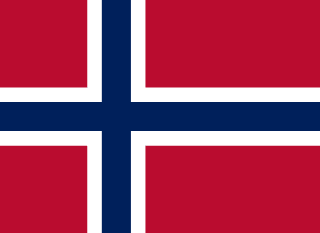
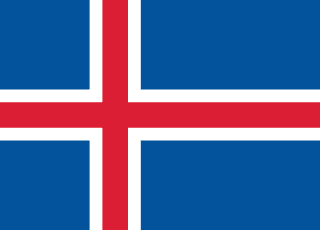
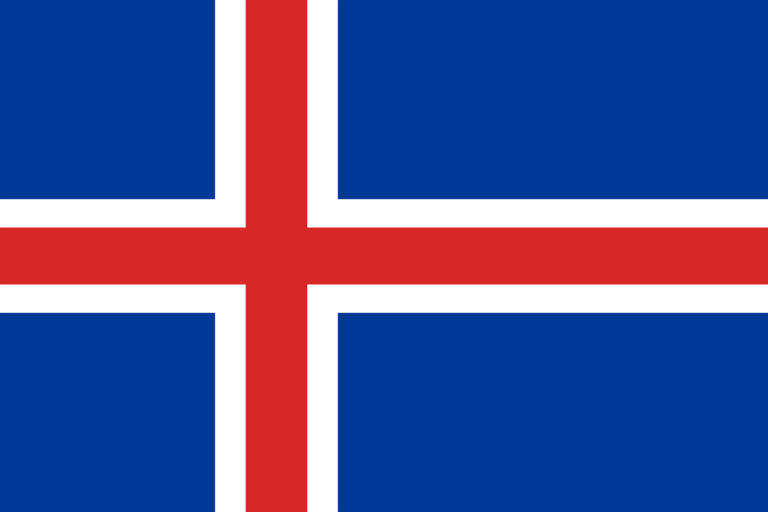
Norway has a red field with a blue Nordic cross edged in white. Iceland reverses the roles of red and blue: its field is blue, and its inner cross is red with a white border. The flags share three colors, an off-center cross and a white separating band, but their dimensions and histories are also distinct. Start by identifying the background color and then check the narrow central cross.
Comparison at a glance
| Feature | Norway | Iceland |
|---|---|---|
| Field | Red | Blue |
| Inner cross | Dark blue | Red |
| Cross edging | White | White |
| Height:length | 16:22 | 18:25 |
| Horizontal parts | 6:1:2:1:12 | 7:1:2:1:14 |
| Vertical parts | 6:1:2:1:6 | 7:1:2:1:7 |
How to distinguish Norway and Iceland immediately
Both flags belong to the Nordic cross family. Their crosses extend to the edges of the rectangle, with the vertical arm shifted toward the hoist. The inner cross is surrounded by a narrower white region. This combination can make the flags look strikingly similar when both are reduced to small icons.
Start with the four background regions around the cross. Norway’s four regions are red, whereas Iceland’s are blue. This is usually the largest and clearest color distinction in a full flag image. Then inspect the center of the cross: it is blue for Norway and red for Iceland.
The white edging is common to both and does not identify either country by itself. If a photograph captures only one arm of the cross, you may still be able to recognize the field and inner cross combination. If the image is monochrome or the colors are badly distorted, additional context may be needed.
The flags are sometimes described as color inversions of one another. This is a useful mnemonic for the roles of the red and blue, but it is not a literal inversion of every color value. White remains white, and the official geometrical proportions are not exactly identical.
Remember the comparison as red outside and blue inside for Norway, blue outside and red inside for Iceland. This approach avoids having to memorize specific shade values, which may vary in screen images and photographs.
When a flag hangs down, the cross may appear in an unfamiliar orientation. Find the pole edge and identify the four colored field regions before deciding which national design is shown. The field and inner cross colors remain reliable when the flag is viewed from either side.
What a Nordic cross is and why it sits off-center
The cross on these flags is not positioned at the geometric center of the rectangle in the way a symmetrical plus sign would be. Its vertical arm is closer to the hoist, leaving longer field regions on the fly side. The horizontal arm runs through the middle of the flag’s height.
This asymmetrical arrangement is a recognizable feature of a wider group of Nordic flags, including Denmark, Sweden and Finland. Different countries use different field colors, cross colors and band widths within that shared construction family.
Norway and Iceland use a two-layer cross. The larger white cross establishes a border, while a narrower colored cross lies inside it. In visual terms, the white area separates the two stronger colors so that the red and blue do not touch directly along the main cross boundaries.
A drawing can be built from two overlapping sets of rectangles: first a broad white horizontal and vertical cross, then a narrower colored horizontal and vertical cross sharing the same centerlines. This is more reliable than drawing a dark cross and tracing a white outline around it by hand.
The off-center position should be preserved when a flag is scaled for a digital interface. Centering the vertical arm simply to make a thumbnail look balanced changes the design. Likewise, cropping the fly side can make the cross look centered even if the original artwork was correct.
At a distance, the proportions of the Nordic cross provide an initial family-level identification. The colors then distinguish individual members. For these two flags, the white border and red-blue combination narrow the possibilities, while the field color resolves the usual comparison.
Norway’s official construction grid
Norway’s rectangular flag is commonly specified using a twenty-two-part horizontal length and sixteen-part vertical height. The horizontal division from the hoist consists of six red parts, one white part, two blue parts, one white part and twelve red parts.
The vertical division consists of six red parts, one white part, two blue parts, one white part and six red parts. Because the upper and lower red areas have equal heights, the horizontal cross is vertically centered.
Choose a construction unit of one centimeter. Draw a rectangle twenty-two centimeters long and sixteen centimeters high. Mark horizontal positions at six, seven, nine and ten centimeters from the hoist. The broad white vertical arm extends from six to ten centimeters, and the narrow blue arm extends from seven to nine.
Along the vertical dimension, mark six, seven, nine and ten centimeters from the top. The broad white horizontal arm extends from six to ten centimeters down the page, and the blue inner arm extends from seven to nine centimeters. Draw each arm across the entire corresponding dimension of the flag.
Color the base red, overlay the broad white cross and then the blue inner cross. The white band remains visible on each side of the blue arm. The cross’s horizontal centerline is eight centimeters down, while its vertical centerline is eight centimeters from the hoist.
The flag’s geometric center is eleven centimeters from the hoist, so the cross center lies three centimeters to the hoist side of that center. This is an example of how the Nordic cross is deliberately offset.
For a larger drawing, multiply every dimension by the same scale factor. A forty-four-by-thirty-two centimeter flag has twice the band widths and offsets. A vector drawing can retain these coordinates exactly rather than relying on a visual approximation.
Iceland’s official construction grid
Iceland’s rectangular national flag has a twenty-five-part length and eighteen-part height. Its vertical division is seven blue parts, one white part, two red parts, one white part and seven blue parts. The horizontal arrangement is seven blue parts, one white, two red, one white and fourteen blue.
Use a one-centimeter construction unit to draw a rectangle twenty-five centimeters long and eighteen centimeters high. Mark the horizontal positions at seven, eight, ten and eleven centimeters from the hoist. These lines establish the broad white vertical arm and the narrower red arm.
The same four measurements from the top establish the vertical locations of the horizontal cross arms. The broad white horizontal arm extends from seven to eleven centimeters, and the red inner arm extends from eight to ten.
Fill the base rectangle blue. Add the broad white cross across the entire length and height, followed by the red inner cross on the same centerlines. Leave the white edging visible consistently around the red cross.
The cross center is nine centimeters from the hoist and nine centimeters below the upper edge. The rectangle’s horizontal midpoint is twelve and a half centimeters from the hoist. Thus the crossing point is three and a half centimeters toward the hoist from the geometric midpoint.
The white and colored inner cross widths are expressed using the same basic part counts as Norway’s grid, but Iceland’s larger overall grid makes the cross proportionally slightly narrower relative to the height. This is a meaningful geometric difference in addition to the reversed field and cross colors.
Use the government reference for the colors and official representation. A simplified color-inverted copy of the Norwegian flag would reproduce the main Icelandic color arrangement, but would retain Norway’s proportions rather than Iceland’s exact construction.
Compare both crosses at the same flag height
A useful mathematical comparison is to draw both flags with an identical height of thirty-six centimeters. Norway uses sixteen parts vertically, so each part measures 2.25 centimeters. Its total length is twenty-two times 2.25, which equals 49.5 centimeters.
For Iceland, divide thirty-six centimeters by eighteen parts. Each part is two centimeters. The total length is twenty-five times two, or fifty centimeters. Although the two flags differ slightly in aspect ratio, their lengths at the same height are close.
Norway’s inner blue cross is two construction parts wide, giving a width of 4.5 centimeters in this example. Its broad white cross is four parts wide, or nine centimeters. Each visible white edging is one part, measuring 2.25 centimeters.
Iceland’s inner red cross is two parts wide, measuring four centimeters. The broad white cross is eight centimeters, and the visible white edge on each side is two centimeters. At equal height, Iceland’s cross occupies a slightly smaller proportion of the height.
The cross centers also differ slightly in position. Norway’s is eight parts from the hoist, giving eighteen centimeters, while Iceland’s is nine parts from the hoist, also giving eighteen centimeters at this chosen height. Both cross centers lie halfway down the flag’s height, even though the rectangles have different overall lengths.
This is a useful exercise for understanding how design proportions behave under scaling. A country flag comparison should not rely on putting both designs into the same arbitrary rectangle, because that can hide small differences in construction.
If comparing the flags in a webpage or printed chart, align them by height and retain their own lengths. The color difference remains the quickest identification clue, but the measurements illustrate that the two official designs are not merely copies with swapped colors.
Norway’s flag: the 1821 design and national identity
Norway’s modern design is associated with Fredrik Meltzer and the Norwegian Parliament in 1821. Its red, white and blue colors and Nordic cross developed in the context of Norway’s political history and the wider Scandinavian flag tradition.
The design was adopted during the period of union with Sweden. Historical flags from that time can contain a union mark in the upper hoist corner. The presence of that mark distinguishes some nineteenth-century Norwegian flags from the current plain-cross national design.
Norway’s flag law of 1898 is an important milestone in the development of the modern national flag. The plain red-white-blue cross flag became a powerful symbol of Norwegian national identity. Norway’s separation from Sweden in 1905 belongs to the political history surrounding that development.
It is helpful to separate the date of the design from the date of later legislation and political changes. The Norwegian flag’s recognizable form dates to the nineteenth century; it did not first appear when Norway became independent from Sweden in 1905.
The three colors are often discussed in relation to ideas of liberty and the Scandinavian cross tradition. Those interpretations should be attributed to historical sources rather than treated as precise statutory definitions of every color.
The Norway flag history guide provides a more detailed chronological account. For the comparison with Iceland, the main point is that Norway’s red field and blue inner cross belong to a historically documented design of its own, not a modern variation invented from Iceland’s flag.
Iceland’s flag: from recognition to republic
Iceland’s flag developed in the context of its relationship with Denmark and the movement toward greater autonomy. The modern blue field with a white-bordered red cross is associated with the recognition of a distinct Icelandic flag in 1915.
Iceland became a sovereign kingdom in personal union with Denmark in 1918. In 1944, it became a republic, and the modern national flag was established within that new constitutional framework. These dates refer to different stages of the country’s flag and political history.
The Icelandic government describes the blue field, red inner cross and white separating areas. The colors are commonly associated with features of Iceland’s landscape, including the blue of the surrounding waters or mountains, white ice or snow and red volcanic fire. These interpretations should be distinguished from the flag’s legal geometric specifications.
The Nordic cross connects Iceland visually with the wider Nordic flag family. Its combination of blue, white and red also creates the striking resemblance to Norway. Shared design traditions do not mean that the flags have identical origin stories.
The official Icelandic flag guidance distinguishes the ordinary rectangular flag from swallowtailed state variants and the presidential flag. A flag with an additional coat of arms or a different outline can therefore represent a distinct governmental use.
In a historical comparison, label the dates and versions carefully. An early Icelandic flag proposal or a historical Danish flag used in Iceland is not necessarily the same as the present national flag. The current design should be identified through its official description and reference artwork.
Other Nordic cross flags and official variants
Denmark uses a red field with a white cross. It has no blue inner cross. If a red Nordic cross flag contains only white as its cross color, Denmark becomes a likely identification rather than Norway.
Sweden uses a blue field and a yellow cross. Its contrast is simpler than the two-layer red-white-blue crosses of Norway and Iceland. Finland reverses another visual arrangement, using a blue cross on a white field.
The Faroe Islands use a white field with a red cross edged in blue. This provides an additional three-color Nordic comparison. The largest field regions are white, not red or blue, making it distinct when enough of the design is visible.
Some official Nordic flags have swallowtailed shapes rather than rectangular national or civil versions. Norway and Iceland both have official-use flag variants whose outlines differ from the plain rectangular flags discussed in the construction grids. Determine the intended role of the flag before selecting a shape.
Regional flags can also use Nordic crosses. A similar cross shape is therefore not sufficient evidence that a design represents a sovereign state. Always identify whether the reference describes a nation, territory, municipality or other organization.
For a flag finder, the best initial filters are the cross family, field color, inner cross color, border color and outline. These features separate a large number of Nordic designs without requiring a perfect match to a particular RGB sample.
The simple recognition rule for Norway and Iceland remains the same even within this larger family. Norway has red around the cross and blue inside it; Iceland has blue around the cross and red inside it. White is the separating color in both.
Frequently asked questions
Which flag has a red field?
Norway.
Which flag has a red inner cross?
Iceland.
Are the proportions identical?
No. Norway is 16:22 and Iceland 18:25 in height-to-length notation.
Why are they similar?
Both belong to the Nordic cross flag tradition and share the red, white and blue palette.
Sources and artwork
Norway flag dimensions, specialist reference
Government of Iceland: Icelandic national flag
Flag artwork: Flagpedia / FlagCDN, public-domain reference artwork. Colors on screen are illustrative. Independent educational comparison; no official endorsement implied. Reviewed November 2026.