Castilla-La Mancha Flag: Golden Castle, Crimson & White Meaning
What does the Castilla-La Mancha flag represent? Explore its precise design, colours, symbols, origins and differences from other Spanish regional flags.
Castilla-La Mancha lies south and east of Madrid, with five provinces: Albacete, Ciudad Real, Cuenca, Guadalajara and Toledo. Toledo is the regional capital and institutional centre. This article explains how its historic emblem and modern regional flag fit together and how to avoid confusing its design with the national flag of Spain.
Castilla-La Mancha flag at a glance
| Region | Castilla-La Mancha, Spain |
|---|---|
| Capital / seat | Toledo |
| Modern recognition | 1982 autonomy statute |
| Flag type | Autonomous-community flag |
| Design clue | No. The flag shows a stylised heraldic castle representing Castilian heritage, not a literal portrait of that building. |
How to recognise the flag
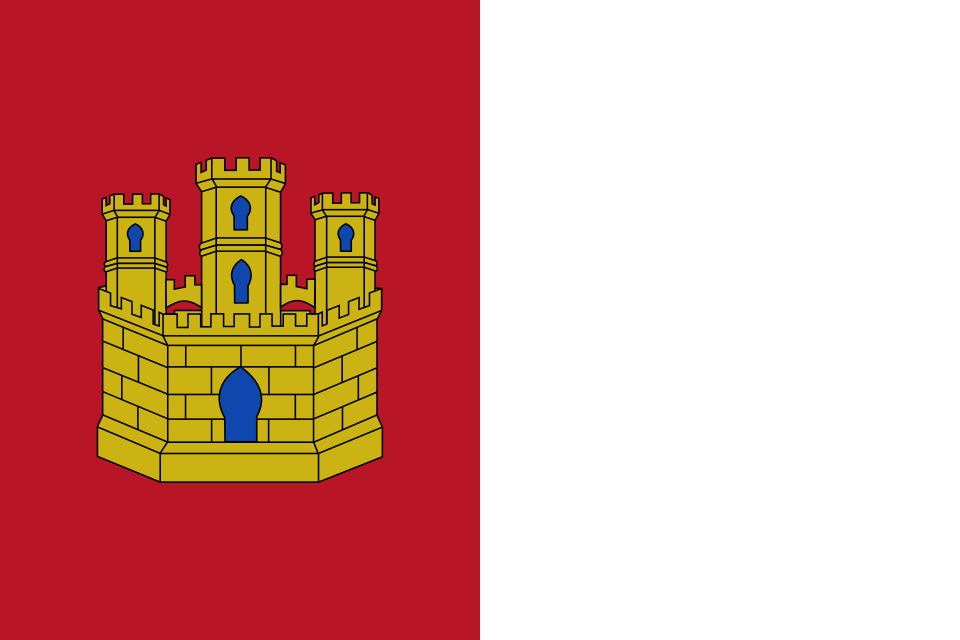
Castilla-La Mancha’s flag is divided vertically into two equal parts. The hoist half is crimson red with a golden castle; the fly half is plain white. The castle contains dark openings and may show blue details in standard artwork.
The precise arrangement matters more than superficial colour similarities with unrelated country flags.
What do its symbols mean?
The golden castle is a direct allusion to the historic Kingdom of Castile, which strongly influenced the region’s medieval and later identity. Its role is heraldic; it does not depict one named local fortress.
The Spanish term castillo means castle, but the region’s flag is a modern symbol of a present autonomous community, not an attempt to reproduce all the medieval banners of Castile.
Why those colours?
Crimson red provides a classic Castilian backdrop for the gold castle. White balances the flag with an unadorned field, producing a very different composition from the red-and-yellow Spanish national flag.
Some colour explanations are customary interpretations rather than words explicitly stated in the law establishing the flag.
History and current status
The modern design was proposed during the transition to regional autonomy and recognised through the 1982 Statute of Autonomy. It adapts historical Castilian symbols for a twentieth-century administrative community.
A historical motif can be centuries old even when its present autonomous-community flag has been in use for only a few decades.
Geography and administrative identity
Castilla-La Mancha lies south and east of Madrid, with five provinces: Albacete, Ciudad Real, Cuenca, Guadalajara and Toledo. Toledo is the regional capital and institutional centre.
The banner belongs to the autonomous community, not to an independent state or merely to one municipal council.
Similar flags: how to tell them apart
Castile and León’s banner is quartered with castles and lions. Castilla-La Mancha has only one castle at the hoist and a clear white half at the fly. The separate city of Toledo has its own municipal flag.
Check symbols, stripe count and the arrangement of fields before deciding which region a flag belongs to.
How to draw the flag
Castilla-La Mancha’s flag is divided vertically into two equal parts. The hoist half is crimson red with a golden castle; the fly half is plain white. The castle contains dark openings and may show blue details in standard artwork.
Start with the main bands or field; if the official design has a detailed shield, use the linked vector file as a reference rather than inventing small heraldic details.
Frequently asked questions
Is the castle on Castilla-La Mancha’s flag the Alcázar of Toledo?
No. The flag shows a stylised heraldic castle representing Castilian heritage, not a literal portrait of that building.
Is Castilla-La Mancha an independent country?
No. Castilla-La Mancha is an autonomous community of Spain, with its own regional institutions.
What is the capital?
Toledo.
When was the current autonomous flag recognised?
1982 autonomy statute.
Does it use the same flag as Spain?
Castile and León’s banner is quartered with castles and lions. Castilla-La Mancha has only one castle at the hoist and a clear white half at the fly. The separate city of Toledo has its own municipal flag.
Is the symbol older than the modern flag?
Often yes. Regional flags frequently reuse much older royal, religious or local heraldic devices.
Sources and image credit
Castilla-La Mancha flag: regional history, design and sources
Flags of the World — Spanish autonomous community reference index
Wikimedia Commons — Flag of Castilla-La Mancha.svg. The featured PNG is a scaled rendering of this original flag image. The original page records author and applicable licence for reuse.
See also Spain’s national flag for the red-yellow-red state banner.
Independent educational guide. Source review: 20 November 2026.