Kuwait vs Palestine Flag: Shapes, Colors and Proportions
The same four colors in different places: Kuwait’s black trapezoid versus Palestine’s red triangle.
A two-step method to tell the flags apart
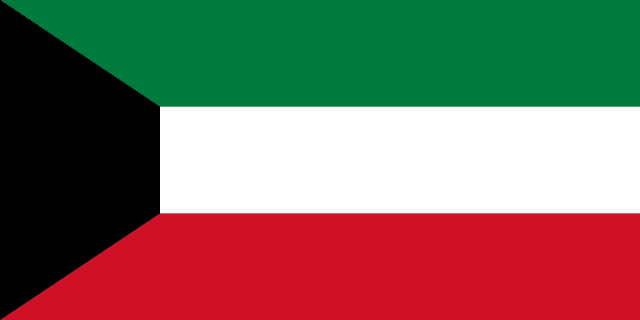
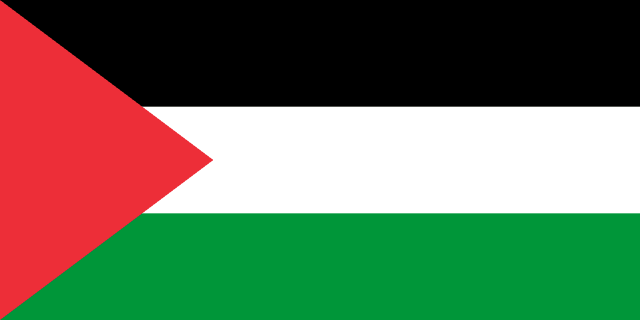
Kuwait and Palestine share black, white, green and red in their ordinary national flags, but a close look quickly reveals that the colors have been arranged differently. Kuwait has a black four-sided shape at the hoist, the edge nearest the pole. Its remaining three bands are green, white and red from top to bottom. Palestine has a red triangular hoist field and three horizontal bands in black, white and green order.
The first step is to identify the color and shape next to the pole. Kuwait’s black trapezoid has a broad vertical base at the hoist and a shorter vertical edge inside the flag. Two slanted edges join these bases. Palestine’s red triangle narrows to a single point in the white field. There is no short vertical edge at the far end of that triangle. The difference is geometric, not simply a change in color.
The second step is to inspect the outer stripes. The upper edge away from the hoist is green for Kuwait and black for Palestine. The lower edge is red for Kuwait and green for Palestine. The white middle field is shared, but its position alone is not enough to distinguish the designs.
This second step is valuable when the hoist cannot be seen. Unlike some close flag pairs where the entire far end is identical, these two have different band colors even away from the hoist. A clear image of all three bands can therefore provide strong identifying evidence within this particular two-country comparison. If the possible answers include other countries, inspect the complete flag before making a final identification.
The table below shows the specifications for the standard national designs, rather than separate historic, military or institutional banners.
| Feature | Kuwait | Palestine |
|---|---|---|
| Hoist shape | Black trapezoid | Red triangle |
| Stripe order | Green, white, red | Black, white, green |
| Height:length | 1:2 | 1:2 |
| Hoist depth | One-quarter of length | One-third of length |
Kuwait’s black trapezoid and what its dimensions mean
Kuwait’s diplomatic missions explain the modern flag with reference to Law No. 26 of 1961. The law establishes a rectangle twice as long as it is high, divided into equal horizontal green, white and red fields. It also specifies the black trapezoid, giving its larger parallel edge the full height of the flag and its smaller parallel edge the height of the white field. The distance between those parallel edges is one-quarter of the total length.
The word trapezoid can mean slightly different things in school terminology depending on the country, but the intended shape is unambiguous here. It has two parallel vertical sides joined by sloping top and bottom edges. The longer side sits against the pole. The shorter side spans the middle horizontal stripe at the inner end of the black area. Unlike a triangle, it does not converge to a single vertex.
An easy way to understand the construction is to start with a rectangle twelve centimeters high and twenty-four centimeters long. The three background bands are four centimeters high. Draw a vertical segment six centimeters from the left edge, extending from four centimeters down from the top to eight centimeters down. Connect the top of that segment to the upper-left corner and its bottom to the lower-left corner. The resulting black quadrilateral is the trapezoidal area.
At the shorter vertical edge, the black field meets the white stripe. The sloping boundaries meet the green and red regions at the ends of the shorter edge. A drawing in which the black shape ends at a point on the centerline would therefore be a triangle rather than the official Kuwaiti form.
This construction is useful for educational measurements. It does not establish precise ink formulations, textile tolerances or every legal requirement for manufacturing flags. Consult the official reference for those matters. The country’s diplomatic explanation provides the key geometry that distinguishes the design from other flags using the same palette.
Palestine’s red triangle and the black-white-green bands
The Palestinian flag’s amended legislative description establishes three horizontal fields of equal height and a red triangle at the hoist. Black occupies the upper band, white the central band and green the lower band. Under the 2006 amendment, the rectangle’s height is half its length and the red triangle has a depth of one-third of the total length.
Using the same twelve-by-twenty-four-centimeter rectangle as before, divide the height into four-centimeter bands. Mark a point eight centimeters from the hoist and six centimeters below the top. Draw straight lines from the upper and lower left corners to that point. Those lines create the two sloping sides of the red triangle. The red triangle’s base coincides with the whole left edge.
Notice that the location of the triangle’s apex is inside the white stripe. It is not an additional vertical strip separating the colors. As the triangular field narrows, more of the upper black and lower green bands becomes visible. The white band remains visible across the rest of the flag.
The current geometry should not be inferred solely from an arbitrary internet illustration. Historical Palestinian references sometimes show different triangle lengths, including the shorter depth given in the original 2005 law before the amendment. When a drawing is intended to illustrate the present statutory specification, the amended official text is a stronger reference than a cropped icon or a photograph of an older flag.
There is no white star in the ordinary Palestinian national design. That observation is particularly useful when comparing the flag with Jordan’s, which shares the black-white-green background and red triangle but adds a white seven-pointed star. In the Kuwait comparison, the triangle color and the band sequence distinguish the two even without reference to a star.
Compare the colored areas mathematically
The two flags have identical overall proportions, yet the size of the hoist device differs. Kuwait’s trapezoid extends a quarter of the length, and Palestine’s triangle extends a third. At a total length of twenty-four centimeters, those distances are six and eight centimeters respectively. The smaller nominal depth of Kuwait’s hoist shape does not imply that its area is smaller in the same proportion, because the inner edge does not narrow to zero.
For the Kuwaiti example, the trapezoid has parallel sides of twelve and four centimeters, separated by six centimeters. The formula for its area is the average of those side lengths multiplied by their separation. The result is forty-eight square centimeters. The Palestinian triangle has a base of twelve centimeters and a perpendicular depth of eight centimeters. Half their product also gives forty-eight square centimeters.
Thus, under the stated official geometric relationships, both hoist devices occupy one sixth of the complete rectangular area. This result can be surprising when looking at the different silhouettes. The trapezoid has a shorter reach, but its broad inner edge compensates for that difference. The triangle reaches farther but tapers to a point.
A student can verify the result by cutting out the two shapes from a paper grid. Use a common rectangle outline and mark the areas before coloring. Divide the shapes into simpler geometric components, or use the standard area formulas. The exercise demonstrates how different silhouettes can cover the same proportion of a field.
The equality concerns the geometric devices, not the total amount of black or red on the respective flags. Kuwait also has a red lower stripe and Palestine also has a black upper stripe. When comparing the complete distribution of colors, account for the portions of the background bands concealed by each hoist device.
These calculations assume flat, properly proportioned designs. They are not estimates of fabric visible in a photograph and are not a guarantee that every commercial icon follows the official dimensions. In a geography reference, maintain aspect ratios so that the comparisons remain meaningful.
Distinct national histories behind the same palette
The Kuwaiti embassy’s national flag account explains that the country adopted its new design upon gaining full independence in 1961. Earlier Kuwaiti banners varied and included red designs. The modern flag’s shape and colors were specified in legislation issued that year. The present four-color rectangle belongs to that independent state’s national-symbol history.
The Palestinian diplomatic account traces the flag’s use through the history of the Arab Revolt and the Palestinian national movement. It describes the use and recognition of the banner during the twentieth century and the later institutional and legislative references. Its history should not be compressed into the date of the 2006 amendment, which concerns the specification of the flag rather than its first appearance.
The four colors are used across a wider family of Arab national designs. They provide a historical and visual connection, but the particular arrangement selected by each country is distinct. The Kuwaiti flag uses black at the hoist, whereas the Palestinian flag uses red there. These are independent national choices reflected in separate legal descriptions.
It is important to distinguish an account of traditional color meanings from the enforceable geometry of the flag. Diplomatic pages often explain historic associations and symbolic interpretations alongside the legal description. A comparison can mention those associations, but an exact claim about what a color symbolizes should be attributed to the relevant source rather than treated as universal for all Arab flags.
A useful timeline exercise places Kuwait’s 1961 legislation beside the Palestinian flag’s earlier historical adoption and later 2005 and 2006 statutory references. The different dates answer different questions. The first modern flag law, a later amendment and a historical account of a national movement should not be described as equivalent events.
This comparison concerns flag design and history. Similar colors do not establish common contemporary policies, political positions or the intentions of the individuals displaying the flags. Recognizing a national symbol does not require drawing those conclusions.
Recognition in photographs, icons and reverse views
A flat reference drawing is the easiest setting in which to distinguish the shapes. Real flags may be folded, wrapped around a pole or photographed from behind. If the hoist device is hidden, inspect the visible upper and lower fields. Green above white and red is consistent with Kuwait’s design, whereas black above white and green is consistent with Palestine’s design.
This rule has limits. Under poor lighting, black and dark green can appear similar. A monochrome photograph removes the color distinction entirely. In those situations the visible trapezoid or triangle provides a more dependable shape clue, if enough of the boundary is present. If neither shape nor color order can be established, record the identification as uncertain.
The short inner vertical edge of Kuwait’s trapezoid is particularly informative in a black-and-white image. Its triangular counterpart converges to a point. A small fold can conceal that edge and make the black device appear more triangular than it really is. Compare several photographs when the precise shape matters, rather than selecting one ambiguous image.
A reverse view of the flag moves its hoist to the right side of the picture. Both the triangle and trapezoid then extend inward from that right edge. The order of the horizontal bands remains unchanged in ordinary upright display. A flag seen hanging vertically requires attention to how the original rectangle has been rotated or suspended.
Online map markers and sports icons may not retain the official one-to-two ratio. A circular crop can conceal much of the left side and leave only a wedge of the original hoist device. Country labels are useful in such contexts; standard two-letter country codes KW and PS can accompany the reference artwork. An accurate label can resolve ambiguity that a tiny graphic cannot.
For a geography resource, include descriptive alternative text and use complete uncropped reference images when comparing geometry. A decorative icon is acceptable for navigation, but a construction guide should use full flag boundaries and clear captions.
Compare Kuwait and Palestine with other four-color flags
Jordan’s flag provides an important comparison with Palestine. Both use black, white and green horizontal bands and a red hoist triangle. Jordan adds a white seven-pointed star and has a longer specified triangle depth. Neither of these designs has Kuwait’s black trapezoid and green-white-red background.
The United Arab Emirates uses a red vertical band at the hoist, with green, white and black horizontal bands extending beside it. This flag illustrates the difference between a vertical rectangle and a tapering shape. A learner might recognize Kuwait’s green top stripe and then choose the wrong country if the other fields and the hoist are not considered.
Sudan’s flag features a green triangle and red-white-black horizontal bands. The triangular field is familiar from Palestine, but its color and the stripe sequence differ. A complete design comparison therefore considers three independent observations: the number of sides in the hoist shape, the color of that shape and the sequence of the bands.
Make a reference table of these five flags and fill in those three observations. Try to identify each from a verbal description of its features. Then reverse the task and provide a description when shown an image. This helps the learner move between visual recognition and accurate written explanation.
Do not sort the flags solely according to the shades used by a particular picture library. Graphics can be updated, screens can render colors differently and older images may reproduce historic designs. Structural characteristics are more robust. Where the color itself is essential, identify it in relation to its place in the design, such as the upper green band or red hoist triangle, rather than giving a naked numerical color code.
The related flag guides provide fuller individual histories. The purpose of a comparison is not to replace those articles but to help the reader distinguish specific lookalikes and understand why their similarities are visually meaningful.
A practical drawing and identification challenge
Start by making two identical rectangles on graph paper. Divide both into three horizontal bands. On the first, construct a trapezoid using the measurements given earlier. On the second, construct a triangle with the different specified depth. Label which country each outline represents before adding the colors.
Fill the trapezoid black and the three remaining Kuwaiti fields green, white and red. Fill the triangle red and the three remaining Palestinian fields black, white and green. Leave temporary construction marks outside the final outlines rather than adding them as visible stripes. Compare the two completed images with the source illustrations.
Ask a learner to explain why the trapezoid and triangle occupy the same fraction of their respective rectangles under the stated measurements. This question integrates geometry with geography. The answer involves the different area formulas and the shorter inner parallel edge on the trapezoid. It is not necessary to memorize the calculation for flag recognition, but it makes the design relationship clearer.
Next, cover the hoist on both drawings and ask which country is represented by the remaining horizontal bands. Unlike a Jordan-versus-Palestine exercise, this one has a second visible distinction because the band order changes. Cover only the bands and test recognition using the different shapes and colors at the hoist.
Finally, introduce a third reference such as the United Arab Emirates. Ask whether the original two-choice rule is sufficient to identify every member of the enlarged group. It is not: the learner must now inspect the exact arrangement and distinguish a vertical rectangular strip from the trapezoid. The activity develops a systematic method rather than a memorized answer to one particular pair.
When presenting a finished classroom project, include source labels and avoid implying that a student diagram is official artwork. An accurate educational illustration can be very useful without being a certified reference for producing national flags or branded merchandise.
Frequently asked questions
Are Kuwait and Palestine’s flags the same? No. They use the same broad palette and rectangle proportions, but different hoist devices and stripe orders.
Which has the black trapezoid? Kuwait. Its wider edge fills the hoist and its shorter edge spans the height of the middle white band.
Which has the red triangle? Palestine. The amended law specifies that its point extends one-third of the flag length. Kuwait’s black device extends one-quarter.
Why can they look similar at a distance? The four shared colors and horizontal bands create a broad visual resemblance. Inspecting the hoist shape and top stripe resolves the comparison in a complete normal view.
Are they equally long at the same height? Yes, when drawn according to their stated one-to-two proportions. Their hoist devices do not have the same shape or depth.
Where can I find official references? The Kuwaiti diplomatic missions explain the 1961 flag law, and the Palestinian official gazette publishes the 2006 amendment. Use these documents for construction details rather than estimating proportions from a commercial icon. Flag image copyright terms are separate from national-symbol and display requirements.
Sources and artwork
- Embassy of Kuwait in Japan — flag law and adoption
- Kuwait Permanent Mission in Geneva — national flag
- Palestinian official gazette — Law 5 of 2006
- Palestinian Embassy in Egypt — flag history
- Flagpedia artwork terms
Flagpedia supplies the reference artwork under its stated public-domain terms. National-symbol and display rules are separate from copyright. The illustrations are educational references, not certified manufacturing specifications.