Guatemala vs El Salvador Flag: Blue and White Designs Compared
Compare the vertical and horizontal blue-and-white designs, their different coats of arms and the officially specified flag classes.
The quickest identification rule: vertical or horizontal?
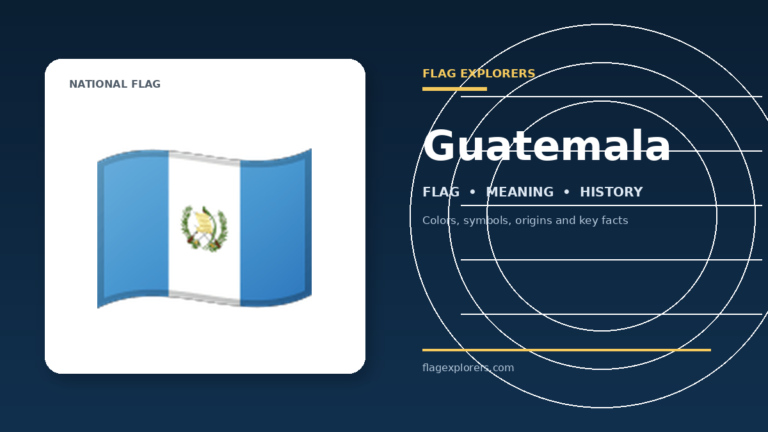
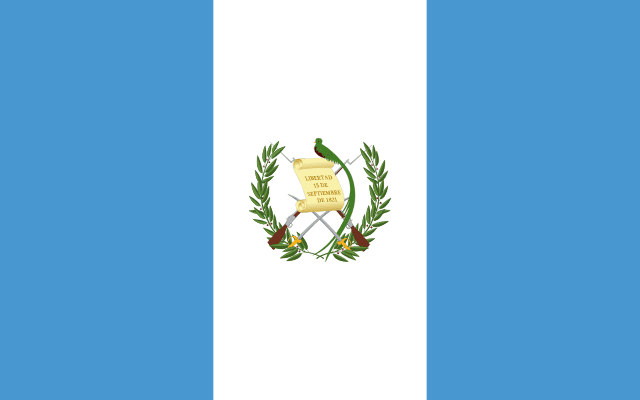
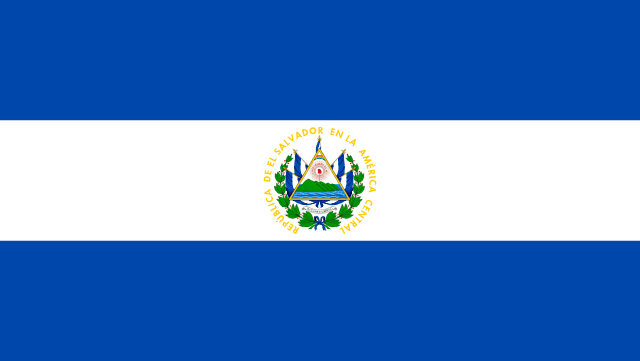
A complete Guatemalan flag can be separated from the flag of El Salvador before you examine either coat of arms. Guatemala places its three bands vertically, with blue at the hoist and fly and white between them. El Salvador places the three bands horizontally, with blue at the top and bottom and white across the middle. In a pair of normally oriented national flag illustrations, this difference is immediately visible. The central emblem is a second way to confirm the country.
The designs use the same broad palette but distribute it differently across their rectangles. On the Guatemalan flag, the white field extends from the upper to the lower edge. On the Salvadoran flag, the white field extends from the left edge to the right. The white field forms a column in one design and a row in the other. These geometric descriptions make the comparison accessible to learners who cannot easily distinguish particular shades of blue.
When a flag is hung vertically or a graphic has been rotated for a poster, the apparent orientation of the bands can change. Identify the original hoist and the intended orientation of the whole design before applying the rule. The arrangement of an emblem can supply a further clue in these situations. A full-size photograph of the flag in its normal position is the best starting point for visual learning.
Neither a shared palette nor a common historical background means the two symbols are interchangeable. The comparison table below describes the main national designs and identifies relevant differences between the officially described flag forms.
| Feature | Guatemala | El Salvador |
|---|---|---|
| Band orientation | Vertical | Horizontal |
| Colors | Blue, white, blue | Blue, white, blue |
| Arms clue | Quetzal and scroll | Triangle and volcanoes |
| Proportions | 5:8 | Varies by official class; see dimensions below |
The Guatemalan design and its central emblem
Guatemala’s Congress identifies the modern basic stripe arrangement with the decree of August 17, 1871 and explains its regulation under Decree 104-97. The reference rectangle has a 5:8 height-to-length relationship. Three equal vertical bands divide that rectangle. In the emblem-bearing national design, the national arms occupy the middle white field. A typical recognizable feature of those arms is the green quetzal above the written scroll.
The scroll relates to the independence date of September 15, 1821. In an accurate reference drawing, it belongs within a larger emblem containing crossed rifles and swords as well as laurel. The bird, scroll, branches and crossed elements are a useful combination of shapes to look for. Unlike the flags discussed in some other Central American comparisons, Guatemala does not place a triangle containing five volcanoes at the center of its coat of arms.
A reader viewing a very small flag image might see only a green shape and a darker cluster in the white field. At that size, do not attempt to read the scroll or count individual elements. The vertical stripe arrangement remains informative, even when the precise arms cannot be inspected. If a worksheet requires the official emblem rather than a recognition sketch, a larger authorized reference is appropriate.
Official Guatemalan sources describe the outer color as sky blue. Illustrations with a pale or more saturated blue can look quite different depending on the screen or fabric. Rather than use a single unverified hexadecimal code to determine the identity of an unknown object, first confirm its stripe orientation and emblem. A color code from a commercial product is evidence of that product’s chosen rendering, not necessarily an official specification.
A drawing without the central emblem can be useful as a preliminary exercise in arranging the three fields. However, the national flag and the national coat of arms have their own rules. An exercise should state whether it represents the bare stripe pattern, the finished emblem-bearing design or another recognized form. That distinction prevents a simple classroom construction from being mistaken for a complete official reproduction.
El Salvador’s flag forms and the five-volcano emblem
El Salvador’s Legislative Assembly publishes Decree 115, the national-symbol law. It distinguishes three principal official flag classes according to use: a ceremonial flag known as the bandera magna, a flag for public buildings and offices, and a parade flag. The underlying blue-white-blue horizontal arrangement is common to these forms, but their central contents and specified dimensions are not all identical.
The ceremonial design carries the complete national coat of arms. Its central triangle encloses a landscape with five volcanoes, a rainbow and a liberty cap. The complete arms include surrounding flags, lettering and laurel. The date of Central American independence appears within the design, and the national motto is also part of the emblem. At a distance, the triangle and its surrounding decorations create a different silhouette from the quetzal and crossed elements of Guatemala.
Articles 9 and 11 of the legislative text specify the national motto on the white stripe for the public-building and parade flags. Article 13 permits reduced flags with arms, motto or just the colors in certain state-property contexts. Consequently, the absence of the full coat of arms from every Salvadoran image is not enough to declare it inaccurate. A national-symbol guide should identify the flag class rather than indiscriminately describe every example as a single standard illustration.
The motto is Dios Unión Libertad, meaning God, Union, Liberty. The words alone can help identify a Salvadoran motto-bearing flag, but they should not be interpreted without the visual context. The same general independence themes appear in several Central American symbols. The combination of a horizontal tricolor and the correct central content is a stronger clue.
If you are making educational flashcards, it is reasonable to choose the familiar complete national-arms version as the reference for El Salvador. Include a caption explaining that other official forms exist. This teaches the most recognizable design without implying that photographs of the public-building or parade flag show an incorrect national symbol.
Official dimensions: compare specific flag classes
Guatemala’s legislature identifies 5:8 as the national flag’s specified height-to-length ratio. A drawing six and a quarter centimeters high, for example, would be ten centimeters long. Each vertical band would be one third of the length. This is a straightforward construction relationship: the boundaries fall at one third and two thirds of the distance from the hoist.
El Salvador’s published legislative text specifies different standard dimensions for different classes. The ceremonial bandera magna is described in Article 7 as 1.89 meters high and 3.35 meters long. The public-building flag is specified as 0.60 meters high by one meter long, and the parade flag as 0.90 meters high by 1.45 meters long. These sizes may be subject to conditions and permissions described in the law. They should not all be collapsed into one universal ratio.
There is also an inconsistency worth noting. The Salvadoran presidency’s public national-symbol reference gives a ceremonial length of 3.25 meters with the same 1.89-meter height. The Legislative Assembly’s text of Article 7 gives 3.35 meters. The Culture Ministry has also used the shorter figure in a public explanation. Because these official references do not agree, this comparison reports both and identifies their sources. For a formal order, consult the applicable consolidated legislation and the competent authority rather than assuming the discrepancy is merely a printing error.
For a classroom diagram, the 0.60-by-1-meter public-building specification is convenient to scale. Draw a rectangle six centimeters high and ten centimeters long. Divide the height into three bands of two centimeters each. Label it as a scaled study of that particular flag form. The Guatemalan example of the same length is slightly taller at 6.25 centimeters and has three vertical rather than horizontal fields. This exercise illustrates that the stripe direction is a much more conspicuous difference than the small change in external dimensions.
For an arms-bearing Salvadoran flag, choose a stated reference class and retain its own proportions. The thumbnails on this page are intended for identification, and their supplier’s raster dimensions need not match a legally required ceremonial fabric size. Using an image to compare designs is different from using a specification to manufacture one.
How two related colors developed into distinct designs
The blue and white colors connect both countries with earlier Central American flag traditions. Guatemala’s Congress describes the influence of the flag of the United Provinces of Central America on the country’s liberal-period design. The 1871 decision changed the arrangement to the vertical form familiar today. This is an important distinction when looking at earlier Guatemalan flags, which may not match the modern design.
El Salvador’s national-symbol law refers to the 1823 adoption of the symbols of the United Provinces. It also records the legislative adoption of the federation’s flag and coat of arms in 1912. These references explain why a horizontal blue-white-blue arrangement and a five-volcano emblem are closely associated with the Salvadoran design. A historic regional symbol provided inspiration for the modern national flag, but it should still be labeled with the date and jurisdiction that applied to the particular object.
A common date in both countries’ arms is September 15, 1821. This historical reference does not mean that their current flags were first adopted on that date. The development of state symbols continued after independence, and the distinct modern designs were established through later political and legislative decisions. Keeping independence, design adoption and subsequent regulation separate produces a more accurate timeline.
When teaching the regional background, consider three layers of evidence. First identify the earlier federation and the shared colors. Next look at each country’s own documented design decisions. Finally examine the modern flag classes and central arms. This prevents the history from being reduced to a vague assertion that one country copied another.
You can also compare the flags as symbols of two neighboring countries. Their shared historical vocabulary does not erase their modern identities, and the different stripe orientation gives a clear visual expression of the separate national designs. A dated reference to an older federation flag should never be substituted for the present flag of Guatemala or El Salvador in a map legend.
Recognize the wider group of similar Central American flags
A flag quiz often includes more than two countries. If the answer choices include Honduras and Nicaragua as well as Guatemala and El Salvador, first classify the stripes. Guatemala stands out from the other three because its main bands are vertical. For the horizontal blue-white-blue designs, the central symbols and particular flag forms become decisive.
Honduras’s ordinary national flag has five separate stars arranged around its center. Nicaragua displays its national arms, which also include a triangular landscape with five volcanoes. El Salvador’s full arms have additional surrounding flags and laurel and their own inscriptions. The Honduran design is relatively easy to separate from the others when the stars are visible, whereas the Nicaraguan and Salvadoran arms require closer attention. A learner should not assume that any triangle automatically identifies Nicaragua, or that any horizontal tricolor with a central emblem must be Salvadoran.
Costa Rica adds a substantial red central stripe to its familiar national flag arrangement. This is another useful structural difference. Before inspecting tiny emblems, check the number and order of the main fields. A color sequence and stripe orientation often reduce the possible answers more efficiently than attempting to remember all of the individual coats of arms.
This method also helps when a country flag is presented in a standardized square icon. The original outer aspect ratio may no longer be visible, but the basic direction of the bands normally survives. Avoid relying solely on the geometry of the icon’s external frame. It could be part of the website interface rather than the flag’s real shape.
In a wider historical collection, look for labels indicating civil, state, merchant or ceremonial forms. Some designs without their usual modern central emblems may be meaningful rather than simply unfinished. A guide to current national flags does not provide sufficient information to identify every historical object in an archive.
A step-by-step classroom comparison activity
Begin with two blank reference cards of similar size. Ask the learner to draw three equal vertical fields on the first and three equal horizontal fields on the second. Do not add the colors immediately. Label the hoist edge and mark the center of each rectangle. At this stage, the two constructions already differ in a way the learner can describe without depending on color perception.
Fill the two outer fields blue, leaving the middle white. The first drawing now has the basic Guatemalan arrangement and the second the basic Salvadoran arrangement. To study complete designs, consult the corresponding illustrations of the arms and add them to the central fields. Avoid inventing fine details if the emblem reference is too small. A beginner can use a separately printed, accurate emblem with the appropriate source credited.
Next make two additional cards with Honduras’s five stars and Nicaragua’s triangular national arms. Ask the learner to sort the four designs using orientation first and the emblem second. A correct explanation for Guatemala should refer to its vertical fields and the recognizable features of its arms. A correct explanation for El Salvador should refer to horizontal fields and the particular central form shown on the reference.
For a more challenging exercise, include a photograph in which a flag is partly folded. Ask the learner what evidence is visible and what information is missing. The right answer might be uncertainty if the central field or orientation cannot be established. This is especially important when a flag is shown hanging from a vertical display rather than flying in its usual position.
Finally compare the national-symbol descriptions with the completed drawings. A teacher can use this activity to introduce the distinction between a flag’s basic geometry, official artwork and legal provisions for particular uses. A student who can explain those distinctions has learned more than a student who only recognizes one set of colorful images.
Frequently asked questions
Are Guatemala and El Salvador’s flags identical? No. Guatemala’s bands run vertically; El Salvador’s run horizontally. Their national arms are also different, although both countries use blue and white and reference Central American history.
What bird appears on the Guatemalan flag? The national arms include the quetzal. It is a useful identification clue when the complete central emblem is visible.
Does every Salvadoran flag have a coat of arms? No. The national-symbol law describes multiple flag classes and permits specified smaller forms with different central treatments. Check the type of flag being represented.
Which country’s arms contain a triangle and volcanoes? El Salvador’s complete national arms include that motif. Nicaragua also uses a triangular volcanic landscape, so the motif alone is not a unique identifier among all Central American countries.
Why are the proportions reported differently in some Salvadoran sources? The different official classes have different specifications, and the ceremonial length given by the presidency differs from the figure in Article 7 of the legislative text. Consult the law for the particular form and confirm requirements before ordering an official flag.
Can I use the illustrations as drawing references? Yes, as educational references. For an exact formal reproduction, use the applicable dimensions and approved emblem artwork. National-symbol rules are separate from the copyright status of the image file.
Sources and artwork
- Guatemala Congress – Decree 104-97
- Guatemala Congress – 155 years of the flag
- Diario de Centro América – flag and emblem history
- El Salvador Legislative Assembly – Decree 115, Articles 2 and 5–13
- El Salvador Presidency – national symbols
- El Salvador Culture Ministry – national symbols exhibition
- Flagpedia / FlagCDN artwork terms
Flagpedia describes its supplied flag artwork as public domain. National-symbol usage rules remain separate; the illustrations are intended for educational reference.