Honduras vs Nicaragua Flag: Blue Stripes, Stars and National Symbols
Two blue-white-blue designs, distinguished by five stars or a national coat of arms. Includes the 2026 Honduras color context.
Reference images from FlagCDN; Honduran blue may vary by rendering and period. See the color section.
The fastest way to tell Honduras and Nicaragua apart
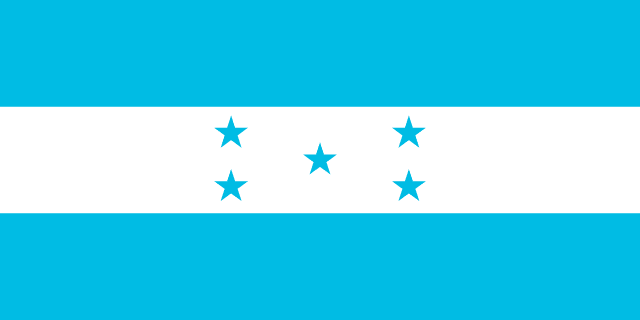
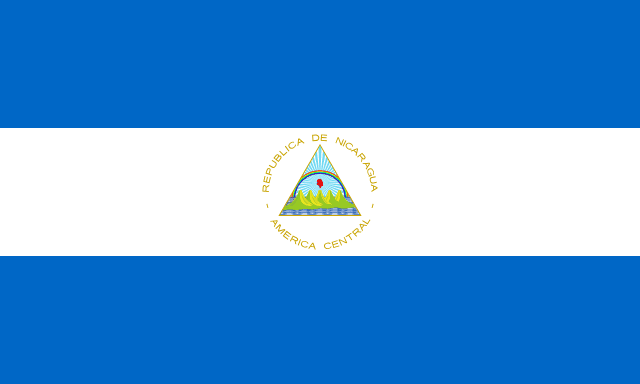
The national flags of Honduras and Nicaragua share a familiar Central American arrangement: a blue horizontal band at the top, a white band in the middle, and a second blue band at the bottom. The middle band supplies the most dependable distinction. The ordinary Honduran flag carries five blue five-pointed stars. Four occupy the corners of an imaginary rectangle and one sits in its center. Nicaragua’s blue-and-white flag instead displays the national coat of arms, whose triangular design is surrounded by lettering.
Those differences are more reliable than comparing two blue samples on a screen. Honduran flag colors have been the subject of a renewed debate, while the Nicaraguan legislation describes its blue as cobalt. A particular image may also be an older rendering, a commercial reproduction or a photograph whose color balance is affected by lighting. A recognizer who checks the center of the white band first is less likely to be confused.
The flags differ in their specified rectangular proportions. Honduras’s historic decree requires a length twice its height, whereas Nicaragua’s 1971 national-symbol law specifies a height-to-length proportion of 3:5. A correct flat illustration at a common height therefore makes the Honduran flag longer. However, square icons and identically sized graphic containers frequently hide that difference. The stars and coat of arms remain the practical identification test.
This comparison concerns the ordinary Honduran national flag and Nicaragua’s blue-white-blue national flag. It does not treat every official, military or political banner as another version of the same design.
| Feature | Honduras | Nicaragua |
|---|---|---|
| Bands | Blue, white, blue | Blue, white, blue |
| Height:length | 1:2 | 3:5 |
| Middle field | Five separate stars | National coat of arms |
| Color reference | Turquoise in 1949 decree; 2026 display debate | Cobalt blue in 1971 legislation |
Five stars or a triangular national coat of arms?
Start with the central emblem on Honduras’s flag. The five stars are distinct shapes rather than parts of a single shield. The four outer stars form the corners of a rectangle aligned with the horizontal bands; the fifth occupies the center. When you mentally connect the opposite corners through the middle, the arrangement resembles an X, but there is no actual diagonal blue line joining them. A drawn cross or saltire would be an extra element that does not belong there.
The Honduran national newspaper’s account of flag history explains the five stars through the earlier Central American federation: Guatemala, El Salvador, Honduras, Nicaragua and Costa Rica. This historical interpretation is worth remembering because the star count is not a count of Honduras’s current departments. The design expresses a regional connection through separate national symbolism.
Nicaragua’s legislature describes a coat of arms with an enclosing circular inscription, a gold-edged equilateral triangle and a landscape containing five volcanoes. Instead of five isolated stars, its reference to five countries is communicated through a very different visual composition. The ordinary flag’s central device has more fine detail than the Honduran arrangement, so the difference is noticeable even before you can identify each element.
The triangle, volcanoes and surrounding words form a coherent emblem. On a small image the text may look like a thin ring. On a larger image it becomes possible to inspect the landscape and other heraldic details. Do not mistake the tiny marks inside the Nicaraguan emblem for the separate Honduran stars: they occupy different relationships to the white background.
A useful explanation for a geography class is that the flags have comparable background structures and distinct central devices. Students can first identify the bands they have in common, then describe each device in a few words. This is more informative than merely saying that both flags are blue and white.
How the proportions and stripe heights compare
Honduras’s Superior Court of Accounts reproduces the dimensions given in the 1949 decree: the full height of the three bands fits twice along the length. The Nicaraguan legislative text establishes a 3:5 rectangle. In the examples below, height is always given before length, regardless of how a seller or another publication chooses to express its measurements.
At a common height of 12 centimeters, Honduras requires a 24-centimeter length. Nicaragua requires 20 centimeters. Both designs have bands of equal height, so each band is four centimeters high in both drawings. The classroom exercise deliberately makes stripe thickness the same; only the horizontal dimension and the central device change. Place the outlines next to one another and the difference in proportion is clear.
If the flags are instead drawn at a common length of 30 centimeters, the Honduran rectangle is 15 centimeters tall and its stripes are five centimeters high. The Nicaraguan rectangle is 18 centimeters tall, and each stripe is six centimeters high. A table of dimensions can therefore help you choose a suitable piece of paper without needing to estimate the geometry from an image.
Mark the central band by drawing a horizontal line one third of the height from the top and another one third of the height from the bottom. For Honduras, locate the center of the whole rectangle before positioning the stars, then consult a trusted reference for the placement of the four outer stars. The decree describes their geometric arrangement but should not be treated as if it supplied a complete pixel-coordinate blueprint for every star outline. For Nicaragua, locate the center of the white band and refer to an approved coat of arms illustration.
Do not give both designs identical lengths and heights simply because you want the pictures to occupy equal spaces in a worksheet. Reserve equal spaces for them if desired, but fit each flag inside its space while maintaining the original aspect ratio. The excess white space around one illustration is not part of the flag. A thin border around the displayed picture can help readers distinguish the white band from its surroundings.
Why blue alone is not a dependable test in 2026
The color question requires particular care. The Honduran 1949 decree, as reproduced by the country’s Superior Court of Accounts, specifies turquoise blue for its outer bands and stars. In Nicaragua, the National Assembly’s explanation of the 1971 law identifies cobalt blue as the color of the outer bands. Those descriptions are useful historical and legal references, but color names are not interchangeable with an exact universal RGB value.
In practice, Honduran flags have appeared in different shades across periods of use. The Honduran national newspaper’s August 2026 history describes the return to turquoise display practice in 2022 and the subsequent return to a darker blue in 2026. This should be distinguished from a legislative amendment. On September 24, 2026, the Honduran Congress reported a proposal to change the legal color wording to azul turquí, a dark blue. A reported proposal is not, by itself, proof of enactment. As of November 27, 2026, the sources consulted for this comparison did not establish that the proposal had become law. Readers seeking manufacturing or official-display specifications should check the latest gazetted legislation rather than use this article as a legal certificate.
This is also why an educational thumbnail can differ from a legal reference or a current photograph. A digital supplier may update its Honduran rendering at a different moment from a school, embassy or flag manufacturer. A photograph may show fabric produced before a change in display practice. A carefully labeled illustration should identify which reference is being used rather than silently treating a darker or lighter example as evidence of a different country.
You can identify Honduras even if a blue rendition looks close to Nicaragua’s: inspect the five stars. Conversely, Nicaragua’s central emblem remains recognizable if its blue is unusually pale under bright sunlight. Color is best used as a supporting observation, not as the final test. The site’s separate Honduras flag colors guide discusses the color question in more depth.
A shared Central American background, separate national designs
The flags’ similarity reflects the historical context in which the Central American countries developed their own national symbols. The Honduran national newspaper traces the blue-and-white pattern to the United Provinces formed in 1823, following independence from Spain in 1821. When the federation dissolved, the region’s successor states continued to draw on related flag traditions.
Honduras incorporated five stars into its flag in 1866, according to that account. The decree of January 18, 1949 later specified the familiar star arrangement and turquoise wording. These are different stages of the design’s history. The date on which a national flag was first created need not be the date on which its latest geometry or official color wording was specified.
Nicaragua also has a history of national-symbol legislation. Its National Assembly records a succession of laws before the 1971 instrument established detailed specifications and use rules. The current blue-white-blue design uses the national arms as its central distinguishing feature. Readers can understand the similarities through the former federation while still treating the legal and historical development of each flag separately.
Nicaragua now also recognizes a red-and-black national symbol connected with the Sandinista tradition, as the National Assembly explained in its 2025 and 2026 material. This article’s visual comparison is intentionally narrower: it concerns Nicaragua’s blue-white-blue design, the flag ordinarily selected in country-flag recognition exercises. A political or constitutional discussion of the red-and-black banner requires its own sources and context. Its existence does not alter the way the blue-white-blue design differs from the Honduran flag.
The shared color pattern is not a sign that Honduras and Nicaragua belong to the same modern state. They are distinct countries whose flags preserve different expressions of regional history. If a reference collection includes older federation flags alongside current ones, use the dates and design labels rather than assume that every blue-and-white banner can be assigned to a modern country.
Compare the wider family of Central American flags
Honduras and Nicaragua are not the only flags in this region to use blue and white. When studying the complete set, El Salvador’s horizontal blue-white-blue design is especially relevant. Its emblem-bearing national flag has a central device, so a reader should inspect the design rather than assume that every central triangle belongs to Nicaragua. El Salvador also has different recognized flag forms; the linked country guide gives the context for each.
Guatemala’s national flag uses vertical blue-white-blue bands instead of the horizontal arrangement discussed here. This gives learners a distinct structural test before they even inspect its central arms. If a national flag has blue at the left and right and a white vertical field in the center, it does not match the ordinary horizontal design of either Honduras or Nicaragua.
Costa Rica’s familiar flag contains a prominent red horizontal band. That red band changes both the stripe count and the visible color sequence, making it easier to separate the Costa Rican design from the two examined on this page. The region’s blue-and-white traditions are thus a starting point for recognizing a family of designs, not a rule that all five flags look the same.
For a classroom sorting task, make five clearly labeled reference cards. First place the cards in groups according to stripe orientation: vertical on one side, horizontal on the other. Within the horizontal group, separate flags containing red from those using only blue and white as the main bands. Finally use the devices in the middle field to identify the remaining similar flags. The order of these decisions teaches a repeatable identification method rather than five isolated facts.
This broader comparison also explains why a question framed as Honduras versus Nicaragua is easier than an open-ended quiz with all national flags. In the two-choice exercise, a visible coat of arms resolves the intended choice. In a wider exercise, the exact coat of arms becomes important. A good flag quiz makes its intended set of possible answers clear.
Exercises for recognizing flags in photographs and games
Prepare two cards from the references above and put a small removable strip of paper over each white band. Ask someone who has not seen the original labels to identify the countries. A confident answer based only on blue may reflect recognition of a particular illustration rather than an understanding of the actual designs. Remove the covering strips and repeat the question. The stars and triangular emblem should now make the distinction clear.
Try the same activity with smaller images. Keep the flags’ actual proportions, but reduce the printed height until details of the coat of arms become difficult to see. The Honduran stars may remain individually recognizable at a size where the letters in the Nicaraguan emblem are no longer readable. At this stage, ask the learner to identify the shape of the central device, rather than to read the inscription.
A photograph of a real flag can be less straightforward than a reference card. If the cloth is partly rolled around a pole, some of Honduras’s stars may be hidden. In the Nicaraguan case, the emblem may be folded into a narrow dark mark. A flag can also be photographed from behind. Seek another view or an independent caption before giving a firm answer if the central area is not visible.
For accessibility, describe the designs in words and include the country name as alternative text for ordinary educational illustrations. When creating a quiz, hide answers from the visual task while providing an accessible way to inspect the question. Learners who find subtle color differences difficult can concentrate on the five individual stars, the circular inscription and triangle, and the relative shape of the rectangle.
Finally, practise with Honduras and Nicaragua alongside the other Central American flags. Keep a record of the reason for each incorrect answer. If you confused two emblems, review the fine details; if you confused vertical and horizontal bands, review the orientation first. That feedback makes the next practice session more useful than simply trying to memorize another image.
Frequently asked questions
What is the most obvious difference between Honduras and Nicaragua’s flags? Honduras has five separate blue stars in the central white field. Nicaragua uses its coat of arms, which contains a triangular emblem surrounded by lettering.
Are their flags the same size? They can be produced in many physical sizes, but the official proportions differ. The Honduran decree specifies 1:2, while Nicaragua’s 1971 law specifies 3:5. An online icon may not preserve these proportions.
Why are both flags blue and white? Both draw on earlier Central American flag traditions. Their distinct national devices preserve different expressions of that shared history. Their resemblance does not make them interchangeable.
Is Honduras’s flag turquoise or dark blue? The 1949 law specifies turquoise; recent display practice has varied, including a return to dark blue in 2026. A September 2026 proposal sought to change the legal color description. Enactment was not established by the sources consulted for this article.
Can I tell them apart from a folded flag? Sometimes the visible stars or coat of arms are sufficient. If the central field is completely hidden, the remaining bands alone may not provide a reliable answer.
Can I reproduce the flag images commercially? The illustrations used here come from a supplier describing its flag artwork as public domain. Separate national-symbol rules can govern display and emblem use. For an official reproduction, consult the applicable legislation and authorized artwork.
Sources and artwork
- Honduras Superior Court of Accounts – 1949 decree text and proportions
- Diario Nacional de Honduras – flag history and 2026 display practice
- Honduras National Congress – September 24, 2026 color proposal
- Nicaragua National Assembly – Decree 1908
- Nicaragua National Assembly – blue-white flag design and arms
- Nicaragua National Assembly – September 2026 national flags
- Flagpedia / FlagCDN artwork terms
Artwork is provided by Flagpedia/FlagCDN under its stated public-domain terms. National-symbol restrictions remain separate from copyright. Reference images are educational, not certified production specifications.