How to Draw the Iowa Flag: Vertical Tricolor, Eagle and Motto
Measured reference transfer, practical examples and accuracy checks.
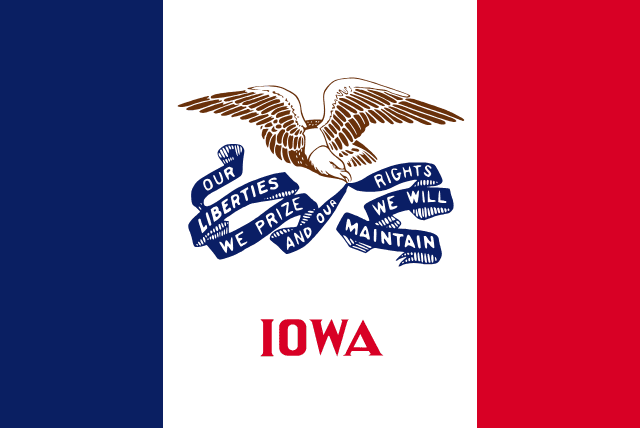
Draw Iowa’s state flag with blue at the hoist, white in the center and red at the fly. The broad central white field contains an eagle carrying blue streamers with the state’s motto, and the name IOWA in red beneath. Iowa Code §1B.1 defines the color order and emblem but does not give a complete numerical construction table. This tutorial shows how to transfer the established flag artwork to paper or an editable digital drawing.
For the history and symbolism, read our Iowa flag guide.
Construction measurements
| Stripe direction | Vertical |
|---|---|
| Hoist color | Blue |
| Central field | White, broader in the reference artwork |
| Fly color | Red |
| Device | Spreading eagle with blue streamers |
| Motto | Our liberties we prize and our rights we will maintain |
| State name | Red lettering below the emblem |
Step 1: Choose a canvas and distinguish Iowa from France
Begin with the entire rectangular reference, rather than a cropped picture of the eagle. Iowa’s flag uses the same three broad color categories and order as the familiar French national tricolor. The difference begins with the relative stripe widths visible in the Iowa artwork, and continues with the central emblem.
The reference image used here has a width of six hundred forty pixels and a height of four hundred twenty-eight pixels. A paper drawing thirty-two centimeters long and 21.4 centimeters high preserves its exact raster proportions. A thirty-by-twenty centimeter classroom approximation is also convenient, provided it is identified as an approximation.
The current law describes the three vertical regions, but the cited section does not assign a separate numerical width to each region or a universal overall aspect ratio. Use the source artwork to establish the exact relative positions of the stripe boundaries instead of assuming that Iowa has three identical thirds.
Mark the vertical midpoint of the canvas and identify the left edge as the hoist. The right edge is the fly. Blue belongs beside the staff, while red belongs at the opposite end in the standard front-facing view.
Keep the entire center area white until the stripe boundaries and emblem have been established. An error at this stage can leave too little room for the eagle’s wings or the motto. The white area in the established reference is noticeably broader than either outer color region.
A digital artist can build the three background rectangles first, then place the eagle and lettering above them. Preserve their separate layers while editing. A single flattened background image makes it harder to correct the stripe boundaries if the central composition is later found to be too wide.
Step 2: Transfer the two vertical stripe boundaries
Measure the position where blue meets white in the reference image, using a ruler or pixel-coordinate tool. Measure the position where white meets red as well. Both measurements should start from the same left-hand origin.
Divide the first measured position by the total reference length to get its relative horizontal location. Do the same with the second position. Those fractions can then be multiplied by the length of the new drawing.
For example, suppose a practice reference had stripe boundaries at one-quarter and three-quarters of the complete length. On a thirty-two-centimeter canvas those marks would be eight and twenty-four centimeters from the hoist. This illustrates the conversion method; it is not an additional legal specification for Iowa.
For an exact reference transfer from the 640-pixel illustration, record the actual boundary pixels from that file. If the drawing is enlarged to 1280 pixels long and 856 pixels high, double the measured boundary coordinates. The broad white center will retain its original proportions.
Use a vertical ruler to connect the top and bottom marks for each boundary. All three stripes extend the full height. Do not add white margins between the three background shapes or place a horizontal line across the center field.
For paper construction, cut the blue and red strips from colored paper and attach them to the left and right sides of a white base. Make sure their inner edges remain parallel. Use the actual source measurements rather than guessing how much white should remain.
Check the white area’s width before drawing the eagle. If all three fields are equal in width, compare the result with Iowa’s established reference. The ordinary French flag’s three equal divisions are not a reason to impose the same layout on this state flag.
The underlying tricolor should be recognizable even before the emblem is added, but the drawing is not yet a complete Iowa flag. The eagle, streamers, motto and state name are essential features of the finished design.
Step 3: Draw the spreading eagle without replacing it with another emblem
The eagle is positioned in the central white field. Its wings extend outward, and its beak holds the blue streamers. Iowa’s legal description identifies this recognizable arrangement; it does not provide a complete numerical set of feather or wing coordinates.
Start by locating the overall limits of the eagle on the source image. Mark the top of the head, the outer wing tips and the lowest part of the bird. Transfer those landmarks onto the white field using the same scale factor as the stripe boundaries.
Sketch the body and head first. Next establish the large wing contours. The wings should remain within the white field and follow the posture shown in the reference. Do not use a random photograph of an eagle with a different wing position.
Add the main feather divisions progressively, from the large outer contours toward the smaller internal details. A close-up tracing grid is useful for this step. Draw a grid over a working reference copy, transfer the crossing points of the outline, and connect them smoothly.
The Smithsonian National Postal Museum identifies the bird as a bald eagle and describes its role in the flag. Use the established flag artwork for the bird’s coloration and stylized form. The drawing is not meant to reproduce the entire Great Seal of the United States.
Pay attention to the position of the beak. It is the attachment point for the streamer arrangement. If the eagle is redrawn in a different posture or the beak is placed too far from the intended streamers, the relationship between the two parts will be lost.
For a vector illustration, use separate filled paths for the body, wings, tail, head and major color regions. Keep these shapes grouped as the eagle while checking its overall placement. This makes it possible to resize the entire bird without stretching an individual wing.
A simplified classroom version can reduce the fine feather detail, but it should remain clearly identified as a student drawing. A formal flag reproduction should use the correct state artwork, not a newly designed eagle silhouette.
Step 4: Draw the blue streamers carried in the beak
The blue ribbon or streamer arrangement is distinctive because it contains the state’s motto. It is part of the eagle composition, not a separate banner placed arbitrarily under the state name.
Use the source image to study how the ribbon leaves the beak, curves across the white field and folds around the emblem. Mark the main contour before writing any letters. This creates a clear area in which the motto can fit.
The streamers should be recognizable as blue shapes carrying white text. If you make them extremely narrow, the lettering will become difficult to place. If you enlarge them to the width of the white stripe, they may interfere with the eagle’s wing positions.
For a paper drawing, sketch the front surfaces of the ribbon first. Add any folds and curved ends shown in the reference afterward. The folded sections help create the established appearance and should not be replaced by an unrelated straight rectangle.
A digital drawing can construct the streamers as several closed blue paths. Use a separate layer for the lettering. This lets the artist correct the text spacing or orientation without altering the ribbon outline.
The code calls for blue streamers bearing the state’s motto in white. It does not provide a complete typography and vector-curve specification in the cited section. Match the reference artwork for the detailed line breaks, letter arrangement and curves.
Before coloring, check that the ribbon actually connects visually to the eagle’s beak. A blue banner placed below an eagle without this relationship would omit a significant feature of the flag.
Reserve room beneath the streamers for the state name. The blue ribbon and the red IOWA inscription have different roles and should not be combined into one text block.
Step 5: Add the motto and state name accurately
Iowa’s state motto is “Our liberties we prize and our rights we will maintain.” The wording is specified in the flag law. Copy it accurately from the official source before fitting the letters into the ribbon.
For a hand-drawn illustration, write the motto on a separate sheet first. Determine which portions belong in each part of the ribbon by inspecting the reference. It is easier to correct a misplaced word before drawing with permanent ink or paint.
Use a light curved baseline or several short guidelines to match the ribbon arrangement. The letters should remain white against blue. Do not replace the motto with a shorter slogan simply because the complete phrase is difficult to fit at a small scale.
The word IOWA appears below the streamers in red. Mark the position of the four letters on the white field and center the complete word according to the reference. The name should not appear inside the blue hoist stripe or on a separate red banner.
The full word has four characters, including two distinct vowel shapes. Check that the initial I remains visible and that the spacing is balanced. A large uppercase state name is a useful recognition clue even when the smaller motto cannot be read.
In digital artwork, preserve the text as editable objects until the spelling and positions have been verified. Convert text to paths if appropriate for the final export, using fonts whose licensing permits the intended use. The code does not require an invented font name.
A classroom project at a very small size may use an enlarged study of the ribbon beside the completed drawing so that students can read the motto. Keep that study outside the flag rectangle rather than enlarging the actual text disproportionately.
The final artwork should contain both the full motto and the state name in their established positions. For more information about the motto’s history, use the linked Iowa flag guide rather than treating the drawing as a complete account of Iowa’s political history.
Transfer the complete emblem at an accurate scale
When enlarging an existing flag reference, use a single scale factor for the entire artwork. The 640-by-428-pixel source can be doubled to 1280 by 856 pixels or halved to 320 by 214. All the positions and shapes should change by the same factor.
For a thirty-two-centimeter-long paper version, one pixel of the source corresponds to 0.05 centimeters. A hypothetical point at x equals 300 and y equals 150 in the reference would appear at fifteen centimeters across and seven and a half down. These coordinates illustrate the arithmetic, not a claimed location of a particular eagle feature.
Record the real coordinates of the stripe boundaries, bird landmarks, streamer outline and the state name from the selected artwork. Put them into a small measurement table and retain the original reference alongside the notes.
If you change the canvas length without changing the height, the relative stripe widths may need to be recalculated and the emblem may need to be repositioned. Do not stretch the eagle and typography nonuniformly; that alters their shape.
A vector drawing can use a clipping rectangle for the complete flag, with the white field and emblem contained within it. Keep the three background panels editable so their boundaries can be compared independently with the source.
For paper, a proportional tracing grid gives the same advantages without requiring a computer. Divide the reference and destination into the same number of rows and columns. Transfer the main outline and use the grid intersections to check difficult details.
When exporting a small preview, preserve the detailed master file. The small inscription may become hard to read, but that does not justify omitting it from the source image. Supply a descriptive caption or larger view instead.
Color and layering checks
Iowa’s underlying field uses blue, white and red. Its central composition introduces the established eagle colors, blue streamers with white text and the red state name. Use the actual flag reference rather than a guessed palette based on another country’s flag.
The blue and red stripe positions are fixed by the statutory description. A reverse view of a fabric flag may show the colors in the opposite apparent left-to-right order. A standard front-facing illustration should keep blue at the hoist.
The code does not give a complete set of digital color numbers for the entire eagle and streamers. A screen sample from one image is not automatically a compulsory textile color standard. Identify the source artwork when exact matching matters.
For a colored-pencil drawing, complete the white-field emblem before coloring the darker outer regions. This avoids accidentally carrying blue or red into the white center and makes it easier to preserve the white motto lettering.
For cut-paper or collage work, assemble the three stripe base separately from the central drawing. Then attach the emblem at its measured location. A full-size white backing can help prevent the colored side strips from showing through the eagle area.
In a vector file, place the central composition above the three base rectangles. Check that no transparent areas appear along the stripe boundaries. Use the original flag’s rectangular outline rather than a rounded badge or shield.
For formal reproduction, consult the state reference and applicable specifications. The measurements derived from an educational raster file are useful for understanding the design, not evidence of official approval for a new manufacturing master.
Final review and a tricolor classroom exercise
Check the three vertical areas first. Blue is next to the pole, white occupies the center and red lies at the fly. Compare the relative widths with the established Iowa image rather than imposing equal thirds.
Inspect the eagle and confirm that its wings spread across the central white area. The blue streamers are carried in its beak, with the full motto rendered in white. Below them, the state name appears in red.
Compare the design with France’s plain tricolor. The state emblem and wider central field distinguish Iowa’s drawing. Also compare it with other state flags containing an eagle, including North Dakota, where the surrounding design and placement differ.
For a practical exercise, give students the 640-by-428 reference dimensions and ask them to calculate a quarter-size image. The answer is 160 by 107 pixels. Then ask them to calculate the positions of measured source landmarks at that scale.
For an additional exercise, remove the state name from a practice image and ask which feature is missing. Another version can have the motto in the wrong color or a ribbon disconnected from the beak. Students should explain the differences using the legal description rather than personal preferences.
The existing Iowa flag article explains the designer, the adoption of the flag in 1921 and the historical background to its tricolor. This construction guide adds a practical reference-transfer workflow for the current design. Keep the two educational purposes distinct when using the articles together.
Frequently asked questions
Which color is next to the staff?
Blue.
Are the stripe widths specified numerically in §1B.1?
No. Use the established state artwork for their relative widths.
What does the ribbon say?
Our liberties we prize and our rights we will maintain.
Where is the word Iowa?
In red below the blue streamers.
Sources and artwork
Iowa Legislature: Iowa Code Chapter 1B
Iowa Code §1B.1, statutory text
Smithsonian National Postal Museum: Iowa flag
Flagpedia/FlagCDN public-domain reference artwork; attachment 2208. Original educational calculations; reviewed November 2026.