Thailand vs Costa Rica Flag: Reversed Red and Blue Stripes Compared
Side-by-side identification, documented history and practical measured comparison.
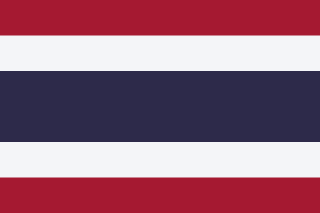
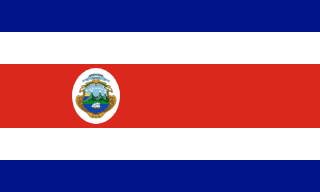
Thailand and Costa Rica both use five horizontal bands with a double-height middle stripe. Thailand has red-white-blue-white-red, while Costa Rica’s plain national flag has blue-white-red-white-blue. The wide central stripe is blue for Thailand and red for Costa Rica. Their common 1:1:2:1:1 band structure is identical, but their usual overall proportions, historical origins and official-use variants differ.
Comparison at a glance
| Feature | Thailand | Costa Rica |
|---|---|---|
| Top and bottom bands | Red | Blue |
| Second and fourth bands | White | White |
| Double-height central band | Dark blue | Red |
| Relative stripe heights | 1:1:2:1:1 | 1:1:2:1:1 |
| Reference height:length | 2:3 | 3:5 |
| Plain national flag emblem | None | None |
| Related official variant | Naval ensign with elephant device | Pabellón Nacional with arms |
Identify the country using the widest stripe
The easiest way to distinguish these flags is to inspect the wide central band. Thailand has a dark-blue middle band, while Costa Rica has a red middle band. Each is twice the height of any one of the four narrower bands.
The two white stripes remain in the same locations in both flags. They sit directly above and below the central band. In Thailand, the two outer red stripes match each other; in Costa Rica, the two outer blue stripes match each other.
This arrangement means the colored bands are exchanged while the white bands stay in place. A red-white-blue-white-red flag with a wide blue center is Thai. A blue-white-red-white-blue flag with a wide red center matches the plain Costa Rican flag.
Unlike some vertical tricolor comparisons, turning either flag upside down does not exchange the countries’ designs. Their horizontal patterns are symmetric from top to bottom. Viewing the reverse side also leaves the stripe order unchanged in the ordinary plain flags.
A cropped image showing only one red or blue area is not enough to identify a country. Even a white band between red and blue could appear in either design. Obtain a view that reveals the thickness of the central band or the top and bottom colors.
If a coat of arms appears within the red center, the image may show Costa Rica’s Pabellón Nacional, an arms-bearing official variant. The plain national flag described in Law 10178 contains only the colored bands. It is the plain version that makes the visual comparison with Thailand particularly close.
The two countries’ flags should not be distinguished by the exact shade of red or blue in an uncontrolled photograph. Their band order and relative thickness provide more reliable evidence.
The shared six-unit stripe construction
Both flags divide the vertical dimension into six equal construction units. The top band uses one unit, the next white band one unit, the middle colored band two units, the second white band one unit and the bottom band one unit.
Choose a height of thirty centimeters. One construction unit measures five centimeters. The stripe heights are consequently five, five, ten, five and five centimeters. Their boundaries lie five, ten, twenty and twenty-five centimeters down from the upper edge.
For Thailand, fill the top five centimeters red, the next five white, the central ten blue, the next five white and the bottom five red. For Costa Rica, exchange the red and blue regions while keeping the white bands unchanged.
The wide central stripe occupies exactly one-third of the total height. The two narrow outer stripes together also occupy one-third. The remaining two white stripes together occupy one-third.
Because all the bands span the full length, each of the three colors occupies one-third of the plain flag’s area. That equality holds for both designs regardless of their differing outer rectangle proportions.
This mathematical observation can help identify mistakes in a classroom drawing. If the central band is only as tall as either of the adjacent white stripes, all three colors will no longer have the intended equal area distribution. If the artist divides the flag into five equal strips, the central band occupies only one-fifth rather than one-third of the height.
The legal Costa Rican description expressly establishes the twice-as-wide central red stripe. Thailand’s official government illustration likewise presents the five bands on a six-part vertical grid. Use these sources for the construction relationship rather than treating the appearance of a low-resolution commercial graphic as the standard.
For an educational comparison, the stripe boundaries can be drawn from one common template. Apply the two separate color arrangements to copies of the template, then adjust the complete flag lengths according to the respective reference ratios.
Compare the flag lengths at the same height
Thailand’s government portal describes its national flag on a nine-part horizontal and six-part vertical grid, equivalent to a two-to-three height-to-length ratio. A flag thirty centimeters high is therefore forty-five centimeters long.
The commonly used Costa Rican reference proportions are three to five. At the same thirty-centimeter height, that flag is fifty centimeters long. It retains the same five, five, ten, five and five centimeter band heights, but its colored rectangles extend farther horizontally.
For a smaller drawing twelve centimeters high, Thailand’s reference length is eighteen centimeters. Costa Rica’s is twenty centimeters. The stripes are two, two, four, two and two centimeters high in both.
The Costa Rican law linked below specifies the band design; the outer three-to-five ratio is the standard reference used in this comparison, rather than a new numerical requirement inferred from the band’s relative dimensions. Consult the applicable current regulations and procurement specifications for formal manufacture.
The distinction in length is less useful than the central band color when viewing a real flag. Commercial textiles may have different formats, and thumbnails often use fixed frames or cropping. A photograph taken obliquely can make a long flag appear much shorter.
On a website, display each flag at its natural aspect ratio rather than stretching both to fit an identical rectangle. Their stripes should stay horizontal and equal in relative thickness. If the image must fit a fixed card, use empty surrounding space rather than distorting the artwork.
An exact comparison can also use two different vector artboards at the same height. For Thailand, set the artboard to 900 by 600 pixels. For Costa Rica, set it to 1000 by 600 pixels. Both have narrow bands one hundred pixels high and a central band two hundred pixels high.
Thailand’s Trairong and the 1917 design
Thailand’s national flag is known as the Trairong, or tricolor. The present red-white-blue arrangement developed in the reign of King Vajiravudh, Rama VI. The flag’s official government history connects the design with the flag legislation of 1917.
Earlier Thai flags used different arrangements, including designs with a white elephant on red. The modern striped flag is distinct from those historical national symbols. A picture of a white elephant on red should be dated and described according to the version shown rather than presented as the current ordinary flag.
The 1917 development of the tricolor also belongs to the period when Siam, as the country was then known internationally, participated in World War I on the Allied side. The addition of blue created a new three-color arrangement within that historical setting.
Common Thai national explanations associate red with the nation, white with religion and blue with the monarchy. The flag’s meanings should be understood through Thai historical and governmental sources rather than assumed to apply to every red-white-blue flag.
The wide central blue stripe is therefore an important component of the national design, not merely a color inserted to make the flag resemble another country’s tricolor. Its width follows the specified five-band construction.
Thailand has other official-use flags, including a naval ensign with an elephant device on a red disk superimposed on the striped base. The plain Trairong should be distinguished from that particular ensign and from earlier historical elephant flags.
A timeline should separate earlier flag designs, the 1917 tricolor development and later legal codification. This avoids assuming that the flag first existed only when the most recent flag legislation was enacted.
Costa Rica’s tricolor and its own historical origins
Costa Rica’s flag developed in the context of the formation of the republic in the nineteenth century. The red-white-blue palette and five-stripe design are associated with the 1848 national symbols and the role of Pacífica Fernández, the wife of President José María Castro Madriz.
Historical descriptions associate the color selection with the French republican tricolor tradition. That historical connection is different from the Thai tricolor’s origins. The similar band pattern does not establish that Costa Rica copied Thailand or that Thailand copied Costa Rica.
Costa Rica’s 2022 Law 10178 provides a contemporary definition of the national symbols. It identifies the first and fifth bands as blue, the second and fourth as white, and the wider central band as red. The law also supplies interpretations connecting blue with the country’s sky, white with peace and red with sacrifice for liberty.
Those interpretations belong to the Costa Rican national flag. Thailand uses the same general colors but connects them with a different national historical tradition. Do not assign the Thai meanings of nation, religion and monarchy to the Costa Rican bands.
The law distinguishes the plain Bandera Nacional from the Pabellón Nacional. The latter includes the national coat of arms. The arms-bearing flag is a specific official-use design and should not automatically be substituted for the ordinary plain reference.
The distinction is particularly relevant to image identification. A photograph of Costa Rica’s flag on an official building may show the arms-bearing form. The central red band remains an important visual identifier, but the coat of arms adds further evidence.
For historical study, identify the specific national symbol and version being shown. A separate Costa Rican coat of arms, a flag with the arms and a plain national flag are related but are not identical images. The main Costa Rica flag guides provide fuller coverage of these distinctions.
The arms-bearing flag and other official-use exceptions
The direct comparison concerns the two plain national flags. That does not mean every flag used officially by Thailand and Costa Rica consists only of five uninterrupted bands.
Costa Rica’s Pabellón Nacional uses the same basic blue-white-red-white-blue pattern and includes the national coat of arms within the central red region. Its official status and permitted uses are set out in the national symbols law. The coat of arms should be reproduced from the appropriate authorized reference rather than from a generic heraldic image.
An image that shows a Costa Rican coat of arms in the red central band is not an inaccurate Thai flag. It is a distinct Costa Rican design variant. In an ordinary educational comparison, the plain version makes it easier to isolate the shared band geometry.
Thailand’s naval ensign likewise contains a device superimposed on its national stripe arrangement. The elephant emblem belongs to that official-use context, not the plain Trairong. It should be labeled according to its actual role.
In a flag database, store plain national flags and official-use variants as separate records linked to the appropriate country. This allows users to identify the design they have actually encountered rather than seeing all possible flag forms collapsed into one image.
If a product or display requires the national coat of arms, check the current law and official artwork restrictions. An educational article about a flag does not establish permission for unrelated commercial use of official symbols.
For the specific plain flag comparison, no emblem is necessary. The most reliable distinction remains the middle stripe’s color. Adding a coat of arms to the reference just to make one design easier to distinguish would undermine the purpose of comparing the ordinary flags.
Other red-white-blue flags with horizontal stripes
The Netherlands uses three equal horizontal bands in red, white and blue. Its flag does not contain five stripes or a double-height middle band. Luxembourg also uses three horizontal bands with a lighter blue in commonly reproduced reference artwork.
Russia uses white, blue and red horizontal stripes, with three equal regions. Unlike Thailand and Costa Rica, its top and bottom colors differ. Counting the number of bands separates it from the five-band designs.
Paraguay uses three horizontal bands in red, white and blue with a central emblem on each side. The number of bands and the central emblem make its structure different from the two plain flags compared here.
Laos has three horizontal bands in red, blue and red, with the blue central region twice the height of either red band and a white disk within it. The double-height central blue band can resemble part of Thailand’s flag, but Laos does not have the two white horizontal separator bands.
The United States uses thirteen red and white stripes with a blue star canton. Liberia has eleven red and white stripes and a single-star canton. Neither has the five-band symmetric arrangement of Thailand and Costa Rica.
A flag finder can therefore narrow the candidates by asking for five horizontal bands, white in the second and fourth positions, and a double-height colored center. The final question is whether that middle region is red or blue.
If a photograph hides either outer edge, the visible fragments may be insufficient to count all five bands. A reliable country label or a second view can then resolve the uncertainty. Avoid relying on a single red or blue strip to identify a country.
A drawing and recognition lesson using the reversed colors
Start with two rectangles eighteen centimeters high. Use a length of twenty-seven centimeters for Thailand and thirty centimeters for the Costa Rican reference. Mark lines at three, six, twelve and fifteen centimeters from the top.
Color the narrow second and fourth bands white in both examples. Give one group of learners red for the two outer bands and blue for the center. Give the other group blue for the outer bands and red for the center.
Ask each group to calculate the central stripe’s share of the total flag height. Then ask how much of the plain flag is white. Both answers are one-third, despite the difference in outer dimensions.
Next turn the drawings upside down. The pattern does not change because the top and bottom bands are the same color, and the white bands are symmetrically placed. This distinguishes the pair from flags whose identification depends on the viewing direction or on a legally defined reversal.
For a historical extension, create two separate timeline cards: Costa Rica’s nineteenth-century design associated with 1848 and Thailand’s tricolor development in 1917. Compare their official meanings and discuss why the resemblance does not establish a direct design relationship.
Finally show the completed flags at thumbnail size and ask students to identify them by the wide center. If the middle is blue, the answer is Thailand. If the middle is red and the surrounding bands follow the Costa Rican sequence, the answer is Costa Rica.
This is the simplest recognition method, while the measured construction and historical comparison explain why the two flags appear so similar without being interchangeable.
Frequently asked questions
Which flag has a wide blue stripe?
Thailand.
Which has blue at the top and bottom?
Costa Rica.
Are their stripe proportions identical?
Yes. Both use 1:1:2:1:1 relative band heights.
Why do some Costa Rican flags have a coat of arms?
The Pabellón Nacional is a separate official-use flag with the national arms.
Sources and artwork
Thailand Government: flag description and history
Costa Rica Official Gazette: Law 10178, national flag and arms
Costa Rican Presidency: law regulating the national symbols
International Protocol Organization: Costa Rica flag description
Reference artwork: Flagpedia/FlagCDN, public-domain flag images. Educational comparison, not official endorsement. Reviewed November 2026.