Flevoland Flag: Wavy Yellow Line, Blue-Green and White Lily
What does the flag of Flevoland mean? Explore the colours, history, provincial symbols and differences from similar Dutch flags.
Flevoland lies in the centre of the Netherlands on reclaimed polder land. Lelystad is its capital, while Almere is its largest urban centre. Both are modern towns associated with ambitious water-management projects. This guide explains the flag’s specific heraldry and how it differs from other provinces and from the national flag.
Flevoland flag at a glance
| Province | Flevoland (Flevoland) |
|---|---|
| Country | Netherlands |
| Capital | Lelystad |
| Flag adopted | 1986 |
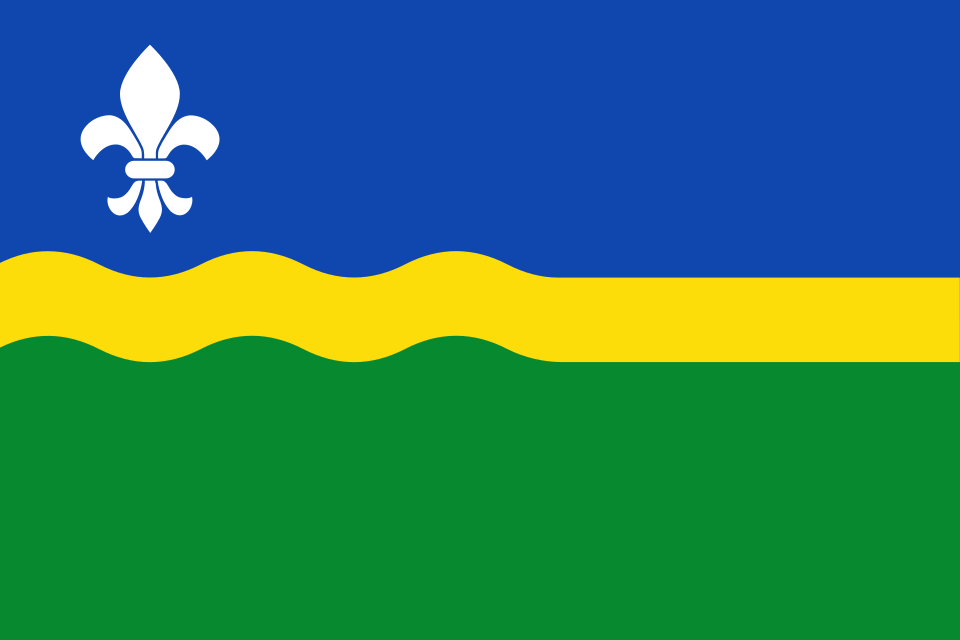
| Design | Flevoland’s flag has blue at the top and green below, separated by a narrow yellow line that waves at the hoist before straightening toward the fly. A white fleur-de-lis stands in the upper-left blue corner. |
How to recognise the provincial flag
Flevoland’s flag has blue at the top and green below, separated by a narrow yellow line that waves at the hoist before straightening toward the fly. A white fleur-de-lis stands in the upper-left blue corner.
Start with the overall layout and count the stripes, stars, lions or other distinctive devices. Exact colour order matters more than guessing from geography alone.
What do the symbols mean?
Blue evokes water, green the newly created land and yellow the work of transforming sea and lake into habitable polder fields. The white fleur-de-lis is associated with Cornelis Lely, a central figure in planning the Zuiderzee Works.
The meaning comes from documented regional heraldry or historic geography; a modern popular interpretation of every colour is not necessarily the legally prescribed meaning.
When was the flag adopted?
Flevoland became the Netherlands’ twelfth province in 1986, after major land reclamation from the former Zuiderzee and IJsselmeer. Its flag was adopted as part of the new provincial identity that year, making it one of the country’s most recent regional banners.
Several provincial coats of arms date back centuries, but today’s Dutch provincial flags were generally standardised much more recently.
Where is the province?
Flevoland lies in the centre of the Netherlands on reclaimed polder land. Lelystad is its capital, while Almere is its largest urban centre. Both are modern towns associated with ambitious water-management projects.
The official or local Dutch name is Flevoland, and the provincial capital is Lelystad. The provincial flag represents the province as a whole, not just its capital city.
Flag colours, arrangement and variants
Flevoland’s flag has blue at the top and green below, separated by a narrow yellow line that waves at the hoist before straightening toward the fly. A white fleur-de-lis stands in the upper-left blue corner.
The featured artwork is the provincial flag itself rather than an unrelated city banner, tourist logo or national flag. A shield-shaped coat of arms can be related without sharing the exact flag layout.
Similar flags and frequent confusion
Overijssel’s wave is blue and its surrounding fields are red and yellow. Flevoland has blue and green, a thin yellow wave and a white fleur-de-lis. The visual connection to land reclamation distinguishes it from older Dutch heraldic flags.
Compare the location of symbols and the number and direction of stripes before identifying a flag. Nearby provinces and neighbouring countries can have banners in very similar colours.
How to draw or reproduce it
Flevoland’s flag has blue at the top and green below, separated by a narrow yellow line that waves at the hoist before straightening toward the fly. A white fleur-de-lis stands in the upper-left blue corner.
Use the cited scalable vector artwork for the proportions and fine heraldic detail. Do not replace a water-lily leaf, heraldic lion or wavy line with a generic clip-art approximation.
Where you may see the flag
Flevoland lies in the centre of the Netherlands on reclaimed polder land. Lelystad is its capital, while Almere is its largest urban centre. Both are modern towns associated with ambitious water-management projects.
Provincial flags can appear at government buildings, community events and sports settings. The Netherlands national flag is separately the familiar horizontal red-white-blue tricolour.
Frequently asked questions
What does the white fleur-de-lis on Flevoland’s flag mean?
It is commonly connected with engineer and statesman Cornelis Lely and the Zuiderzee land-reclamation project.
What is the capital of Flevoland?
Lelystad.
When was the current flag adopted?
1986.
Does Flevoland have its own national flag?
It has a provincial flag; Flevoland is part of the Netherlands, not an independent country.
How is this different from similar flags?
Overijssel’s wave is blue and its surrounding fields are red and yellow. Flevoland has blue and green, a thin yellow wave and a white fleur-de-lis. The visual connection to land reclamation distinguishes it from older Dutch heraldic flags.
Can I use this flag artwork?
Inspect the original image file linked below for the artist, licence and any restrictions concerning official heraldic symbols.
Sources and image credit
Netherlands provincial flags — designs and adoption years
Flags of the World — Dutch provincial and municipal references
Wikimedia Commons: Flag of Flevoland.svg. Featured PNG rendered from the original SVG, scaled without intentional artwork changes. Consult the original file for author, licence and legal use of heraldic insignia.
See the Netherlands national flag for the red-white-blue tricolour.
Independent educational guide; source review 20 November 2026.