Carinthia Flag: Yellow, Red, White Stripes & Kärnten Arms
The flag of Carinthia explained: official colours, coat of arms, origins and important differences from similar Austrian regional banners.
Carinthia occupies southern Austria near Italy and Slovenia. Klagenfurt am Wörthersee is the capital; Villach and the Wörthersee lake area are also well known. The meaning of the state emblem and the exact difference between the civil and service versions are covered below.
Carinthia flag at a glance
| State | Carinthia (Kärnten), Austria |
|---|---|
| Capital | Klagenfurt am Wörthersee |
| Modern adoption | 1946 |
| Version shown | civil flag |
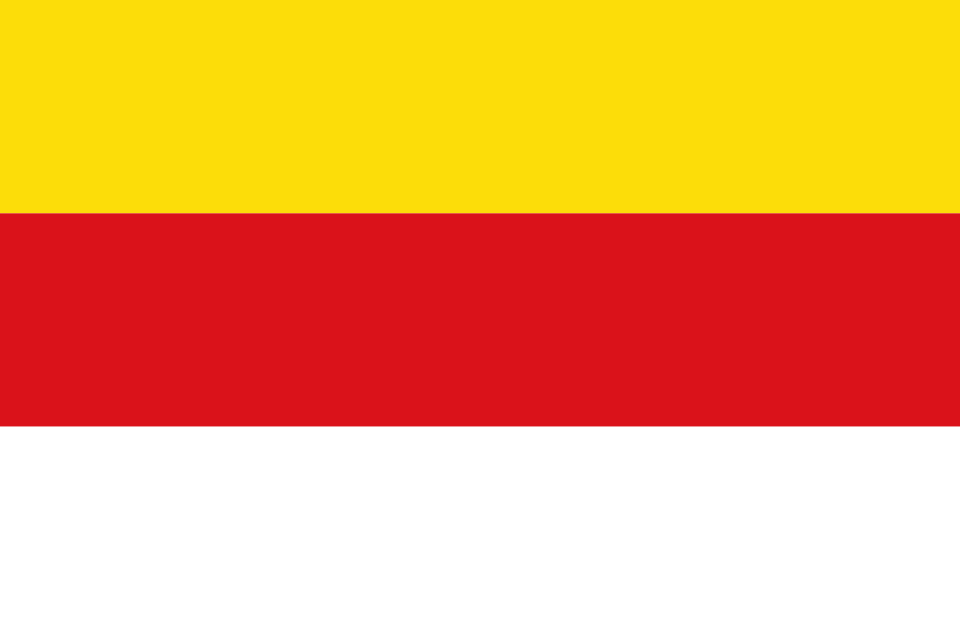
| Identifying feature | Carinthia’s civil flag is a three-band horizontal tricolour: yellow on top, red in the middle, and white at the bottom. This is one of the few Austrian federal-state civil flags to use three colours rather than a two-stripe bicolour. |
What does the flag look like?
Carinthia’s civil flag is a three-band horizontal tricolour: yellow on top, red in the middle, and white at the bottom. This is one of the few Austrian federal-state civil flags to use three colours rather than a two-stripe bicolour.
The featured illustration is identified as the civil flag. In Austrian Länder it is common to distinguish a plain flag of regional colours from an arms-bearing flag used by public authorities.
What does the coat of arms symbolise?
The official Carinthian coat of arms uses a divided shield with three black lions and a white horizontal band on a red field, representing traditions of the historic Duchy of Carinthia. Government service versions incorporate these historical arms.
An Austrian Land coat of arms may use old heraldic symbols that are not printed on the plain regional flag. The difference is important in accurate flag identification.
What do the colours represent?
Yellow, red and white are the formal state colours drawn from the regional armorial tradition. The yellow belongs at the top—reversing the order would no longer reproduce the recognised Carinthian banner.
Simple explanations claiming every colour stands for a modern ideal can be unreliable. Historic arms and formal state colours offer firmer evidence of what appears on the flag.
History and adoption
Carinthia’s historic heraldic identity goes back to the medieval duchy. The contemporary state flag and colours were reaffirmed in 1946 as Austria’s federal states were re-established after World War II.
A historical emblem can be centuries older than the state law regulating a modern banner, so those dates should not be treated as interchangeable.
Where is Carinthia?
Carinthia occupies southern Austria near Italy and Slovenia. Klagenfurt am Wörthersee is the capital; Villach and the Wörthersee lake area are also well known.
Its official German name is Kärnten, and the federal-state capital is Klagenfurt am Wörthersee. Each Austrian Land has a separate regional government.
Similar flags and common mix-ups
The Austrian national flag is red-white-red and does not show yellow. Salzburg is red above white; Upper Austria is white above red. Carinthia’s yellow-red-white order makes a clean identification clue.
Some flags cannot be distinguished solely by the bands of colour. Country, province, government flag and civil flag are different search intents and should be labelled accordingly.
Civil flag versus government flag
Do not confuse the state-service flag with the Carinthian civil tricolour: the source image here deliberately illustrates the plain colour-banded version.
For public or commercial display, follow the applicable rules for official arms and service variants. The image-source page identifies the precise artwork reproduced here.
How to draw and identify it
Carinthia’s civil flag is a three-band horizontal tricolour: yellow on top, red in the middle, and white at the bottom. This is one of the few Austrian federal-state civil flags to use three colours rather than a two-stripe bicolour.
Begin with the correct upper and lower stripes, then use a referenced original file if the appropriate version includes heraldic animals, shields or banners.
Frequently asked questions
Which Austrian state uses yellow, red and white stripes?
Carinthia (Kärnten). Its civil state flag has three horizontal stripes in that order, from top to bottom.
Is Carinthia a country?
No. It is one of Austria’s nine federal states, or Bundesländer.
What is the capital?
Klagenfurt am Wörthersee.
When was the modern flag adopted?
1946.
Is it the same as the national Austrian flag?
The Austrian national flag is red-white-red and does not show yellow. Salzburg is red above white; Upper Austria is white above red. Carinthia’s yellow-red-white order makes a clean identification clue.
Does the state flag always include a coat of arms?
Do not confuse the state-service flag with the Carinthian civil tricolour: the source image here deliberately illustrates the plain colour-banded version.
Can I reuse this artwork?
Check the Wikimedia Commons source page for artist, licence and any separate restrictions on official heraldic symbols.
Sources and image credit
Flags of the World — Austrian state and service flags
Austria’s regional heraldic arms — Austrian reference encyclopaedia
Wikimedia Commons: Flag of Carinthia.svg. Featured image is a proportional PNG conversion of the original SVG. Consult its file page for artwork credits, copyright licence and official-insignia restrictions.
Austria’s national flag guide explains the federal red-white-red flag.
Independent educational guide, not an Austrian government publication. Reviewed 20 November 2026.