North Rhine-Westphalia Flag: Green, White, Red & State Arms
Discover the meaning of North Rhine-Westphalia’s flag, including its official design, colours, historic symbols, adoption and civil-versus-government variants.
North Rhine-Westphalia is western Germany’s most populous state and includes Cologne, Düsseldorf, Dortmund, Essen and Bonn. The capital is Düsseldorf. This guide compares the flag’s distinctive details with other German state banners and explains when emblems are present.
North Rhine-Westphalia flag at a glance
| Location | North Rhine-Westphalia, Germany |
|---|---|
| Capital | Düsseldorf |
| Modern flag date | 1953 |
| Key design clue | Green-white-red horizontal tricolour; composite arms appear on service flags. |
What does the North Rhine-Westphalia flag look like?
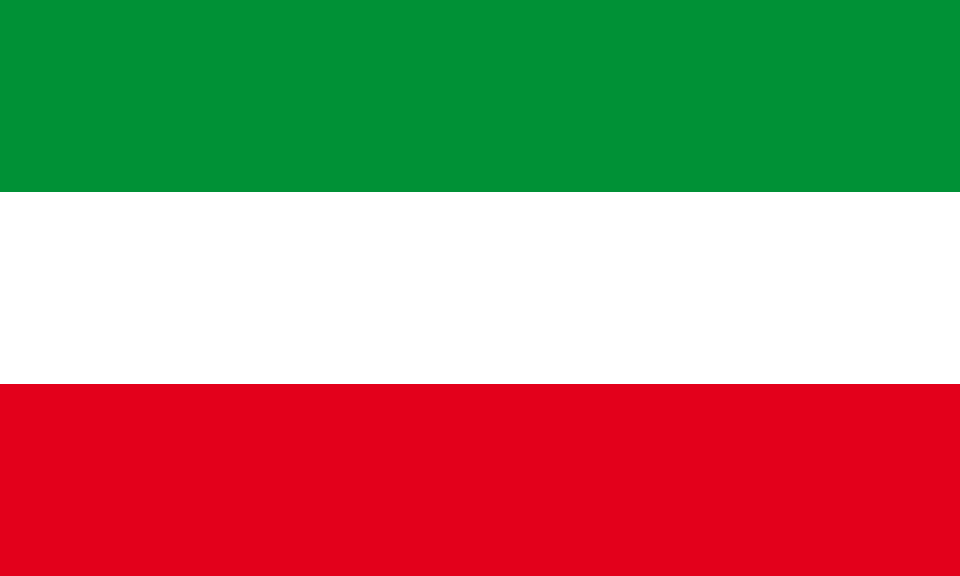
The civil flag of North Rhine-Westphalia consists of three equal horizontal bands: green, white and red. A service flag used by state authorities adds the state’s composite coat of arms.
The exact flag variant is important: in Germany, a civil Landesflagge and an official Dienstflagge can have different designs even for the same state.
What does the emblem or design mean?
The shield combines a wavy silver Rhine motif for the Rhineland, a white Westphalian horse on red, and the Lippe rose. These devices describe the historic components of a post-war state.
This historical detail is more useful for identification than attributing vague meanings to the flag without a documented source.
What do the colours represent?
Green and white recall the Rhineland, while white and red recall Westphalia’s older colours. The plain civil flag leaves the historical component symbols off the fabric.
The colour order and placement of any heraldic device are key clues for recognising the flag accurately.
History and adoption
North Rhine-Westphalia was created in 1946 in the British occupation zone, with Lippe joining in 1947. Its modern three-colour state flag was adopted in 1953.
The origins of a historic animal or shield should not be confused with the legal date of the modern banner.
Where is North Rhine-Westphalia?
North Rhine-Westphalia is western Germany’s most populous state and includes Cologne, Düsseldorf, Dortmund, Essen and Bonn. The capital is Düsseldorf.
Capital: Düsseldorf. The flag stands for a German federal state, not for an independent country.
Civil flag versus government flag
The civil flag of North Rhine-Westphalia consists of three equal horizontal bands: green, white and red. A service flag used by state authorities adds the state’s composite coat of arms.
German flag usage often distinguishes a public civil flag from an arms-bearing service flag. Some service designs are reserved for authorised government use.
How to identify and draw it
Green-white-red horizontal tricolour; composite arms appear on service flags.
Begin with the colour blocks and their direction. Add an emblem only if it is part of the version being reproduced; the Wikimedia image below is the specific version illustrated here.
Frequently asked questions
What is the flag of North Rhine-Westphalia?
The civil flag of North Rhine-Westphalia consists of three equal horizontal bands: green, white and red. A service flag used by state authorities adds the state’s composite coat of arms.
When was it adopted?
1953.
What is its most recognisable feature?
Green-white-red horizontal tricolour; composite arms appear on service flags.
Is it the same as the German national flag?
The state flag is not the same as the Cologne city flag, which uses red and white and a shield bearing three crowns and eleven flames. Compare its three horizontal stripes with the two city colours.
Can anyone fly the illustrated flag?
This article illustrates the civil flag. Government service flags may have different regulations.
Which city is the capital?
Düsseldorf.
Sources and image credit
North Rhine-Westphalia flag — design, variants and historical references
Flags of the World — German state flags and restrictions
Wikimedia Commons — Flag of North Rhine-Westphalia.svg. Scaled PNG illustration; check the original file page for creator and licence details before further reuse.
Germany’s national flag explains the federal tricolour used in some state designs.
Independent educational guide; not an official state government website. Researched 20 November 2026.