Monmouthshire Flag: Three Gold Fleurs-de-Lis on Blue & Black
What do three yellow fleurs-de-lis mean on Monmouthshire’s vertically divided flag? Explore Gwent, King Inyr, medieval attribution and civic use.
What do three yellow fleurs-de-lis mean on Monmouthshire’s vertically divided flag? Explore Gwent, King Inyr, medieval attribution and civic use. The details below distinguish traditional attributions and later records from modern flag registration, and explain the visual elements using identifiable evidence.
The primary reference is the Flag Institute’s UK Flag Registry entry. Historic county flags may remain in use even where today’s local-government boundaries differ from earlier county boundaries.
Monmouthshire flag at a glance
| Feature | Details |
|---|---|
| Historic county | Monmouthshire / Sir Fynwy, southeast Wales |
| Background | Vertical blue hoist and black fly |
| Main emblems | Three golden fleurs-de-lis |
| Traditional attribution | Inyr, early ruler of Gwent |
| Civic adoption | Monmouthshire council arms used the emblem by 1948 |
| Modern artwork | Blue shade standardized by Jason Saber |
| Registry code | UNKG7429 |
| Ratio | 3:5 |
Scope: This guide concerns the registered historic county flag and its symbolism. In British vexillology, registration by the Flag Institute is a recognized reference for community designs; it is not by itself a separate governmental grant of national sovereignty.
appearance
What does the Monmouthshire flag look like?
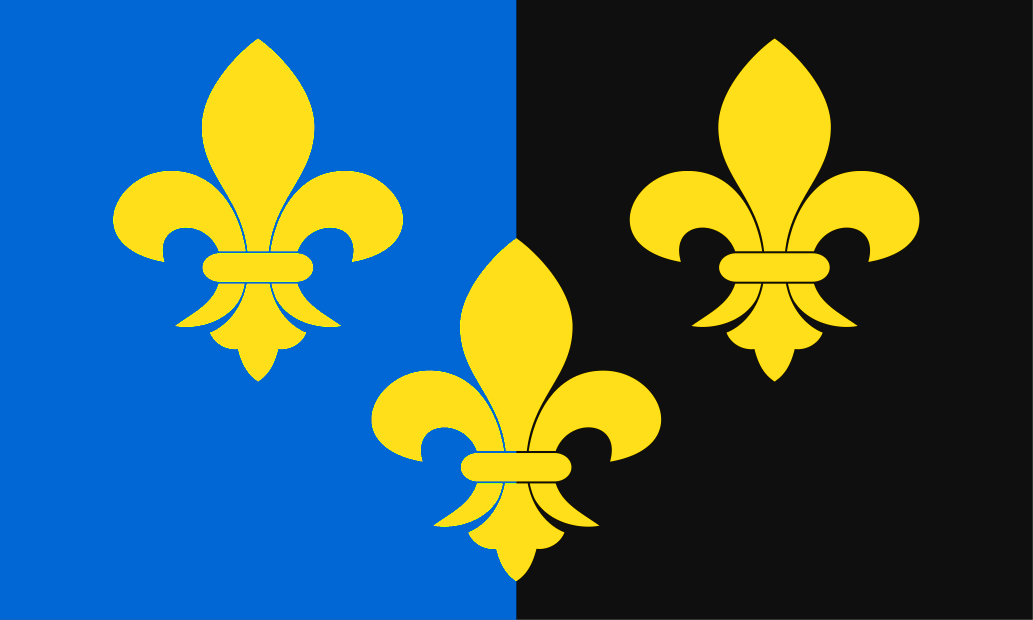
The field is divided into two equal vertical panels: bright blue on the hoist side and black on the fly. Three golden fleurs-de-lis overlap the areas in a two-above-one arrangement.
fleurs
Why are there three fleurs-de-lis?
These symbols are derived from arms attributed by later medieval heralds to an early ruler of Gwent named Inyr.
inyr
Who was King Inyr of Gwent?
Inyr is a figure from early Welsh tradition associated with the region of Gwent, which later formed much of historic Monmouthshire.
blueblack
What do the blue and black halves signify?
The blue-and-black division is part of the traditional heraldic design, with three gold fleurs-de-lis providing a high-contrast motif.
civic
Where are the arms used locally?
The emblem appears in the arms of the Diocese of Monmouth and in the civic heraldry of Monmouthshire and Blaenau Gwent authorities.
1948
What happened to the emblem in 1948?
The former Monmouthshire County Council included the traditional symbols in its official heraldic arms from 1948.
geography
Is Monmouthshire a historic or modern county?
The name applies to a historic Welsh county and to a modern principal-area authority with different boundaries. The flag is chiefly a banner of historic county identity.
compare
Monmouthshire vs Glamorgan and Flintshire
Glamorgan uses three white chevrons on red. Flintshire has a black ornate cross with red-billed choughs on white.
drawing
How to draw the Monmouthshire flag
Split a 3:5 rectangle vertically into blue on the left and black on the right. Add three golden fleurs-de-lis, two above and one below, in the proportions of the reference.
Frequently asked questions
How many fleurs-de-lis are on Monmouthshire’s flag?
Three.
What are the two background colours?
Blue at the hoist, black at the fly.
Which early ruler is associated with the arms?
King Inyr of Gwent.
Were the arms certainly flown in the sixth century?
No, they are attributed by later heralds.
When did the county council use the arms?
From 1948.
Who standardized the colour contrast?
Jason Saber.
Is this the national flag of Wales?
No, it is a local historic-county flag.
Are the gold motifs stars?
No, they are fleurs-de-lis.
Sources and illustration credits
Flag Institute — Monmouthshire flag (UK Flag Registry)
Image:Registered PNG flag illustration downloaded from the Flag Institute’s Monmouthshire entry. The Institute states its Registry’s flag artwork is free to download and reuse. Flag imagery is reproduced for independent educational identification, without an endorsement claim.
Source-checked November 2026. Historical arms attributed to ancient figures are distinguished from modern archival proof where appropriate.