County Durham Flag: St Cuthbert’s Cross, Blue & Gold Meaning
Learn why County Durham’s flag has a counterchanged blue-and-yellow St Cuthbert’s Cross, how a family designed it, and when the 2013 flag was raised.
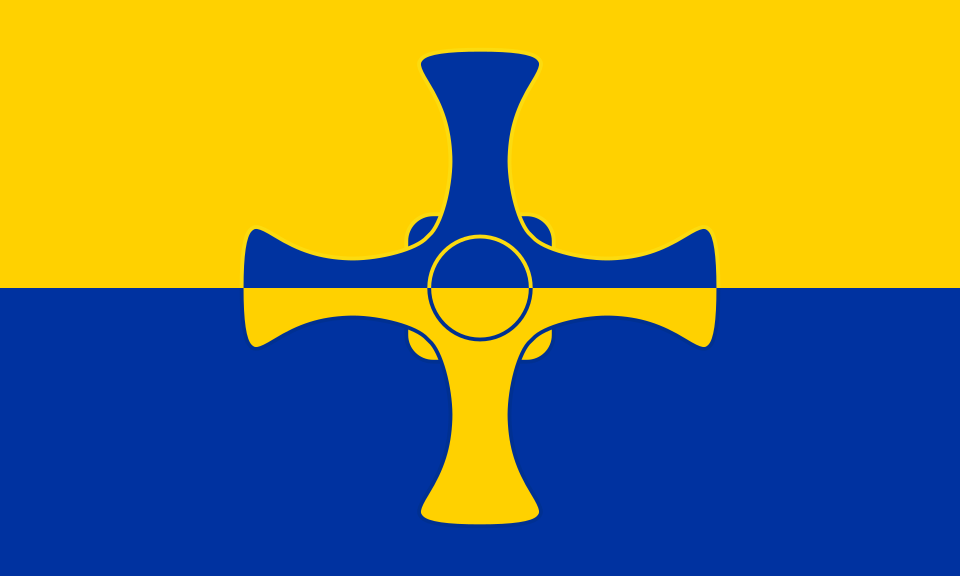
County Durham has a distinctive flag whose details are often lost in small icons or confused with neighbouring county designs. The field is divided horizontally: gold/yellow above, blue below. At the centre is a stylized St Cuthbert’s Cross, with its colours reversed across the boundary. This guide explains the main motifs, supported historical milestones and its place in the UK Flag Registry.
County Durham flag at a glance
| Feature | Details |
|---|---|
| County | Historic County Durham, northeast England |
| Flag date | 21 November 2013 |
| Designers | James, Katie and Holly Moffatt |
| Main motif | St Cuthbert’s Cross |
| Field | Gold/yellow above blue |
| Cross colours | Blue on the yellow half, yellow on the blue half |
| Selection | Public vote from six finalists |
| First raising | Durham Cathedral |
| Ratio | 3:5 |
Historic county identities, modern geographic regions and local-government authorities are different things. The dated flag reference below distinguishes inherited heraldic designs from modern public flag registrations.
What does County Durham’s flag look like?
The field is divided horizontally: gold/yellow above, blue below. At the centre is a stylized St Cuthbert’s Cross, with its colours reversed across the boundary.
The upper arms of the cross are blue against the yellow field and the lower parts are yellow against blue. This technique, called counterchanging, is the defining feature of the flag.
Who was St Cuthbert?
St Cuthbert was an early medieval saint associated with Lindisfarne and northern England. His relics and cult are closely linked with Durham Cathedral, a major spiritual and historic centre.
The flag uses the saint’s distinctive cross as a county identifier. It is a symbol of Durham’s medieval cultural history rather than a claim that the exact 2013 flag was flown by Cuthbert.
What makes the St Cuthbert Cross distinctive?
The cross has arms that expand in a characteristic shape rather than a simple thin St George’s Cross. Its round central detail and broad ends help identify the design.
Because the colours switch at the field’s midpoint, it can appear as two different crosses touching; it is one unified heraldic cross with counterchanged colours.
Why blue and yellow?
Blue and yellow are traditional County Durham colours. Their strong contrast supports a simple two-colour design that displays well at a distance.
Both the field and cross share the same two colours. This creates visual symmetry without needing a shield, animal or motto written onto the flag.
How was the County Durham flag selected?
A county design competition produced numerous submissions. A panel chose six finalists, followed by a public vote. The winning design is credited to James, Katie and Holly Moffatt.
The formal Flag Institute date is 21 November 2013, associated with a public unveiling and first raising at Durham Cathedral.
Why is Durham Cathedral important to the flag story?
Durham Cathedral is central to the county’s association with St Cuthbert. It provided a fitting location for the first public raising of a flag featuring his cross.
The ceremony underscored the relationship between historical heritage and a new community symbol. County flag adoption should not be confused with a change in national constitutional status.
Is this the same as Durham County Council’s older banner?
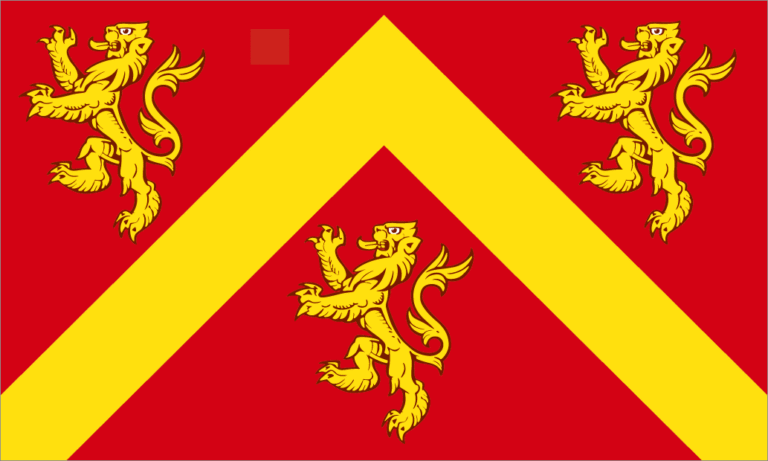
No. Older council heraldic banners can feature different shapes and colours. The registered public flag is the yellow-blue bicolour with a counterchanged St Cuthbert’s Cross.
When selecting a thumbnail, distinguish the 2013 county community flag from banners showing the arms of a particular city, diocese or county authority.
County Durham vs Northumberland and Cumberland
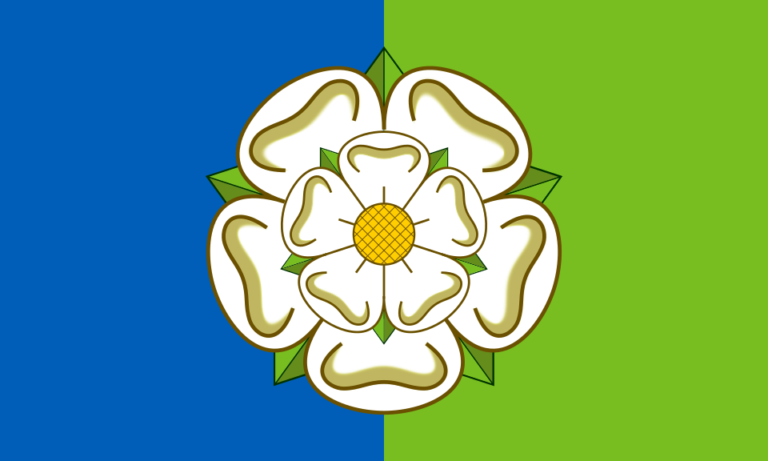
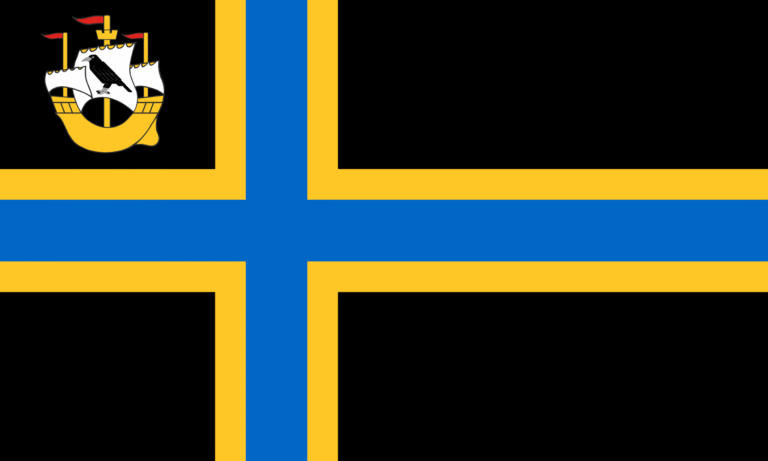
Northumberland uses red-and-gold stepped bars; Cumberland uses three white flowers on green over blue-white waves.
County Durham has a single large blue-yellow cross and no animals or flower motifs. Its religious heritage symbol is recognizable even without a caption.
How to draw the County Durham flag
Fill the upper half yellow and lower half blue. In the middle draw St Cuthbert’s Cross with the top half blue and lower half yellow.
Keep the proportions consistent with the Flag Institute’s 3:5 image. The strongest quiz clue is ‘St Cuthbert’s Cross counterchanged blue and gold‘.
Frequently asked questions
Which cross is on the County Durham flag?
St Cuthbert’s Cross.
What does counterchanged mean?
The blue and yellow colours swap between the field and the cross at the midpoint.
When was it adopted?
21 November 2013.
Who designed it?
James, Katie and Holly Moffatt.
How was it chosen?
A public vote after six designs were shortlisted.
Where was it first raised?
Durham Cathedral.
Is it the same as Northumberland’s flag?
No, Northumberland has red and yellow stepped bars.
Is County Durham independent?
No, it is a historic county of England.
Official references and illustration credits
Flag Institute — County Durham county flag
Image rights and attributionFlag illustration: Wikimedia Commons — County Durham flag. The displayed PNG is a raster conversion of the Commons SVG. See the linked source for artist, copyright licence and applicable attribution/share-alike terms; official insignia may be subject to additional restrictions.
Independent educational guide. Research checked November 2026; no endorsement by the Flag Institute or local authorities is implied.