Cheshire Flag: Three Golden Wheat Sheaves & Sword on Blue
What do Cheshire’s three gold wheat sheaves and sword represent? Explore the Earldom of Chester, county palatine rights and the 1938 heraldic banner.
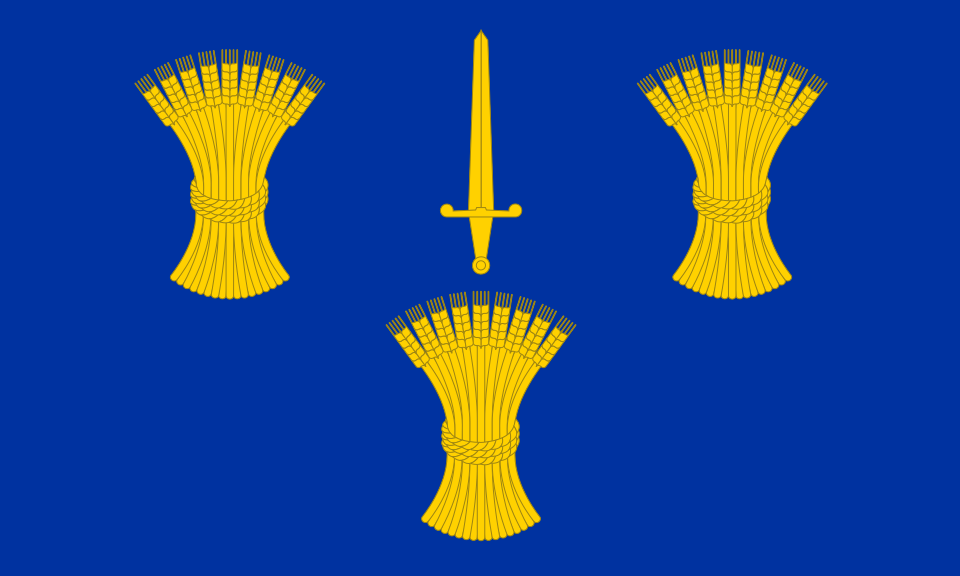
Cheshire has a distinctive flag whose details are often lost in small icons or confused with neighbouring county designs. The flag is a deep-blue field with three golden wheat sheaves, usually two near the upper section and one lower down, plus an upright gold sword. This guide explains the main motifs, supported historical milestones and its place in the UK Flag Registry.
Cheshire flag at a glance
| Feature | Details |
|---|---|
| County | Cheshire, northwest England |
| Main field | Deep blue |
| Symbols | Three golden wheatsheaves and golden sword |
| Arms granted | 3 May 1938 |
| County history | Earldom and County Palatine of Chester |
| Sheaf heritage | Associated with Earls of Chester since the 12th century |
| Flag ratio | 3:5 |
| Registry code | UNKG7427 |
Historic county identities, modern geographic regions and local-government authorities are different things. The dated flag reference below distinguishes inherited heraldic designs from modern public flag registrations.
What does Cheshire’s flag look like?
The flag is a deep-blue field with three golden wheat sheaves, usually two near the upper section and one lower down, plus an upright gold sword.
The wheat sheaves are tied bundles of harvested grain, not three gold crowns or flames. The sword has a clearly identifiable blade and hilt, making this one of the few English county flags with both agriculture and a weapon.
Why are there three golden sheaves?
Golden wheat sheaves have been connected to the Earls of Chester since at least the late twelfth century and appear in the city’s civic arms granted in the sixteenth century.
The sheaves represent a long-established heraldic tradition in the region. It would be too simple to assign each one to a modern local-authority district; they existed centuries before present council boundaries.
What does the sword represent?
The gold sword refers to Cheshire’s historical status as a county palatine, where the Earl of Chester exercised special legal and administrative powers.
The image does not commemorate one named battle; it expresses a particular constitutional and heraldic history that distinguished Cheshire from many other medieval English counties.
What was the County Palatine of Chester?
A county palatine was an area where a noble ruler historically held particular powers normally exercised by the Crown. Chester’s earldom had an exceptional place in medieval English governance.
The sword on Cheshire’s banner is best understood in that context, rather than as a modern sign of independent sovereignty. Cheshire is now a county within England.
When was the current county heraldic flag established?
The Flag Institute dates the underlying grant to 3 May 1938, when the College of Arms granted arms to the former Cheshire County Council.
The sheaf symbolism is much older, as shown by historic Chester civic heraldry and even earlier records. The present registered community flag uses that older emblem in the 1938 armorial arrangement.
Where else do Cheshire’s symbols appear?
The sheaves appear in the arms of Chester, on older civic architecture, and on markers of local organizations. The Flag Institute notes historical appearances on the Chester Eastgate and in the Chester Assay Office hallmark.
Many organizations have used the three sheaves and sword as a recognisable county badge. This continuity helped establish the banner as a traditional community flag.
Why is the background blue?
Blue is the registered heraldic field for the gold devices. The contrast makes both sheaves and sword highly legible.
While residents may see blue as recalling local waters or sky, the strongest documented explanation is the arms-and-banner tradition. Colour significance should not be invented without a source.
Cheshire compared with Shropshire and Middlesex
Shropshire has three golden animal faces in blue triangles on gold; Middlesex has three white seaxes and a crown on red.
Cheshire is distinguished by three gold wheatsheaves and a vertical sword on plain blue. The gold devices are plant bundles and one blade rather than leopard faces or curved seaxes.
How to reproduce Cheshire’s flag
Fill a 3:5 rectangle blue and draw the three golden wheat bundles and one upright gold sword in the official relative positions.
Wheat sheaves should have tied stems and a fan of heads; a simple golden circle would omit the identifying agricultural imagery. The clue is ‘three gold wheat sheaves and sword‘.
Frequently asked questions
What do the gold bundles represent?
Wheat sheaves associated with the Earls of Chester.
Why is there a sword?
It recalls Chester’s historic county-palatine powers.
When were the council arms granted?
3 May 1938.
Are the sheaves an ancient symbol?
Yes, their heraldic use is traced to the Earls of Chester in the twelfth century.
What colour is the field?
Deep blue.
Is it a sovereign state flag?
No, it is a historic English county flag.
How many sheaves appear?
Three.
Is it the same as Shropshire?
No; Shropshire shows three heraldic faces and ermine shapes.
Official references and illustration credits
Flag Institute — Cheshire county flag
Image rights and attributionFlag illustration: Wikimedia Commons — Cheshire flag. The displayed PNG is a raster conversion of the Commons SVG. See the linked source for artist, copyright licence and applicable attribution/share-alike terms; official insignia may be subject to additional restrictions.
Independent educational guide. Research checked November 2026; no endorsement by the Flag Institute or local authorities is implied.