Sussex Flag: Six Gold Martlets on Blue, Meaning & History
Sussex’s deep-blue flag carries six golden martlets, arranged three, two and one. Learn the unusual birds, seventeenth-century record and 2011 registry campaign.
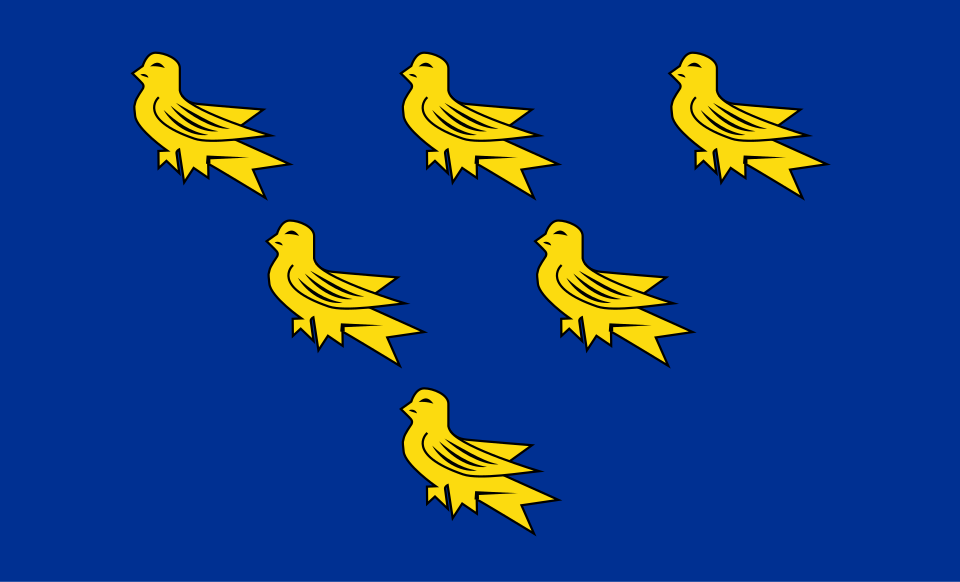
Among English county flags, Sussex is unusual for using six small birds instead of a cross, rose or single large animal. Martlets have been associated with Sussex heraldry for centuries, although the exact medieval origins of the emblem remain uncertain.
The Flag Institute verifies the number of birds, the blue field and the seventeenth-century evidence. The Sussex flag campaign history documents the modern registration on 20 May 2011, while UK Government records show public recognition on Sussex Day.
Sussex flag at a glance
| Feature | Details |
|---|---|
| County | Sussex, southern England |
| Type | Traditional community county flag |
| Background | Azure / royal blue |
| Birds | Six golden heraldic martlets |
| Arrangement | Three, two and one |
| Earliest securely recorded county use | John Speed’s atlas, 1611/12 |
| UK Registry date | 20 May 2011 |
| Designer | Traditional emblem; modern registration campaign led by Brady Ells |
| Flag ratio | 3:5 |
| Sussex Day | 16 June |
This is a county community flag, not the national flag of an independent state. Historic symbols, original documentary references and modern UK Flag Registry dates are not always the same; the article distinguishes them.
What does the Sussex flag look like?
The entire field is deep blue. Six golden-yellow martlets are arranged in a symmetrical triangular pattern, with three in the upper row, two beneath and one at the bottom. The birds are depicted in profile with stylized wings and distinctive tails.
There is no crest, crown or lettering on the ordinary Sussex county flag. Reproductions with a large golden band across the top may be a West Sussex council or county-related flag, not the simple all-Sussex traditional six-martlet banner.
What is a martlet bird in heraldry?
A martlet is a stylized bird used in medieval heraldry. Traditional drawings often show it without conventional feet, representing perpetual flight in later interpretations. It resembles a swallow or swift, but it is a heraldic figure rather than a precise zoological species.
The six birds on Sussex’s flag should therefore not be called gulls, ducks or crows. In a small flag icon they may appear as yellow bird silhouettes; at full size, their curved tails and feather-like shapes are more apparent.
Why are there six martlets on Sussex’s flag?
Sussex was historically divided into six administrative districts called rapes: Chichester, Arundel, Bramber, Lewes, Pevensey and Hastings. The number six is frequently associated with these divisions in popular county-flag explanations.
However, the Flag Institute notes that the martlet emblem is recorded in the early seventeenth century and that its origins may lie in medieval personal heraldry. It is safest to say the six-bird pattern is historically established, while the one-bird-per-rape explanation is a customary interpretation, not a proven original design brief.
How old is the Sussex martlet emblem?
The Flag Institute identifies John Speed’s Theatre of the Empire of Great Britaine (1611/12) as the earliest securely recorded use of six gold martlets on blue to denote the ancient kingdom of the South Saxons.
The emblem is older than its 2011 registration as a county flag, and versions have appeared in local heraldry for many generations. But a medieval association should not automatically be described as an unbroken surviving Anglo-Saxon cloth flag.
When was the modern Sussex flag registered?
Sussex residents Brady and David Ells campaigned to secure recognition of the traditional county flag from 2010. The Flag Institute added the Sussex design to the UK Flag Registry on 20 May 2011.
The registration formalized a long-established emblem for community flag use. The Flag Institute’s record still dates the design’s historical origin to the seventeenth century. Thus 2011 is a modern registry milestone, not the first appearance of the six martlets.
What is Sussex Day and when is it celebrated?
Sussex Day is 16 June, the feast day of St Richard of Chichester, the county’s patron saint. Flag-raising ceremonies and public celebrations often use the six-martlet banner.
The UK Government confirmed the Sussex flag was raised above its Whitehall offices on Sussex Day in 2011. The 16 June annual celebration is distinct from the flag’s registry date of 20 May.
Is the Sussex flag for East Sussex or West Sussex?
The six gold martlets on blue is the flag of historic Sussex as a whole. The modern administrative areas of East Sussex and West Sussex have their own councils and may display different civic banners or modified flags.
This distinction matters for image-search results. A blue-and-yellow banner with a different layout could be an administrative council flag, while the traditional all-Sussex county flag has only six gold martlets on an uninterrupted blue field.
Sussex flag compared with Kent and Essex
The nearby Kent flag shows a large white horse on red. Essex has three white Saxon seaxes on red. Sussex uses six gold birds on blue.
These three English county flags have a strong visual distinction through both colour and emblem. If the motif consists of six small golden birds, Sussex is the best match. A single horse points to Kent; curved swords point to Essex.
How to draw and identify the Sussex county flag
Draw a blue rectangle with a 3:5 aspect ratio. Place three evenly spaced yellow martlets across its upper area, two in the middle and one centred below. Keep all six birds in the same stylized heraldic profile.
Avoid replacing the martlets with photographic seagulls or drawing six yellow stars. For a school worksheet the clue ‘six gold martlets on blue‘ identifies Sussex immediately.
Frequently asked questions
What birds are on the Sussex flag?
Six golden heraldic martlets.
Why are there six birds?
The six-bird emblem is traditional; the number is commonly associated with Sussex’s six historic rapes, although that interpretation is not a proven original explanation.
How are the martlets arranged?
Three in the upper row, two in the middle and one below.
When was the flag registered?
20 May 2011.
How far back does the design go?
The Flag Institute identifies use in John Speed’s atlas of 1611/12.
When is Sussex Day?
16 June, St Richard of Chichester’s feast day.
Is the Sussex flag only for West Sussex?
No. It represents historic Sussex, including areas now administered as East and West Sussex.
Are martlets ordinary gulls?
No. They are stylized heraldic birds often depicted without normal feet.
References and illustration credits
Flag Institute — Sussex county flag and seventeenth-century history
Sussex Flag Campaign — History and May 2011 registration
GOV.UK — Sussex flag flown on Sussex Day, June 2011
Flag image from Wikimedia Commons: Sussex county flag vector. The Flag Institute released the reference vector into the public domain via Wikimedia Commons; rasterized as PNG without altering the design. Government-symbol usage rules can differ from copyright terms.
Independent educational guide. Information reviewed November 2026; no endorsement by the Flag Institute or local government is implied.