South Carolina State Flag: Palmetto Tree & Crescent Meaning
A sourced guide to the current flag’s symbolism, distinctive design, historical changes and accurate identification.
Official design at a glance
| Feature | Description |
|---|---|
| Field | Indigo blue |
| Symbols | White palmetto and white crescent |
| Palmetto added | January 28, 1861 |
| Historical link | Sullivan’s Island, 1776 |
What does South Carolina’s state flag look like?
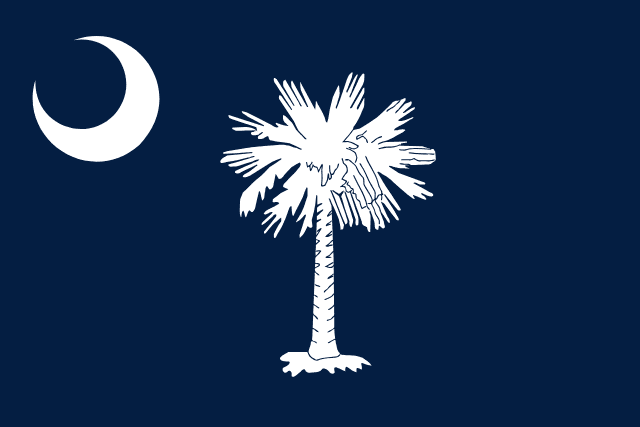
South Carolina’s flag has a dark indigo-blue field, a white crescent near the upper hoist corner and a white palmetto tree centered toward the middle. There are no stars, stripes or text. The simplicity of the arrangement makes it easy to distinguish from neighboring state flags based on elaborate seals.
The palmetto should resemble the familiar low-country palm, with a distinct trunk and arching fronds, rather than a pine tree or a coconut palm loaded with fruit. The exact shade of blue and tree artwork vary slightly among reproductions; an official government illustration is preferable for formal use.
Why is there a palmetto tree on the flag?
The palmetto refers to the Revolutionary War defense of a fort on Sullivan’s Island in June 1776. Colonel William Moultrie led troops defending the harbor from a British naval attack. The fort was constructed using palmetto logs whose resilient material helped absorb cannon fire. The episode became a major symbol in South Carolina’s Revolutionary-era identity.
When a new state flag was chosen in January 1861, the palmetto was added to the earlier Moultrie-style crescent banner to recall that defense. The 1861 date must be distinguished from 1776: the famous battle inspired the tree symbolism, but the current combination of tree and crescent was formally adopted much later.
Is the white crescent a moon or a military gorget?
The crescent derives from the symbol on William Moultrie’s 1775 Revolutionary-era flag. Many official descriptions connect it with the silver or white emblem worn on soldiers’ caps or a gorget, a type of military insignia. Others interpret the shape as a crescent moon. The debate has a long history, and presenting either theory as unquestionably settled oversimplifies the evidence.
The state legislature’s own educational material explains the connection with Moultrie’s uniform insignia, while a South Carolina State Library guide explicitly notes the competing interpretations. A reliable flag guide should describe the origin and acknowledge this uncertainty rather than inventing a religious or astronomical explanation.
How did the South Carolina flag develop?
Moultrie’s original blue-and-crescent design dates to 1775, before U.S. independence. It became associated with American forces in South Carolina during the Revolutionary War. The palmetto-tree version was adopted by the state’s secession-era legislature on January 28, 1861, adding an emblem commemorating the 1776 fort defense.
That means the familiar modern flag combines a Revolutionary-era military motif with an adoption date tied to a different period: the beginning of the American Civil War. These histories should both appear in an article, without claiming the existing palmetto flag was flying in exactly the same form throughout the Revolutionary War.
How to recognize the palmetto flag
Look for one white tree against an indigo field, with a small white crescent in the upper left. The broad shape is relatively simple, unlike Florida’s central seal or North Carolina’s star and inscriptions. The most common drawing error is putting a large crescent around the tree as though the tree were inside a moon.
The crescent sits separately near the hoist and the palmetto stands beneath it nearer the center. Neither element should include lettering. The tree and crescent on a plain blue background are sufficient identification clues even when a small image lacks fine line detail.
How South Carolina compares with other southern state flags
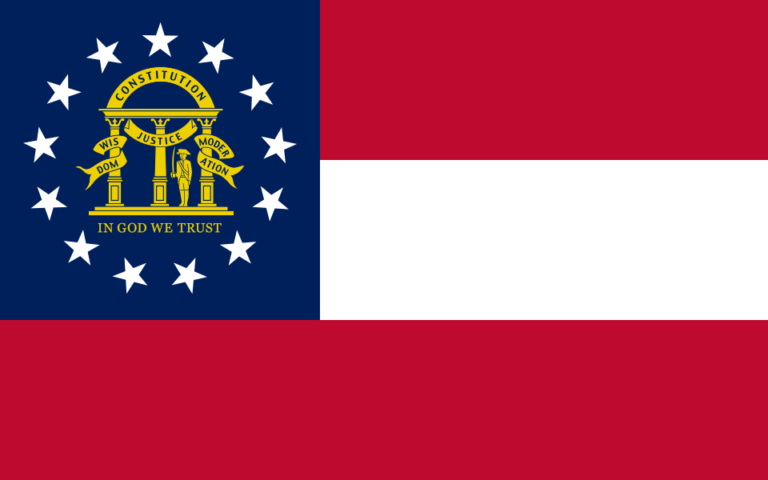
South Carolina’s design predates many official modern state flags and focuses on one famous Revolutionary-era event. Tennessee uses three stars for its grand divisions; Florida uses a red diagonal cross and state seal; Georgia uses stripes and a blue canton. These differences make the South Carolina flag a useful example of a symbol-rich but visually simple design.
Readers interested in other recent proposals should distinguish South Carolina’s current long-established design from the legal debates about exact tree and crescent artwork. Minor variations in digitized images do not automatically indicate the state has adopted a completely new flag.
Frequently asked questions
What does South Carolina’s palmetto mean?
It commemorates the 1776 defense of Sullivan’s Island, where a palmetto-log fort resisted a British attack.
What is the crescent?
It derives from the 1775 Moultrie flag; its interpretation as a military insignia or moon remains debated.
When was the palmetto flag adopted?
January 28, 1861.
Is the background black or blue?
Official descriptions call for a dark indigo-blue field.
The present South Carolina flag evolved from Moultrie’s 1776 blue-and-crescent colors. Compare the original with two other Revolutionary designs in our Gadsden, Pine Tree and Moultrie historical flag guide.
South Carolina Legislature — state flags
South Carolina State Library — flag background
South Carolina Department of Archives and History
Illustration from the FlagExplorers WordPress media library, using publicly distributed state flag artwork from Flagpedia/FlagCDN. Reviewed November 2026.