Tonga vs Switzerland Flag: White and Red Cross Designs
Compare the cross colors, position, flag shape and separate national histories.

The quickest way to tell Tonga and Switzerland apart
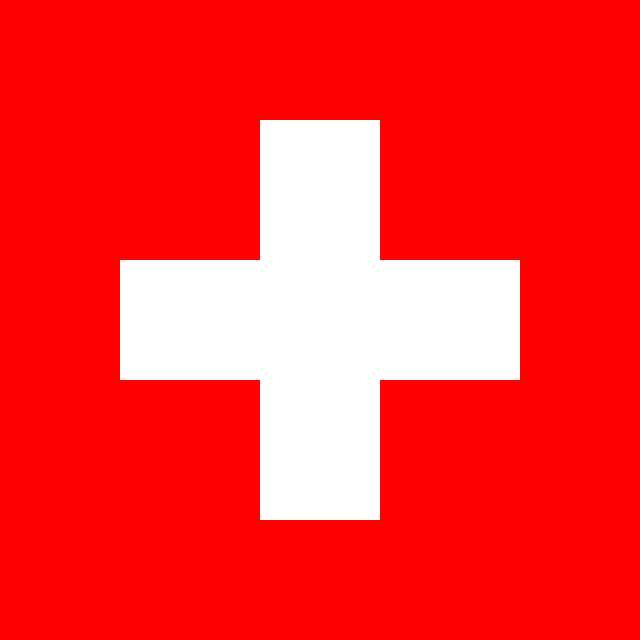
The flags of Tonga and Switzerland both use red and white, and each features a cross. Their similarities end once you examine where the cross appears and which color it uses. Switzerland has a white cross in the center of a red square. Tonga has a red rectangular field with a white panel in the upper corner nearest the pole, and a red cross inside that panel. The whole Tongan flag is normally much longer than it is high. A white cross centered on red identifies the Swiss national design, whereas the small red cross surrounded by white within a larger red field identifies Tonga.
The quickest recognition method is to look at the entire flag rather than search for the word cross in its description. First determine whether there is a separate white rectangular canton. If there is, examine the symbol inside it. Next check whether a cross instead occupies the middle of the entire red field. Both of these observations are usually possible even when the image is small.
The term canton describes a corner area of a flag, usually the upper corner at the hoist. The Tongan design uses this distinct area for its cross; the Swiss design does not have a canton at all. The contrast between a central device and a corner device is more useful than trying to distinguish the precise red shades.
This page compares the ordinary national flags. Switzerland also uses a rectangular maritime ensign, and Tonga has additional official flags. Those designs have their own contexts and should not be confused with the two ordinary national references shown here.
| Feature | Tonga | Switzerland |
|---|---|---|
| Cross | Red in white canton | White in center |
| Main field | Red rectangle | Red square |
| Height:length | 1:2 conventional reference | 1:1 ordinary national flag |
| Best clue | White upper-hoist panel | Detached central cross |
Compare the shapes and proportions
The square shape of Switzerland’s national flag is established by its federal Coat of Arms Protection Act. Its height and length are equal. Tonga’s commonly illustrated national flag uses a one-to-two proportion, making it twice as long as it is high. The Tongan constitutional provision protects the established national design from alteration but does not provide a numerical construction table in that clause. Accordingly, the one-to-two proportion here is identified as the conventional reference format rather than a numerical rule quoted from clause 47.
Take two pieces of graph paper and use a common height of twelve centimeters. The Swiss outline measures twelve by twelve centimeters. The conventional Tongan outline measures twelve by twenty-four centimeters. The first is a square containing a central cross. The second is a long rectangle containing a white corner panel. Even if both drawings are initially uncolored, their outlines and internal organization distinguish them.
The Swiss cross has four equal arms. Swiss federal sources explain the relationship between the arms’ length and width: each arm extending from the central square is one-sixth longer than it is wide. A useful numerical study begins with an arm width of six units. The extension of each arm beyond the central square is seven units, giving an overall span of twenty units. This is a study of the cross’s internal geometry, not a substitute for the complete statutory flag diagram, which also specifies the cross in relation to the square field.
For Tonga, use a faithful complete national flag reference when studying the canton and cross. Flags of the World records variation in historical and manufactured illustrations. Do not infer an exact statutory canton size by measuring an arbitrary web icon. The decisive recognition fact remains that the white panel occupies the upper hoist area rather than the entire field.
A flag shown within a square navigation icon may have been cropped or surrounded by padding. A rectangular display box can likewise contain a Swiss square with empty space beside it. Distinguish the picture’s real boundary from the enclosing layout before using shape as evidence.
Why color placement matters more than color names
A useful comparison exercise is to write the design of each flag as a short sequence of observations. For Switzerland, begin with the background, then identify the single contrasting device. For Tonga, identify the main background, the contrasting corner field and the device within that corner. These sequences are different even though the same two colors appear in both.
The Swiss white cross is surrounded entirely by red. It does not touch any edge of the square. The Tongan red cross is surrounded by the white canton, which itself meets the top and hoist boundaries of the outer flag. The remainder of the Tongan rectangle is red. If a student draws a cross extending all the way across the main rectangle, the result will not accurately represent either country.
This approach is useful for someone who cannot easily distinguish subtle differences between red hues. The relative light and dark areas and the location of their boundaries supply the identification cues. Even in a grayscale image, the Swiss design normally appears as a light central cross on a darker square, while Tonga has a lighter corner area containing a dark cross. Lighting, image inversion and unfamiliar display conditions can still affect this comparison, so use a caption whenever necessary.
Switzerland’s official flag reference prescribes the colors and geometry. A digital image may display those colors differently because of screen settings and image conversion. Tonga’s flag may likewise look different in sunlight, shade or printed material. A named color does not establish that two national flags must use precisely identical dyes. Do not identify either by sampling one pixel from a photograph.
For a classroom worksheet, make a separate color legend below the flag pictures and label the fields. Keep the legend outside the flags. Additional outlines, explanatory text or marks placed over an official flag can change the appearance of the reference and create confusion.
The two national designs have different historical roots
The Swiss white cross is associated with the country’s historical confederation. The Federal Department of Foreign Affairs connects the establishment of the national flag with the federal state formed in 1848. The geometry of the cross was subsequently defined in federal rules, and the modern Coat of Arms Protection Act provides the current statutory definition and reference illustration. A date associated with the establishment of the federal state should not be confused with the date of the most recent legislation.
Tonga’s flag has a separate history connected with the monarchy of King George Tupou I. The 1875 constitution contains the provision preserving the national flag. The consolidated constitutional text continues to distinguish the national flag from the royal ensign. This distinction matters for historical illustrations of the kingdom: a banner associated specifically with the royal family need not be identical to the ordinary national flag.
Historical flag specialists describe the earlier Tongan design as a red cross on white and explain the development of the present red-field arrangement. These accounts associate the relocation of the cross into the canton with the resemblance of the earlier banner to the international humanitarian emblem. The constitutional provision itself does not narrate every design stage. Treat the specialist history as historical context and the constitution as evidence of the national flag’s protected status.
The cross in Tonga’s flag is associated with Christianity in the kingdom. Switzerland’s cross belongs to a different European heraldic and political tradition. Using the same elementary geometric form does not establish that one country’s modern national flag is simply a copy of the other. It is more informative to understand the documented national histories separately, then compare their visual results.
When preparing a history assignment, record the dates of the documents and identify what happened at each date. A design’s earlier use, constitutional recognition and subsequent graphic standardization are distinct events. This practice avoids the common mistake of assigning one adoption date to every aspect of a national symbol.
Distinguish both national flags from humanitarian emblems
The resemblance to the Red Cross emblem deserves special attention. The International Committee of the Red Cross describes the humanitarian red cross on white as an inversion of the Swiss national colors. It serves protected and identifying functions under international humanitarian law and applicable domestic legislation. A red cross on white is not an unrestricted decorative mark merely because the geometric shape is easy to draw.
The complete national flag of Tonga is a distinct design with a red main field and a white corner containing a red cross. When studying it, retain the whole flag and the country label. Do not extract its canton and use that isolated image to identify a first-aid service, medical product or humanitarian organization. A cropped fragment can lose the very contextual information that makes it recognizable as part of a national flag.
The Swiss flag is also different from the Swiss coat of arms, which places the cross within a heraldic shield. The Swiss Federal Institute of Intellectual Property explains that the flag and cross may have permitted uses subject to conditions, whereas the official coat of arms has more restrictive rules. It also warns about uses that may cause confusion with the protected humanitarian emblem or misrepresent the origin of goods and services.
For this reason, the educational pictures on this page depict complete national flag designs, with captions, rather than distribute isolated symbols as logos. Flagpedia describes its flag images as public-domain artwork. That addresses the copyright status of the files, not every legal condition involving national symbols, indications of geographic origin or protected humanitarian emblems.
If you are creating a school presentation, label the pictures as national flags. If you are designing a product, logo or medical sign, consult the relevant legal and professional requirements before using similar shapes. The visual comparison is not a grant of permission to adopt any of these symbols for unrelated purposes.
Identify the flags in real-world photographs
A waving flag is often only partially visible. If Tonga’s canton is concealed behind folded fabric, the remaining portion may look like a plain red flag. A Swiss flag folded through its center may show only a fragment of its white cross. Neither fragment is necessarily enough to identify the country with certainty.
Look for the white area first, then determine where it sits in relation to the actual flag edges. On a complete Tongan flag, the white canton meets two outer boundaries. On the Swiss flag, the white cross is surrounded by the red field. If the photographer has cropped the image, those relationships may not be visible. A second photograph, a readable caption or a reliable event label can resolve the uncertainty.
Reverse views also matter. A Tongan flag viewed from behind may have its canton on the viewer’s right, because the hoist is on that side of the picture. The central cross on Switzerland’s square remains centered. The front-view location of a canton is an orientation convention, not a reason to reject a genuine flag photographed from its reverse side.
On sports websites and mobile applications, icons may be rounded, compressed or cropped into uniform shapes. The Swiss square can appear rectangular if the interface stretches it. The Tongan flag may lose part of its red fly area if cropped. Country abbreviations such as TON and SUI in many sporting settings can help resolve an ambiguous picture, but check the particular organization’s labeling convention.
A useful habit is to distinguish observation from conclusion. Write down what you can see, such as a white corner panel or a centered white cross, before deciding which country is represented. If the image provides insufficient evidence, acknowledge the uncertainty rather than guessing from a partial red field.
A practical classroom comparison
Prepare two reference cards displaying the complete flags at a common height. Cover their country names. Ask a learner to describe the background, the position of the cross and its color before naming the country. This is a better test than asking for immediate recognition, because it reveals which visual clues the learner is using.
Next, make two empty proportional outlines: a square and a long one-to-two rectangle. Mark the center of the square and the upper hoist region of the rectangle with temporary pencil notes. Ask the learner which flag uses each position. Use the official and specialist references to check the answer. Avoid creating or distributing a separate red-on-white cross graphic as part of the exercise.
Now conceal the Tongan canton with a removable piece of paper. Ask the learner whether the exposed red rectangle identifies Tonga on its own. The appropriate conclusion is that it may not. Cover part of the Swiss cross in the other picture and repeat the exercise. These tasks demonstrate why complete flag boundaries and devices are important in an identification quiz.
For a mathematical challenge, give the Swiss cross arm a width of twelve units. Its extension beyond the center is fourteen units under the official internal relationship. The overall cross span is forty units. Ask the student to explain why this calculation alone does not determine the entire flag’s size; the official square-to-cross relationship must also be consulted.
Finally, add a reference to another national flag with a cross, such as Denmark. Its Nordic cross reaches the outer edges and is offset toward the hoist. The student can now sort examples by whether the cross is centered and detached, placed in a corner panel, or extended to the boundaries. This develops a transferable recognition method rather than memorizing two isolated answers.
Record the source of each image and place any explanatory labels beneath the pictures. This makes the worksheet suitable for revision later and avoids modifying the national designs.
Frequently asked questions
Are Tonga and Switzerland’s flags the same? No. Tonga has a red cross inside a white canton on a red rectangle. Switzerland has a white cross centered on a red square.
Is Switzerland’s national flag rectangular? Its ordinary national flag is square. The rectangular Swiss maritime ensign is a distinct flag form, so a rectangular illustration must be identified in its particular context.
What is the normal ratio of Tonga’s flag? The conventional reference is one to two. Clause 47 of its constitution preserves the established flag rather than supplying a full set of numerical construction dimensions.
Is the Tongan cross white? No. It is red on the white canton. The Swiss cross is white on red.
Is either flag the same as the Red Cross humanitarian emblem? No. The complete national flags identify their countries; the protected humanitarian emblem has distinct legal functions. Do not extract the Tongan canton or use a similar cross to imply humanitarian affiliation.
Can I identify the flags from a partial image? Sometimes, if the relevant features remain visible. A complete outline, cross position and reliable country label provide stronger evidence than a folded or cropped image.
Where should I find precise design references? Consult the linked Swiss federal source, Swiss legislation and Tongan constitutional and specialist references. Use the complete national designs rather than an unrelated logo or a distorted icon.
Sources and artwork
- Constitution of Tonga, clause 47 (2025 text)
- Flags of the World — Tongan design history and reference proportions
- Swiss Federal Department of Foreign Affairs — national flag
- Swiss Coat of Arms Protection Act, Articles 2–3 and 10
- Swiss Federal Institute of Intellectual Property — Swiss cross use
- International Committee of the Red Cross — protected emblems
- Flagpedia artwork terms
Complete national flag artwork supplied by Flagpedia / FlagCDN under its stated public-domain terms. National-symbol and humanitarian-emblem rules remain separate.