Samoa vs Taiwan Flag: Red Fields, Blue Cantons and White Symbols
Compare Samoa’s five Southern Cross stars with the twelve-rayed white sun on the flag used by Taiwan.

Five stars or one sun: the decisive difference
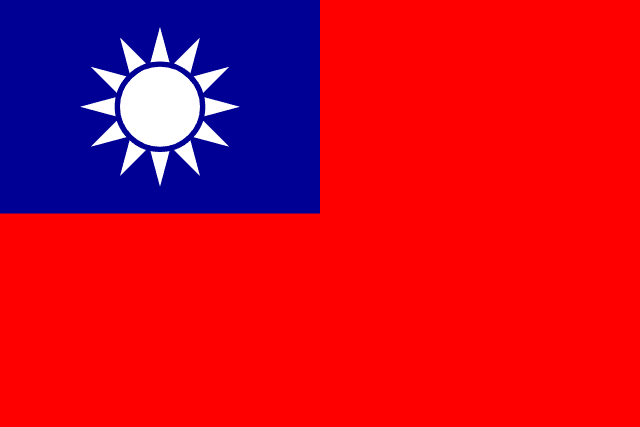
Samoa and the flag used by Taiwan share a striking arrangement of red, blue and white. Both have a red background and a blue rectangle in the upper corner nearest the pole. The main distinguishing feature is inside that blue rectangle. Samoa displays five individual white stars. The flag of the Republic of China, used by Taiwan, displays a single white sun surrounded by twelve pointed rays.
Look for the blue space between the white shapes. Samoa’s constellation consists of separate stars distributed across the canton. The Taiwanese design concentrates its white features around one central circular body. Even when a small picture makes the number of points or rays difficult to count, the difference between multiple separate stars and a centrally organized sun is usually visible.
The full rectangle provides another clue. Samoa’s official flag is twice as long as it is high. Taiwan’s official reference specifies a rectangle one and a half times as long as it is high. At equal height, the Samoan design is longer. The canton in each design occupies the upper hoist quarter, so the difference in the outer ratio also affects the apparent proportions of that blue rectangle.
This article uses Taiwan as the familiar geographic label for the Republic of China flag described in its official design law. The purpose is to compare flag designs, not to determine diplomatic recognition or resolve questions about political status. Other flags and sporting symbols associated with Taiwan may use different designs. The reference here is the red flag with the blue canton and white sun specified in the Republic of China constitution.
If all you can see is the red field or a small portion of the blue corner, either design could be plausible. Seek a complete view of the white device before assigning the name. A flag identification exercise is most useful when the available evidence is clear enough to support a definite answer.
| Feature | Samoa | Taiwan |
|---|---|---|
| Main field | Red | Red |
| Canton | Blue upper hoist | Blue upper hoist |
| White device | Five separate stars | Single twelve-rayed sun |
| Height:length | 1:2 | 2:3 |
Understand Samoa’s constellation
The Samoan national design places five white stars on a blue canton. They represent the Southern Cross, a recognizable feature of several Pacific flags. The stars are not arranged as a ring, and they are not five equally sized decorative objects scattered randomly across the blue rectangle. They form a specified constellation pattern.
The schedule to Samoa’s Official Flag and National Anthem Act 1994 provides a numerical construction reference based on 144 vertical units and 288 horizontal units. It gives relative positions and sizes for each star. The top and bottom stars sit along a line dividing the blue quarter vertically. Other stars occupy positions to either side, and a smaller fifth star completes the arrangement.
The Act’s size measurement is specific: it describes a distance from one ray tip to the tip of the next ray but one. That should not be confused with the diameter of an arbitrary circle drawn around the star. A student attempting a geometrically exact reproduction should follow the official measurement convention instead of simply scaling five clip-art stars to the same size.
Notice the substantial blue gaps between the stars. Those gaps are as useful as the white points for identifying the flag at a distance. If an image is compressed or the flag is folded, one or two stars might disappear from view. In that case the remaining distinct marks can still suggest a constellation, but a complete picture is needed to confirm the count.
Samoa’s foreign affairs reference describes the design’s earlier adoption in 1949. The modern 1994 Act is a later legislative specification. The difference between those dates is important: a law codifying an established national symbol does not necessarily mark the day on which the design first appeared.
For a detailed drawing activity, use the schedule’s reference units to calculate the intended positions at the chosen scale. For an ordinary recognition exercise, begin by learning the separate constellation shapes, then inspect the official image to distinguish the sizes and positions. The second approach is easier for a beginner while preserving the distinction between a recognition sketch and a precise flag reproduction.
Recognize the white sun and its twelve rays
The national flag described in the Republic of China constitution has a red field with a blue and white-sun canton. Taiwan’s presidential office gives the historical background of the design and its symbolic interpretation. The white sun consists of a circular body and twelve outward-pointing rays. The overall arrangement is symmetrical about its center.
The National Emblem and National Flag Act specifies the flag’s proportions in Article 4. The blue rectangle takes up a quarter of the whole flag. The center of the sun coincides with the intersection of the canton’s horizontal and vertical midlines. The Act gives the white circular body’s radius in relation to the canton width and refers to the preceding article for the geometry of the surrounding rays and blue separating band.
This is not a constellation composed of twelve independent stars. The rays belong to a single radiating design. They are equally distributed around the center, so a small reference graphic can appear like a bright circular device with pointed edges. The narrow blue ring separating the white body and rays is an important feature in detailed artwork.
The presidential office associates the twelve rays with a traditional division of time, including twelve months and twelve double-hour periods. These are official symbolic explanations rather than evidence that the design must be interpreted as an astronomical illustration. For recognition, the geometry of the single sun matters more than remembering every interpretation.
Taiwan’s Ministry of the Interior also distinguishes color reference values from a formally prescribed universal color standard. Readers should not confuse a suggested printing mixture with a legally fixed screen color. The Ministry provides guidance for drawing the emblem and flag. That makes it a better reference for an exact construction exercise than an arbitrary recolored image found elsewhere.
Someone who sees this design on a historical object should inspect its date and caption. The white-sun device has its own history and can appear in related political or institutional symbols. The full red field and blue canton are necessary parts of the complete flag considered here.
Compare the two rectangles and canton measurements
The official ratios create a simple mathematical comparison. In Samoa’s Act, 144 vertical units correspond to 288 horizontal units, reducing to a height-to-length ratio of one to two. Taiwan’s National Emblem and National Flag Act gives a horizontal-to-vertical ratio of three to two, which is two to three when written with height first.
Draw two rectangles with a common height of twelve centimeters. The Samoan flag measures twenty-four centimeters long, whereas Taiwan’s flag measures eighteen centimeters long. Divide each rectangle into two equal horizontal and two equal vertical parts. The upper-left quarter marks the blue canton. In Samoa’s example that canton is twelve centimeters wide and six centimeters high. In Taiwan’s example it is nine centimeters wide and six centimeters high.
Although the blue fields have different absolute areas in this exercise, both occupy one quarter of the corresponding rectangle. The remaining red area accounts for three quarters of the rectangle in each case. The white devices replace parts of the blue field rather than covering any of the red background. This makes a useful exercise in comparing proportions rather than absolute areas.
In the Taiwan example, the white circular body has a reference radius equal to one eighth of the canton width. For a width of nine centimeters, that gives a radius of 1.125 centimeters. The full ray arrangement and blue separating ring require the further relationships in the official Act. Do not assume that the white circle alone represents the complete sun.
For Samoa, the detailed schedule expresses the five star sizes and placements relative to the 144-by-288-unit coordinate framework. A drawing with a height of twelve centimeters therefore uses a scale of one twelfth of a centimeter per vertical unit. Calculate the positions directly from the schedule rather than using the Taiwanese sun construction as a guide to arranging a constellation.
The rectangle comparison is an accessible way to introduce scaling. If a student later makes the flag twice as large, all specified linear dimensions must double together. The shapes and relative positions remain unchanged. A website icon that fills an arbitrary box by stretching the picture breaks this relationship and should not be used for measurement.
Separate the historical development of the flags
Samoa’s flag developed during the period when the territory was under New Zealand administration. Its foreign affairs reference traces the present design to 1949. Samoa became independent in 1962 and continued to use the design. The current official legislative description appears in the 1994 Act. These events belong to the same flag’s history but are not interchangeable dates.
The Southern Cross is a motif shared by several countries in the Pacific region. Its use provides a useful geographic and historical comparison, although the exact placement, size and coloring of stars varies across flags. Samoa’s red main field and blue canton give its version a distinctly different structure from the dark blue Australian national flag.
The Republic of China presidential office traces the white-sun device to an earlier revolutionary emblem associated with Lu Haodong. Its account describes the red-background flag’s formal adoption in 1928, before the current constitutional specification. Readers should distinguish the origin of the sun emblem, the later adoption of the complete design and its constitutional definition.
The historical context explains why the same basic palette does not establish a direct relationship between Samoa’s flag and the flag used by Taiwan. The Samoan design uses a Pacific constellation; the Taiwanese design uses a sun emblem with its own political and historical origins. The national symbols developed in separate contexts.
For an educational timeline, record the relevant design adoption and later legislative dates for each example. Include the source names and label any historical images by their period. A flag’s visual resemblance to another flag is not sufficient evidence that one was directly copied from the other.
When reading the source references, keep the flags’ history separate from contemporary international politics. The official sources explain the particular design adopted and its symbolic associations. A comparison of these visual features cannot resolve questions about the status of Taiwan in international institutions. Use precise labels for the images, and avoid treating flag recognition as a statement about the positions of particular governments.
Recognize similar flags and other official symbols
Samoa’s Southern Cross also appears on other Pacific designs. Australia’s flag uses white stars on a dark blue background with a Union Jack; New Zealand uses red stars outlined in white. Those flags place their constellation on the fly rather than entirely inside a blue canton on a red background. A star group alone does not uniquely identify Samoa.
The flag of American Samoa is a separate design. It does not use the same red field with a blue constellation canton. It represents a different jurisdiction. In a geographic quiz, labels that distinguish Samoa and American Samoa are essential, rather than treating the two names as synonyms.
The red-and-blue flag with a white sun should also be distinguished from sporting or organizational emblems used for Taiwan in particular international contexts. An athlete’s event badge may not be the same as the ordinary national flag reference. A reader can recognize the event symbol while understanding that it is not the design specified in the Republic of China flag law.
An isolated blue field with a white sun is not the complete red flag used in this comparison. Similarly, the isolated blue constellation area of Samoa’s flag is only one part of the design. The surrounding red field establishes the relationship between the canton and the rest of the flag. Avoid identifying an incomplete symbol as a complete national flag without describing the missing area.
The most efficient learning method is to separate broad features from unique features. First recognize a red rectangle with a blue upper-hoist canton. Then decide whether the white device is a constellation or a radiating sun. Finally inspect the complete rectangle and the exact arrangement of the symbol. This procedure works even when other flags with red fields and decorated corners are added to the exercise.
For a historical flag collection, consult the dates and source descriptions before applying modern country names. A political or institutional symbol may share an element of a modern flag without representing the same object. A complete design comparison should identify the particular flags and not merely associate them with a shared color palette.
Recognition at small sizes and in real photographs
At ordinary viewing distance, the Samoan flag’s red field can occupy most of the visible fabric while its stars are partly obscured by folds. The Taiwan design can likewise show an almost uninterrupted red area when the canton is hidden. Both cases demonstrate why a photograph that lacks the upper hoist is insufficient for a reliable two-country identification.
If the canton is visible, inspect the pattern of white marks. Five distinct locations suggest Samoa, whereas a compact circular shape with rays indicates the other design. Tiny thumbnails may blur Samoa’s individual stars or merge the Taiwan sun’s circle and rays. A larger picture is necessary to count them accurately.
The flags have different rectangle proportions, but the comparison only works when the full borders are visible and the picture has not been stretched. A flag on a pole can appear foreshortened according to the camera angle. A web interface may crop the artwork to a square. In either case, the outer shape is not reliable evidence of the original official ratio.
When the flag is seen from behind, the canton may appear on the right rather than the left. The white sun’s general symmetry still distinguishes it from the separate constellation pattern. The relevant question is which corner belongs to the hoist, not whether the canton happens to occupy the left side of every photograph.
Accessible captions should describe the distinguishing features, including the five white stars or single twelve-rayed sun. This makes the comparison useful to readers who cannot easily distinguish colors. For quiz interfaces, the answer should be revealed appropriately rather than placed into visible text that defeats the recognition task.
A geography learner can combine the visual evidence with a country label. If only part of the artwork is available, checking the original source is preferable to inventing missing details. The ability to explain uncertainty is as useful as recalling the correct name from a fully visible image.
A geometry and geography learning exercise
Make two correctly proportioned reference outlines. Divide each into four equal rectangular areas and identify the upper hoist quarter. Before drawing any internal device, note which example is the longer Samoan rectangle and which is the shorter Taiwan rectangle. This establishes the proportions without requiring the learner to memorize a finished picture.
Then examine the official Samoan schedule and the Taiwan flag drawing reference. For the first, place five individual stars according to the constellation arrangement. For the second, identify the center of the canton and study the circular white body and twelve rays. A beginner can write the name of each device on a temporary note rather than attempt exact heraldic construction immediately.
For a practical recognition task, use the complete reference images and cover the names. Ask a learner to describe the white shape before naming the place. If the learner says simply that both have stars, explain the difference between a constellation and a single sun with pointed rays. The individual ray shapes do not make the sun a collection of separate stars.
Repeat the task with the cantons concealed. Both exposed designs become largely red. The correct conclusion is that the color alone is insufficient. Then reveal the corners and compare the amount of space between the white devices. The visual method becomes clear without depending on whether two screens display slightly different shades of blue.
Finally add other Southern Cross flags to the exercise. Explain where the constellation appears and whether a Union Jack or a different emblem accompanies it. This turns a two-choice recognition task into a broader study of flag design. Students can keep a record of the specific feature that caused each mistake rather than merely count incorrect answers.
If creating a published educational resource, label the artwork and cite the official specifications. Taiwan’s emblem and flag law includes restrictions on adding symbols and use as commercial marks or undignified items. Samoa’s Act addresses respectful use of its national flag. The reference images supplied here are for identification; they should not be treated as approval to manufacture or market official symbols.
Frequently asked questions
What is the difference between Samoa and Taiwan’s flags? Samoa has five separate stars in its blue canton; the Republic of China flag used by Taiwan has one white sun with twelve rays.
Which flag is longer? At the same height, Samoa is longer because its ratio is one to two. The Taiwan flag’s height-to-length ratio is two to three.
Do both use the same blue canton size? Each canton occupies one quarter of its corresponding rectangle, but the different rectangle proportions produce different widths at equal flag heights.
Is Samoa’s star pattern the Southern Cross? Yes. The five stars represent that constellation, with their positions and sizes specified in the flag Act.
Does Taiwan’s flag have twelve stars? No. Its white design has a central circular sun and twelve rays, not twelve separate stars.
Does the comparison establish Taiwan’s political status? No. It identifies and compares the particular flag design described in official sources. Questions of diplomatic recognition are separate.
Where can I find the official specifications? The Samoan Act’s schedule and the Taiwan Ministry of Justice’s national flag legislation give the relevant construction measurements. Use them for exact geometry rather than relying on a thumbnail.
Sources and artwork
- Samoa Attorney General — Official Flag and National Anthem Act 1994
- Samoa Ministry of Foreign Affairs and Trade — flag background
- Office of the President, Republic of China (Taiwan) — national flag history and geometry
- Taiwan Ministry of Justice — National Emblem and National Flag Act, Articles 3–4 and 20–21
- Taiwan Ministry of the Interior — flag drawing and color reference
- Flagpedia artwork terms
Flagpedia supplies the displayed educational artwork under its stated public-domain terms. National-symbol rules remain separate from copyright.