Exmoor Flag: White Stag, Dark-Sky Star & Moorland Waves
Why does Exmoor’s regional flag show a white stag and star above purple-green wavy stripes? Discover its Dark Sky Reserve meaning and 2014 design.
Why does Exmoor’s regional flag show a white stag and star above purple-green wavy stripes? Discover its Dark Sky Reserve meaning and 2014 design. The history and registered design were checked against the UK Flag Registry.
Exmoor flag at a glance
| Region | Exmoor, Somerset and Devon, England |
|---|---|
| Field | Blue upper with green, white and purple waves |
| Main animal | White stag’s head |
| Upper symbol | White star |
| Star reference | Exmoor Dark Sky Reserve |
| Designer | Jenny Stevens |
| Selection | Public vote |
| Adoption | 29 October 2014 |
Appearance
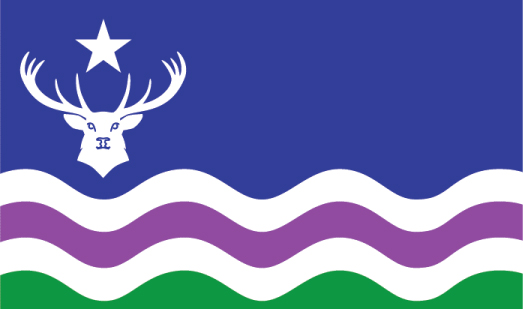
The Exmoor flag carries a white stag’s head beneath a white star in a dark-blue upper field. The lower half has rolling horizontal bands of white, purple and green.
This combination of wildlife, night sky and landscape is distinctive among English regional banners. It is not a county cross flag.
The white stag
The stag’s head depicts Exmoor’s famous deer and rich wildlife, rather than the symbol of a particular royal family.
The white colouring creates a strong silhouette on the blue field; the registered emblem is not a claim that every local deer is white.
The white star
The star celebrates Exmoor’s status as Europe’s first International Dark Sky Reserve, where low light pollution provides opportunities to experience the night sky.
It is a single symbolic star, not a complete constellation or a sign of an independent state.
Purple moorland wave
The purple wavy stripe evokes heather and the moorland landscape. Combined with white and green, it conveys cliffs, vegetation and the point where moorland meets the sea.
The Flag Institute explains the waves collectively. There is no need to assign a separate town to each coloured band.
Green and blue
Green evokes land and forest, while the blue upper section brings sky and sea into the picture. The white wavy lines keep the colours distinct.
The overall design emphasizes Exmoor as a place of contrasting habitats rather than copying Somerset’s or Devon’s individual county flags.
Designer and competition
Jenny Stevens designed the winning flag in a community design contest. The Flag Institute gives 29 October 2014 as its adoption date.
The Exmoor Flag Project Team organized the process with financial help from Exmoor National Park Authority and involvement from local publications and conservation groups.
Dark-sky identity
Exmoor’s recognition as a dark-sky area is part of its modern natural heritage. The single white star connects flag education with a characteristic local environmental attraction.
It gives the design a contemporary meaning alongside the more traditional deer imagery.
Exmoor vs Somerset and Devon
Somerset has a red dragon on gold, while Devon shows a black-edged white cross on green. Exmoor uses a blue stag-and-star field over coloured waves.
The Exmoor region crosses parts of the two counties, so a regional flag can be relevant even though the two counties have their own symbols.
Drawing instructions
Fill the upper field dark blue, add a white stag’s head and a star overhead, then create the white, purple and green wavy bands below.
The outline of the antlers and the order of the waves are easier to reproduce from the official image than from a generic deer illustration.
Frequently asked questions
What animal is on the Exmoor flag?
A white stag’s head.
What does the star mean?
Exmoor’s Dark Sky Reserve status.
When was it adopted?
29 October 2014.
Who designed it?
Jenny Stevens.
What do the waves represent?
Moorland, sea, cliffs and forests.
Which counties include Exmoor?
Somerset and Devon.
Is Exmoor a country?
No, it is a region of England.
How is it different from Devon’s flag?
Devon uses a white cross; Exmoor has a stag, star and waves.
Sources and image credits
Registered flag image sourced from the Flag Institute’s downloadable reusable artwork. Reproduction for independent educational reference; not endorsed by the Flag Institute. Verified 20 November 2026.