Caernarfonshire Flag: Three Golden Eagles, Green & Eryri
What do the three golden eagles mean on Caernarfonshire’s flag? Learn the Owain Gwynedd attribution, Snowdonia and medieval Welsh heraldry.
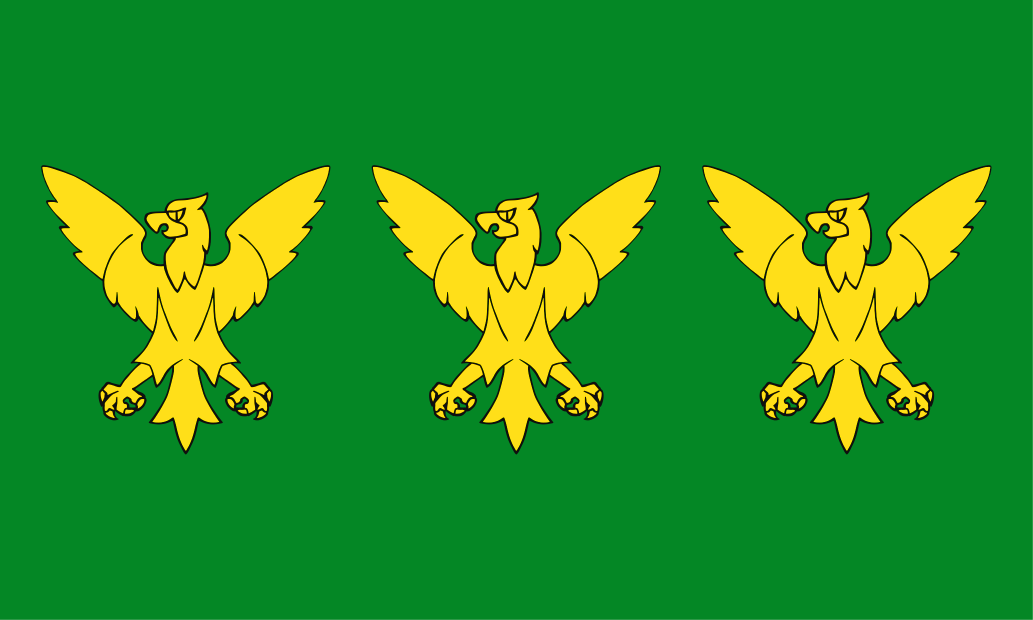
What do the three golden eagles mean on Caernarfonshire’s flag? Learn the Owain Gwynedd attribution, Snowdonia and medieval Welsh heraldry. The details below distinguish traditional attributions and later records from modern flag registration, and explain the visual elements using identifiable evidence.
The primary reference is the Flag Institute’s UK Flag Registry entry. Historic county flags may remain in use even where today’s local-government boundaries differ from earlier county boundaries.
Caernarfonshire flag at a glance
| Feature | Details |
|---|---|
| Welsh name | Sir Gaernarfon |
| Design | Three gold eagles on green |
| Bird arrangement | Three spread-wing eagles in a horizontal row |
| Historic association | Arms attributed to Owain Gwynedd |
| Natural association | Eryri, Snowdonia, interpreted as ‘nest of eagles’ |
| Literary account | Michael Drayton’s early-modern Agincourt poem |
| Registry code | UNKG7426 |
| Ratio | 3:5 |
Scope: This guide concerns the registered historic county flag and its symbolism. In British vexillology, registration by the Flag Institute is a recognized reference for community designs; it is not by itself a separate governmental grant of national sovereignty.
appearance
What is shown on the Caernarfonshire flag?
The entire field is green, carrying three equally sized golden eagles with spread wings and visible feet, positioned in a horizontal row.
birds
Why does the design use golden eagles?
The eagles are associated with Eryri, the Welsh name of Snowdonia, sometimes explained as a ‘nest of eagles’ in local tradition.
owain
Who was Owain Gwynedd?
Owain Gwynedd ruled Gwynedd during the twelfth century. Medieval heralds later attributed a green banner bearing three golden eagles to his dynasty.
three
Why are there three eagles?
The number three is part of the attributed arms and makes the banner a distinctive local emblem. The birds’ wings and talons are outlined in stylized heraldic fashion.
history
How old is this county-flag tradition?
The Flag Institute lists a traditional design date around the seventeenth century and notes that historic narratives attributed the three-eagle arms to Owain Gwynedd.
agincourt
Were these eagles carried at Agincourt?
The early-seventeenth-century poet Michael Drayton described men from Caernarfonshire carrying the eagle banner during the 1415 battle of Agincourt.
geography
Where is historic Caernarfonshire?
Caernarfonshire is a historic county of northwest Wales, covering terrain that includes coastal districts and parts of Eryri.
comparison
Caernarfonshire vs Anglesey and Merioneth
Anglesey has three golden lions and a chevron on red. Merioneth has three leaping white goats and a rising sun on blue.
drawing
How to draw Caernarfonshire’s flag
Fill a rectangle green and place three matching yellow-gold heraldic eagles side by side in the middle.
Frequently asked questions
How many eagles are on the flag?
Three.
What colour is the background?
Green.
What does Eryri mean in the flag story?
It is the Welsh name of Snowdonia and is traditionally associated with an ‘eagles’ nest’ interpretation.
Which historic ruler is linked to the arms?
Owain Gwynedd.
Are the birds gulls or doves?
No, they are heraldic golden eagles.
Is this a national Welsh flag?
No, it represents a historic county.
Can it be dated with certainty to Owain’s lifetime?
No; the medieval attribution is reported by later heraldic sources.
How is it different from Flintshire?
Flintshire has black chough birds and a black cross on white.
Sources and illustration credits
Flag Institute — Caernarfonshire flag (UK Flag Registry)
Image:Registered PNG flag illustration downloaded from the Flag Institute’s Caernarfonshire entry. The Institute states its Registry’s flag artwork is free to download and reuse. Flag imagery is reproduced for independent educational identification, without an endorsement claim.
Source-checked November 2026. Historical arms attributed to ancient figures are distinguished from modern archival proof where appropriate.