Suffolk Flag: St Edmund’s Crown, Crossed Arrows & Blue Meaning
Suffolk’s county flag is a golden crown and crossed arrows on blue. Discover its connection to St Edmund, the history of Bury St Edmunds and its modern registration.
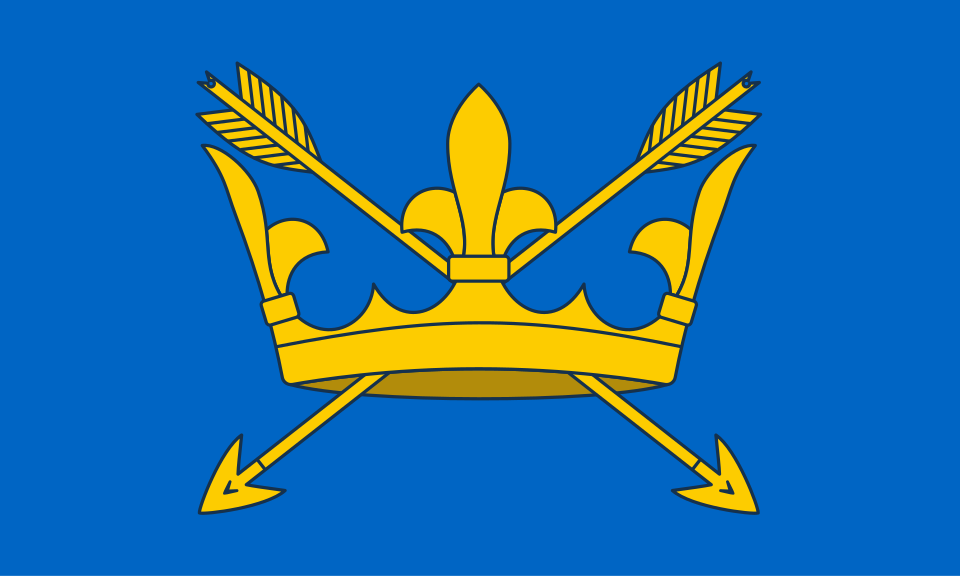
A crown crossed by arrows is an unusual English county-flag design because the symbols identify a particular historical and religious figure. Suffolk’s flag uses these elements without lettering, a coat-of-arms shield or a Union Jack.
The Flag Institute’s Suffolk registry entry identifies the connection to St Edmund and the flag’s blue-and-gold colours. Its 2017 registry announcement clarifies the modern recognition of Suffolk’s traditional emblem.
Suffolk flag at a glance
| Feature | Details |
|---|---|
| County | Suffolk, East Anglia, England |
| Flag type | Registered traditional county community flag |
| Main field | Blue (Pantone 300) |
| Emblem | Gold crown and two crossed arrows |
| Historic association | St Edmund, king of East Anglia |
| Edmund’s death | 869, according to the historical tradition |
| Modern UK registry entry | 2017 |
| UK Registry code | UNKG7459 |
| Registered ratio | 3:5 |
| Flag Institute design date | Ninth century: historic origin attributed to the emblem, not a surviving cloth flag |
The historic origins of a county emblem, an arms grant, the public flag approval and a modern registry entry can refer to different dates. The following guide keeps those stages distinct.
What does the Suffolk flag look like?
Suffolk’s flag is a solid blue rectangle. In its central area a gold or yellow crown stands above a pair of crossed golden arrows, arranged in a saltire or diagonal X shape. The arrows extend out from the central point, creating a compact gold emblem against blue.
The UK Flag Registry specifies a 3:5 ratio, with blue and two yellow-gold shades. It does not contain the three crowns of Cambridgeshire; Suffolk has one crown and arrows. Some reference illustrations make the gold detailing finer than others, so use the licensed registry artwork to preserve its identity.
Who was St Edmund and how does he relate to Suffolk?
Edmund was a king of East Anglia who died in 869 amid Viking activity in eastern England. His story developed into one of the region’s best-known medieval traditions, with a cult of St Edmund centred on what became Bury St Edmunds.
The county flag draws on St Edmund’s symbolic identity, not a claim that he personally designed a modern rectangular flag. Bury St Edmunds remains an important place in Suffolk’s historical geography because its name and abbey history are connected with the saint.
Why are two arrows crossed beneath the crown?
The crossed arrows recall traditions of Edmund’s martyrdom, in which arrows are part of the story of his death. The device has appeared in local church, town and regional heraldry and became an emblem recognized across Suffolk.
The exact details of Edmund’s death come from medieval accounts written after the event. It is more accurate to describe the arrows as symbols drawn from martyrdom tradition than as archaeological proof of what occurred in 869.
What does the golden crown symbolize?
The crown reflects Edmund’s status as a king of East Anglia. It connects the county’s traditional identity with an early English kingdom, while the arrows add the later saintly and martyrdom associations.
The crown is not a contemporary British royal crown placed on the flag as a current constitutional statement. Suffolk remains an English county; the device is an inherited local emblem, not evidence of a sovereign Suffolk monarchy today.
Why is Suffolk’s flag blue and gold?
The registered design places the traditional gold emblem on blue for a striking high-contrast composition. The Flag Institute gives Pantone Blue 300, Yellow 116 and Gold 125 in its specifications.
Unlike some modern community flags, Suffolk’s design has no newly commissioned narrative where every stripe represents a river or landscape. The symbol’s documented historical connection to St Edmund is a firmer explanation than invented meanings for each shade of blue.
When was Suffolk’s county flag registered?
The county emblem had existed for centuries, but Suffolk’s community flag was entered in the UK Flag Registry in 2017 after support from local organizations and Suffolk County Council. The Flag Institute’s registry lists the flag as a traditional design.
The distinction is essential: 869 relates to the historical figure, the Middle Ages saw development of his emblem, and 2017 records the modern public county-flag registration. These three events should not be treated as one adoption date.
When is Suffolk Day, and is it the flag’s adoption day?
Suffolk Day is celebrated on 21 June, the summer solstice. Residents and local councils use the occasion for community events, recognition of the county and displays of its blue-and-gold flag.
The date is not the day the historical St Edmund emblem was invented and should not be confused with the 2017 registry entry. It is an annual occasion to celebrate Suffolk, whose history and distinctive flag now appear in many county events.
Suffolk vs Cambridgeshire and Norfolk flags
The Cambridgeshire flag also uses blue and gold, but it has three gold crowns and two light-blue wavy horizontal lines, not arrows. Suffolk’s design has one crown and a large X of arrows.
Neighbouring East Anglian counties have their own heraldic traditions. The Suffolk flag is most easily recognized by its paired diagonally crossing arrow shafts below a crown, and by the absence of any river waves.
How to draw and identify the Suffolk county flag
Draw a 3:5 blue rectangle. In the middle add two golden arrows crossed diagonally, with arrowheads pointing outward. Place a single matching gold crown at their crossing, following the official vector’s proportions.
Do not substitute a rose, coat-of-arms shield or three crowns. The clue ‘crown and crossed arrows on blue’ identifies the registered Suffolk county flag.
Frequently asked questions
What are the symbols on Suffolk’s flag?
One golden crown and two crossed golden arrows on blue.
Who is represented by the crown and arrows?
St Edmund, the ninth-century king of East Anglia associated with martyrdom traditions.
Why are arrows on the flag?
They recall the traditional account of Edmund’s martyrdom.
When was Suffolk’s flag registered?
In 2017, recognizing a much older emblem.
Does the ninth-century date mean the same flag was flown in 869?
No. That date refers to St Edmund’s history and attributed symbolism, not an authenticated surviving ninth-century flag.
When is Suffolk Day?
21 June.
Is Suffolk’s flag the same as Cambridgeshire’s?
No. Cambridgeshire has three crowns and waves; Suffolk has a crown and crossed arrows.
What is the flag’s colour scheme?
Blue field with yellow-gold heraldic symbols.
Official references and image attribution
Flag Institute — Suffolk county flag registry
Flag Institute — Suffolk and Oxfordshire registry announcement
UK Government — Suffolk county information and local councils
Flag illustration derived from Wikimedia Commons: Suffolk county flag. Vector by Vexilo, with later revisions by Commons contributors, licensed CC BY-SA 4.0. Converted to PNG without changing the design; original creator, source and licence credited.
Independent educational reference. Verified against the UK Flag Registry in November 2026; not an official Flag Institute or local government service.